County Durham · England
Cast iron and heritage bollards in Durham
Local installation of cast iron bollards in Durham — free survey, fixed written price, and posts set to the right spacing for people and vehicles.
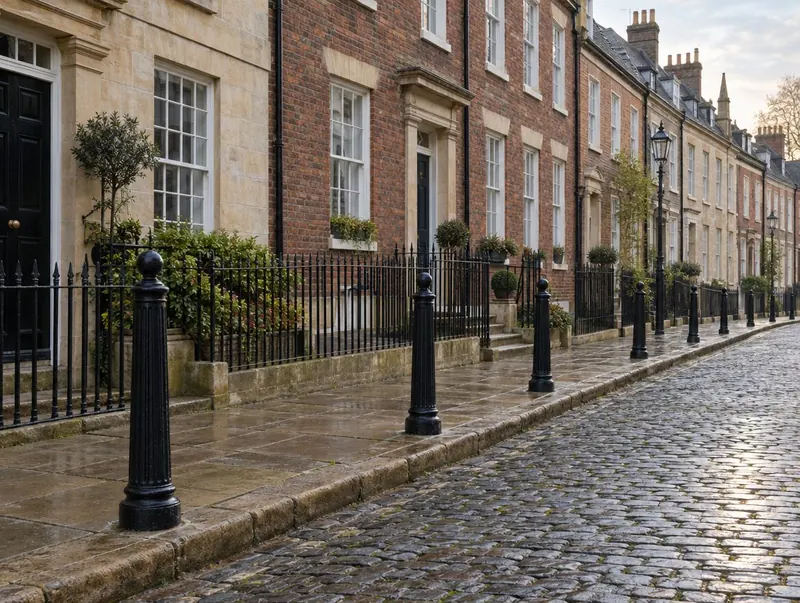 Computer-generated image
Cast iron bollards in Durham
Across Durham, typical sites for cast iron bollards include community car parks, residential driveways and high street shopfronts. Traditional grey cast iron is hard but brittle, while modern ductile iron castings are tougher and bend before they break.
We work across DH1, DH7 and DH6 — Durham itself and places including High Shincliffe, Shincliffe, Sherburn House and Houghall. Nearby, we also work in Chester-le-Street (5.7 miles), Houghton-le-Spring (6.2 miles), Stanley (8 miles) and Washington (8.8 miles), measured as the crow flies. Durham is about 14 miles from Newcastle upon Tyne.
Local details
- Area
- County Durham, England
- Highway authority
- Durham County Council (local roads)
- Planning authority
- the council for County Durham
- Postcodes
- DH1, DH7 and DH6
- Guide price
- Typically £425–£1,645 per bollard + VAT (£505–£1,945 inc VAT for homes); minimum job £715
- Survey
- Free, with a fixed written quote
- Nearby
- Chester-le-Street (5.7 mi), Houghton-le-Spring (6.2 mi), Stanley (8 mi), Washington (8.8 mi)
Durham: typical cast iron bollard prices
| Specification | Guide price | Includes |
|---|---|---|
| Standard | £425–£935 + VAT · £505–£1,095 inc VAT | Standard post, foundation, reinstatement |
| Upgraded | £785–£1,295 + VAT · £935–£1,545 inc VAT | Upgraded finish or fittings, reflective band, matched keys |
| Premium | £1,145–£1,645 + VAT · £1,345–£1,945 inc VAT | Heavy-duty or architectural spec, premium finish |
Per bollard, supplied and installed; -4% for North East. Guide only — the fixed price follows a survey.
Typical cast iron bollards jobs in Durham
Typical reasons Durham sites choose cast iron bollards:
- Conservation areas and historic town centres
- Resetting original bollards that have tilted or worked loose
- Period residential streets and mews
Permissions and groundwork in Durham
In Durham, work on adopted pavements and verges needs consent from Durham County Council, the local highway authority. Car parks, forecourts and other private land only need the owner's permission.
Many private-land installations in Durham need no planning application, but the rules don't clearly cover bollards, so listed buildings, conservation areas and prominent frontages are worth raising with the planning team at the council for County Durham before posts go in.
Original stone flags and setts are reused wherever possible, because new stone rarely matches weathered material. Excavation is by hand, positions are checked against service records and scanning, and anything unexpected is recorded rather than broken through.
- Check whether existing bollards are of historic interest or listed before removing them; repair and resetting may be expected.
- Avoid chains between posts on pedestrian routes, which can trip blind and partially sighted people.
How the job runs
Record what is there
The free site survey records existing bollards, their pattern, spacing, height and condition, and the paving they sit in. You receive a fixed written quote covering new castings, resets and reinstatement.
Lift paving carefully
Natural stone flags, setts and kerbs are lifted by hand, numbered where needed and stored for relaying.
Relay and finish
Stone is relaid in its original pattern with suitable mortar, and the bollard is painted or touched up after fixing.
Choosing the right spec
| Option | Detail |
|---|---|
| Contrast details | Painted bands or contrasting caps agreed with the conservation officer so posts are visible to partially sighted people. |
| Ductile iron | Same patterns with much greater toughness; bends before it breaks. The usual choice for new posts on trafficked streets. |
| Paint finishes | Primed and painted, commonly black, with traditional highlights in gold or white on bands and crests where appropriate. |
Pricing cast iron bollards in Durham
Our North East guide prices are a starting point; the survey in Durham firms them up. What tends to move them:
- Lifting and relaying natural stone paving
- Painting, highlights and crest details
- Resetting or repairing original bollards
Looking after them
Inspect annually for chips, rust spots and cracks, particularly at the base where water and grit collect. Cast iron lasts well if its paint is kept intact.
We can also service, repair or replace existing posts anywhere in Durham.
Questions about cast iron bollards in Durham
Which parts of Durham do you cover for cast iron bollards?
We cover all of Durham (DH1, DH7 and DH6) and the rest of County Durham. We also work in Chester-le-Street, Houghton-le-Spring and Stanley.
Who gives permission for bollards on the pavement in Durham?
The highway authority for local roads in Durham is Durham County Council; motorways and trunk roads sit with National Highways. Cast iron bollards on the adopted footway are a matter for the highway authority, so we only install there with its written agreement.
What's a typical price for cast iron bollards in Durham?
In Durham, typically £425–£1,645 per bollard, supplied and installed, plus VAT (£505–£1,945 including VAT for homeowners), with a minimum job of £715 plus VAT, using our North East guide prices. The fixed figure comes in writing after we've seen the site.
Do we need consent for bollards in a conservation area?
Possibly. Consent requirements depend on where the bollards go, who installs them and whether nearby buildings are listed. Ask the local planning authority or conservation officer before ordering.
What colour should cast iron bollards be painted?
Black is the traditional choice in many places, sometimes with gold or white highlights on bands or crests. Some areas have their own historic colours. The conservation officer can confirm what suits the street.
Cast iron bollards in nearby towns
- Chester-le-Street (5.7 mi)
- Houghton-le-Spring (6.2 mi)
- Stanley (8 mi)
- Washington (8.8 mi)
- Bishop Auckland (9.3 mi)
- Peterlee (9.6 mi)