Fermanagh and Omagh · Northern Ireland
Cast iron and heritage bollards in Enniskillen
Planning cast iron bollards in Enniskillen? We check ownership, consents and buried services first, then quote a fixed price.
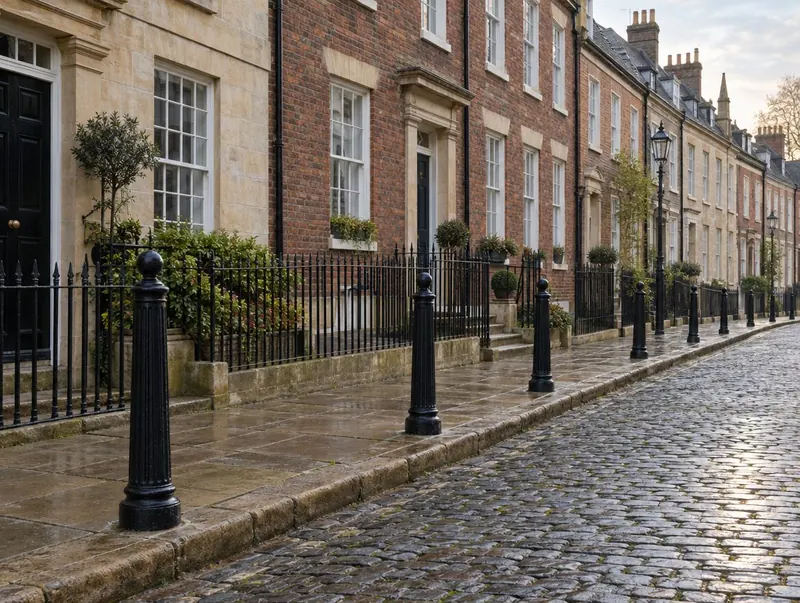 Computer-generated image
Enniskillen cast iron bollards
Whether it's community car parks, community buildings and filling-station forecourts, cast iron bollards in Enniskillen are planned around who needs to get through and who doesn't. Heritage bollards are often fitted over a steel or concrete core to add strength without changing their appearance.
Coverage in Enniskillen takes in the BT74 and BT94 postcode districts. There are no other towns of Enniskillen's size close by, so crews travel in specifically for jobs here.
Key facts for this area
- Area
- Fermanagh and Omagh, Northern Ireland
- Roads authority
- the Department for Infrastructure (DfI Roads)
- Planning authority
- Fermanagh and Omagh District Council
- Postcodes
- BT74 and BT94
- Guide price
- Typically £435–£1,645 per bollard + VAT (£515–£1,945 inc VAT for homes); minimum job £725
- Survey
- Free, with a fixed written quote
Enniskillen: typical cast iron bollard prices
| Specification | Guide price | Includes |
|---|---|---|
| Standard | £435–£955 + VAT · £515–£1,145 inc VAT | Standard post, foundation, reinstatement |
| Upgraded | £805–£1,295 + VAT · £965–£1,545 inc VAT | Upgraded finish or fittings, reflective band, matched keys |
| Premium | £1,195–£1,645 + VAT · £1,445–£1,945 inc VAT | Heavy-duty or architectural spec, premium finish |
Per bollard, supplied and installed; -2% for Northern Ireland. Guide only — the fixed price follows a survey.
Where cast iron bollards go in around Enniskillen
Around Enniskillen, cast iron bollards usually solve one of these:
- Streets and squares around listed buildings
- Conservation areas and historic town centres
- Cathedral closes, college courts and historic estates
Before we dig in Enniskillen
Kerbside work in Enniskillen is a DfI Roads question: the Department for Infrastructure is the roads authority for Northern Ireland, and its permission is needed for anything placed in the public road or footway.
Many private-land installations in Enniskillen need no planning application, but the rules don't clearly cover bollards, so listed buildings, conservation areas and prominent frontages are worth raising with the planning team at Fermanagh and Omagh District Council before posts go in.
Historic streets were built in layers: modern services sit over older drains, coal holes and sometimes vaults, and the paving may be natural stone on a lime or sand bed rather than concrete. Excavation is by hand, positions are checked against service records and scanning, and anything unexpected is recorded rather than broken through.
- Avoid chains between posts on pedestrian routes, which can trip blind and partially sighted people.
- Check whether existing bollards are of historic interest or listed before removing them; repair and resetting may be expected.
How the job runs
Record what is there
The free site survey records existing bollards, their pattern, spacing, height and condition, and the paving they sit in. You receive a fixed written quote covering new castings, resets and reinstatement.
Set the post
Each bollard is set plumb in concrete with its root, flange or core, at a height that matches its neighbours. Original posts being reset are cleaned and checked for cracks first.
Relay and finish
Stone is relaid in its original pattern with suitable mortar, and the bollard is painted or touched up after fixing.
Specification choices
| Option | Detail |
|---|---|
| Steel cores and covers | Cast covers over root-fixed steel or crash-tested cores for strength without changing the look. |
| Contrast details | Painted bands or contrasting caps agreed with the conservation officer so posts are visible to partially sighted people. |
| Grey cast iron | Traditional material with crisp detail and good corrosion resistance. Brittle under heavy impact, so suited to low-risk positions. |
What affects the quote
Two Enniskillen jobs with the same number of posts can price quite differently. The usual reasons:
- Steel cores, concrete fill or tested cores beneath covers
- Grey iron, ductile iron or cast aluminium
- Lifting and relaying natural stone paving
Keeping them working
Grey iron that has been struck should be checked closely for hairline cracks, which can spread with frost. Inspect annually for chips, rust spots and cracks, particularly at the base where water and grit collect.
We can also service, repair or replace existing posts anywhere in Enniskillen.
Common questions
Can you install cast iron bollards anywhere in Enniskillen?
We cover all of Enniskillen (BT74 and BT94) and the rest of Fermanagh and Omagh.
Who gives permission for bollards on the pavement in Enniskillen?
Kerbside work in Enniskillen is a DfI Roads question: the Department for Infrastructure is the roads authority for Northern Ireland, and its permission is needed for anything placed in the public road or footway.
What's a typical price for cast iron bollards in Enniskillen?
In Enniskillen, typically £435–£1,645 per bollard, supplied and installed, plus VAT (£515–£1,945 including VAT for homeowners), with a minimum job of £725 plus VAT, using our Northern Ireland guide prices. The fixed figure comes in writing after we've seen the site.
Can heritage bollards give real vehicle protection?
On their own, untested cast bollards cannot be relied on for security. Where protection is needed, heritage covers designed for crash-tested cores give the traditional look over a tested product.
What colour should cast iron bollards be painted?
Black is the traditional choice in many places, sometimes with gold or white highlights on bands or crests. Some areas have their own historic colours. The conservation officer can confirm what suits the street.