Kent · England
Cast iron and heritage bollards in Sevenoaks
Local installation of cast iron bollards in Sevenoaks — free survey, fixed written price, and posts set to the right spacing for people and vehicles.
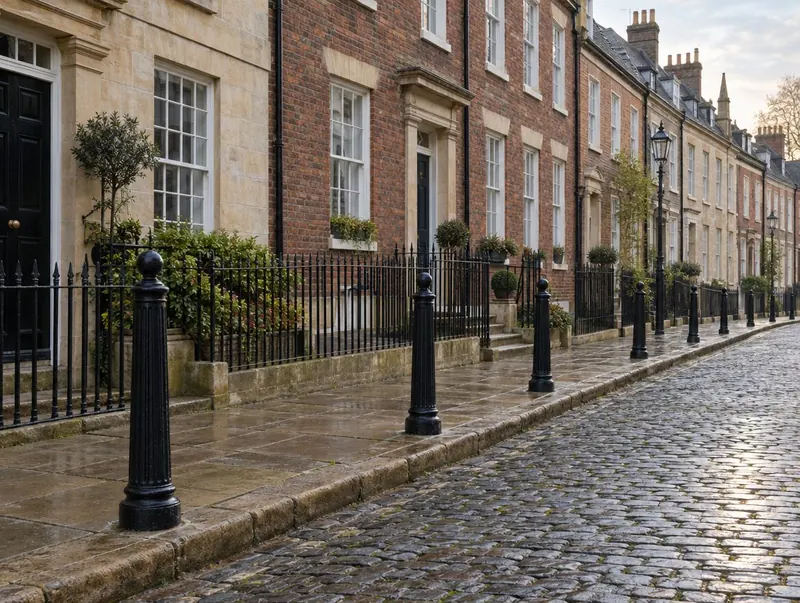 Computer-generated image
Cast iron bollards in Sevenoaks
Cast iron bollards suit plenty of Sevenoaks sites, filling-station forecourts, community buildings and local parades among them. Heritage bollards are often fitted over a steel or concrete core to add strength without changing their appearance.
Coverage in Sevenoaks takes in the TN13, TN14 and DA4 postcode districts and nearby places like Dunton Green, Otford, Knockholt Pound and Shoreham. We also cover neighbouring Tonbridge (6.5 miles), Bromley (8.5 miles), Swanley (8.6 miles) and Tunbridge Wells (10.2 miles) — distances are straight-line. Brighton is around 34 miles away.
Key facts for this area
- Area
- Kent, England
- Highway authority
- Kent County Council (local roads)
- Planning authority
- the council for Sevenoaks
- Postcodes
- TN13, TN14 and DA4
- Guide price
- Typically £475–£1,795 per bollard + VAT (£565–£2,145 inc VAT for homes); minimum job £785
- Survey
- Free, with a fixed written quote
- Nearby
- Tonbridge (6.5 mi), Bromley (8.5 mi), Swanley (8.6 mi), Tunbridge Wells (10.2 mi)
Typical cast iron bollards jobs in Sevenoaks
Typical reasons Sevenoaks sites choose cast iron bollards:
- Streets and squares around listed buildings
- Heritage-style covers over modern steel or tested cores
- Period residential streets and mews
Sevenoaks: typical cast iron bollard prices
| Specification | Guide price | Includes |
|---|---|---|
| Standard | £475–£1,045 + VAT · £565–£1,245 inc VAT | Standard post, foundation, reinstatement |
| Upgraded | £865–£1,445 + VAT · £1,045–£1,745 inc VAT | Upgraded finish or fittings, reflective band, matched keys |
| Premium | £1,245–£1,795 + VAT · £1,495–£2,145 inc VAT | Heavy-duty or architectural spec, premium finish |
Per bollard, supplied and installed; +6% for South East. Guide only — the fixed price follows a survey.
What we check first in Sevenoaks
Kent County Council is the highway authority covering Sevenoaks's local roads. If any post would stand on adopted highway rather than your land, that consent is the first thing we sort out.
Many private-land installations in Sevenoaks need no planning application, but the rules don't clearly cover bollards, so listed buildings, conservation areas and prominent frontages are worth raising with the planning team at the council for Sevenoaks before posts go in.
Excavation is by hand, positions are checked against service records and scanning, and anything unexpected is recorded rather than broken through. Original stone flags and setts are reused wherever possible, because new stone rarely matches weathered material.
- Ask the local planning authority whether consent is needed for new or replacement bollards in a conservation area or near a listed building.
- On public highway, agree positions and specification with the highway authority.
What happens on site
Record what is there
The free site survey records existing bollards, their pattern, spacing, height and condition, and the paving they sit in. You receive a fixed written quote covering new castings, resets and reinstatement.
Agree pattern and approvals
We source a matching pattern or close equivalent and, where needed, provide details for the conservation officer or planning authority before ordering.
Lift paving carefully
Natural stone flags, setts and kerbs are lifted by hand, numbered where needed and stored for relaying.
Choosing the right spec
| Option | Detail |
|---|---|
| Grey cast iron | Traditional material with crisp detail and good corrosion resistance. Brittle under heavy impact, so suited to low-risk positions. |
| Traditional patterns | Cannon, fluted Doric, ball-top, Victorian and Georgian styles, and crest panels for estates or boroughs. |
| Ductile iron | Same patterns with much greater toughness; bends before it breaks. The usual choice for new posts on trafficked streets. |
What affects the quote
Our South East guide prices are a starting point; the survey in Sevenoaks firms them up. What tends to move them:
- Steel cores, concrete fill or tested cores beneath covers
- Lifting and relaying natural stone paving
- Pattern complexity and whether a special casting is needed
Looking after them
Cast iron lasts well if its paint is kept intact. Inspect annually for chips, rust spots and cracks, particularly at the base where water and grit collect.
If posts in Sevenoaks are later hit or damaged, we can repair or replace them — see bollard repairs.
Cast iron bollards in Sevenoaks: FAQs
Can you install cast iron bollards anywhere in Sevenoaks?
We cover all of Sevenoaks (TN13, TN14 and DA4) and the rest of Kent. We also work in Tonbridge, Bromley and Swanley.
Do I need consent for cast iron bollards on a public footway in Sevenoaks?
Kent County Council is the highway authority covering Sevenoaks's local roads. If any post would stand on adopted highway rather than your land, that consent is the first thing we sort out.
What's a typical price for cast iron bollards in Sevenoaks?
In Sevenoaks, typically £475–£1,795 per bollard, supplied and installed, plus VAT (£565–£2,145 including VAT for homeowners), with a minimum job of £785 plus VAT, using our South East guide prices. The fixed figure comes in writing after we've seen the site.
What colour should cast iron bollards be painted?
Black is the traditional choice in many places, sometimes with gold or white highlights on bands or crests. Some areas have their own historic colours. The conservation officer can confirm what suits the street.
Do we need consent for bollards in a conservation area?
Possibly. Consent requirements depend on where the bollards go, who installs them and whether nearby buildings are listed. Ask the local planning authority or conservation officer before ordering.
Cast iron bollards near Sevenoaks
- Tonbridge (6.5 mi)
- Bromley (8.5 mi)
- Swanley (8.6 mi)
- Tunbridge Wells (10.2 mi)
- Caterham (11.6 mi)
- Dartford (12.1 mi)