Lancashire · England
Cast iron and heritage bollards in Leyland
Planning cast iron bollards in Leyland? We check ownership, consents and buried services first, then quote a fixed price.
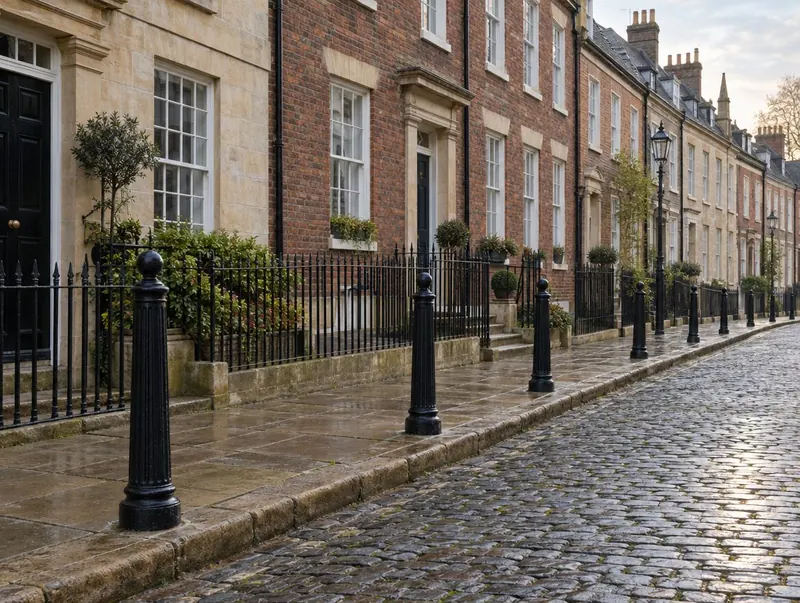 Computer-generated image
Cast iron bollards in Leyland
In the town of Leyland, cast iron bollards tend to go in at schools, residential driveways and small industrial units. Heritage bollards are often fitted over a steel or concrete core to add strength without changing their appearance.
We cover Leyland's PR25, PR26 and PR5 postcode districts, including places such as Farington Moss, Midge Hall, Bamber Bridge and Gregson Lane. Nearby, we also work in Chorley (4.4 miles), Preston (4.5 miles), Blackburn (9.1 miles) and Darwen (9.1 miles), measured as the crow flies. Preston is around 5 miles away.
Leyland at a glance
- Area
- Lancashire, England
- Highway authority
- Lancashire County Council (local roads)
- Planning authority
- the council for South Ribble
- Postcodes
- PR25, PR26 and PR5
- Guide price
- Typically £435–£1,645 per bollard + VAT (£515–£1,945 inc VAT for homes); minimum job £725
- Survey
- Free, with a fixed written quote
What cast iron bollards cost in Leyland
| Specification | Guide price | Includes |
|---|---|---|
| Standard | £435–£955 + VAT · £515–£1,145 inc VAT | Standard post, foundation, reinstatement |
| Upgraded | £805–£1,295 + VAT · £965–£1,545 inc VAT | Upgraded finish or fittings, reflective band, matched keys |
| Premium | £1,195–£1,645 + VAT · £1,445–£1,945 inc VAT | Heavy-duty or architectural spec, premium finish |
Per bollard, supplied and installed; -2% for North West. Guide only — the fixed price follows a survey.
Typical cast iron bollards jobs in Leyland
Typical reasons Leyland sites choose cast iron bollards:
- Heritage-style covers over modern steel or tested cores
- Period residential streets and mews
- Resetting original bollards that have tilted or worked loose
Permissions and groundwork in Leyland
Lancashire County Council is the highway authority covering Leyland's local roads. If any post would stand on adopted highway rather than your land, that consent is the first thing we sort out.
Bollards on private land often don't need planning permission, but it depends on the council's view, the height and the location; in a conservation area, next to a listed building or under an Article 4 direction, ask the local planning authority (the council for South Ribble) first — we flag this at survey.
Reinstatement follows the original laying pattern and joint style, and on lime-bedded paving uses compatible materials so new work does not crack old stones around it. Original stone flags and setts are reused wherever possible, because new stone rarely matches weathered material.
- On public highway, agree positions and specification with the highway authority.
- Ask the local planning authority whether consent is needed for new or replacement bollards in a conservation area or near a listed building.
Installation, step by step
Agree pattern and approvals
We source a matching pattern or close equivalent and, where needed, provide details for the conservation officer or planning authority before ordering.
Set the post
Each bollard is set plumb in concrete with its root, flange or core, at a height that matches its neighbours. Original posts being reset are cleaned and checked for cracks first.
Relay and finish
Stone is relaid in its original pattern with suitable mortar, and the bollard is painted or touched up after fixing.
Choosing the right spec
| Option | Detail |
|---|---|
| Paint finishes | Primed and painted, commonly black, with traditional highlights in gold or white on bands and crests where appropriate. |
| Contrast details | Painted bands or contrasting caps agreed with the conservation officer so posts are visible to partially sighted people. |
| Steel cores and covers | Cast covers over root-fixed steel or crash-tested cores for strength without changing the look. |
What affects the quote
Our North West guide prices are a starting point; the survey in Leyland firms them up. What tends to move them:
- Resetting or repairing original bollards
- Pattern complexity and whether a special casting is needed
- Lifting and relaying natural stone paving
Looking after them
Grey iron that has been struck should be checked closely for hairline cracks, which can spread with frost. Touch up damaged paint promptly and repaint fully when the finish has dulled or worn through.
For damaged or loose posts in Leyland, repairs and replacements are priced in writing first.
Questions about cast iron bollards in Leyland
Can you install cast iron bollards anywhere in Leyland?
We cover all of Leyland (PR25, PR26 and PR5) and the rest of Lancashire. We also work in Chorley, Preston and Blackburn.
Who gives permission for bollards on the pavement in Leyland?
The highway authority for local roads in Leyland is Lancashire County Council; motorways and trunk roads sit with National Highways. Cast iron bollards on the adopted footway are a matter for the highway authority, so we only install there with its written agreement.
What's a typical price for cast iron bollards in Leyland?
In Leyland, typically £435–£1,645 per bollard, supplied and installed, plus VAT (£515–£1,945 including VAT for homeowners), with a minimum job of £725 plus VAT, using our North West guide prices. The fixed figure comes in writing after we've seen the site.
Can heritage bollards give real vehicle protection?
On their own, untested cast bollards cannot be relied on for security. Where protection is needed, heritage covers designed for crash-tested cores give the traditional look over a tested product.
Can an old cast iron bollard be repaired?
Usually, if it is tilted, loose or has damaged paint: it can be lifted, cleaned, reset on a new foundation and repainted. Cracked grey iron is harder to repair and may need specialist work or a matching replacement.
Cast iron bollards in nearby towns
- Chorley (4.4 mi)
- Preston (4.5 mi)
- Blackburn (9.1 mi)
- Darwen (9.1 mi)
- Skelmersdale (10.8 mi)
- Wigan (10.9 mi)