Lancashire · England
Cast iron and heritage bollards in Morecambe
Local installation of cast iron bollards in Morecambe — free survey, fixed written price, and posts set to the right spacing for people and vehicles.
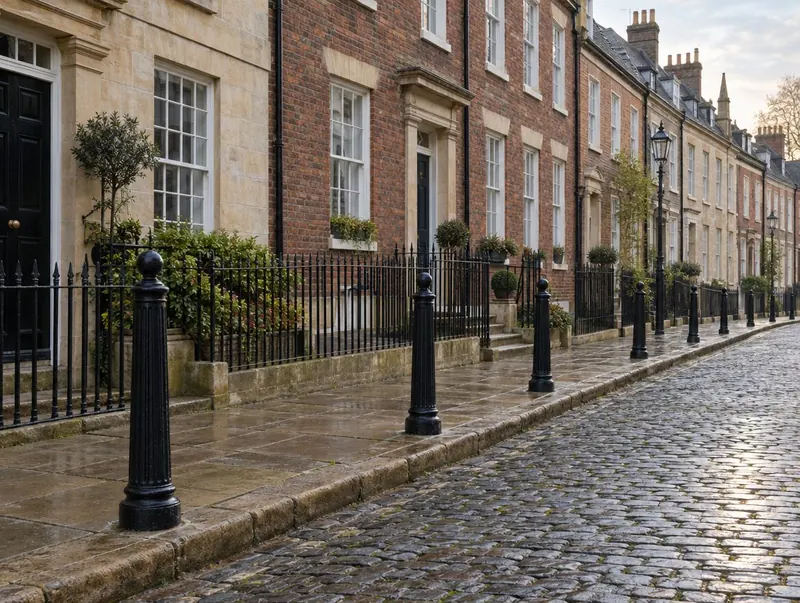 Computer-generated image
About cast iron bollards in Morecambe
In the town of Morecambe, cast iron bollards tend to go in at local parades, high street shopfronts and residential driveways. Traditional grey cast iron is hard but brittle, while modern ductile iron castings are tougher and bend before they break.
Coverage in Morecambe takes in the LA4, LA3 and LA5 postcode districts and nearby places like Heysham, Heaton, Carnforth and Bolton-le-Sands. Jobs in Morecambe can be combined with work in Lancaster (2.9 miles) and Kendal (18.4 miles) (straight-line distances). Preston is around 22 miles away.
Local details
- Area
- Lancashire, England
- Highway authority
- Lancashire County Council (local roads)
- Planning authority
- the council for Lancaster
- Postcodes
- LA4, LA3 and LA5
- Guide price
- Typically £435–£1,645 per bollard + VAT (£515–£1,945 inc VAT for homes); minimum job £725
- Survey
- Free, with a fixed written quote
Guide prices for Morecambe
| Specification | Guide price | Includes |
|---|---|---|
| Standard | £435–£955 + VAT · £515–£1,145 inc VAT | Standard post, foundation, reinstatement |
| Upgraded | £805–£1,295 + VAT · £965–£1,545 inc VAT | Upgraded finish or fittings, reflective band, matched keys |
| Premium | £1,195–£1,645 + VAT · £1,445–£1,945 inc VAT | Heavy-duty or architectural spec, premium finish |
Per bollard, supplied and installed; -2% for North West. Guide only — the fixed price follows a survey.
Where cast iron bollards go in around Morecambe
Typical reasons Morecambe sites choose cast iron bollards:
- Replacing lost or broken posts in an existing heritage line
- Heritage-style covers over modern steel or tested cores
- Resetting original bollards that have tilted or worked loose
Consents, ground and services in Morecambe
The highway authority for local roads in Morecambe is Lancashire County Council; motorways and trunk roads sit with National Highways. Cast iron bollards on the adopted footway are a matter for the highway authority, so we only install there with its written agreement.
Bollards on private land often don't need planning permission, but it depends on the council's view, the height and the location; in a conservation area, next to a listed building or under an Article 4 direction, ask the local planning authority (the council for Lancaster) first — we flag this at survey.
Reinstatement follows the original laying pattern and joint style, and on lime-bedded paving uses compatible materials so new work does not crack old stones around it. Historic streets were built in layers: modern services sit over older drains, coal holes and sometimes vaults, and the paving may be natural stone on a lime or sand bed rather than concrete.
- Agree contrasting paint details with the conservation officer so posts remain visible to partially sighted people, in line with Inclusive Mobility guidance.
- Avoid chains between posts on pedestrian routes, which can trip blind and partially sighted people.
What happens on site
Record what is there
The free site survey records existing bollards, their pattern, spacing, height and condition, and the paving they sit in. You receive a fixed written quote covering new castings, resets and reinstatement.
Set the post
Each bollard is set plumb in concrete with its root, flange or core, at a height that matches its neighbours. Original posts being reset are cleaned and checked for cracks first.
Relay and finish
Stone is relaid in its original pattern with suitable mortar, and the bollard is painted or touched up after fixing.
Specification choices
| Option | Detail |
|---|---|
| Cast aluminium | Lighter and easier to handle, with traditional patterns, but less robust and not always accepted in sensitive settings. |
| Paint finishes | Primed and painted, commonly black, with traditional highlights in gold or white on bands and crests where appropriate. |
| Grey cast iron | Traditional material with crisp detail and good corrosion resistance. Brittle under heavy impact, so suited to low-risk positions. |
What affects the quote
When we price cast iron bollards in Morecambe, these make the biggest difference:
- Resetting or repairing original bollards
- Steel cores, concrete fill or tested cores beneath covers
- Grey iron, ductile iron or cast aluminium
After installation
Touch up damaged paint promptly and repaint fully when the finish has dulled or worn through. Grey iron that has been struck should be checked closely for hairline cracks, which can spread with frost.
For damaged or loose posts in Morecambe, repairs and replacements are priced in writing first.
Cast iron bollards in Morecambe: FAQs
Which parts of Morecambe do you cover for cast iron bollards?
We cover all of Morecambe (LA4, LA3 and LA5) and the rest of Lancashire. We also work in Lancaster and Kendal.
Do I need consent for cast iron bollards on a public footway in Morecambe?
Lancashire County Council is the highway authority covering Morecambe's local roads. If any post would stand on adopted highway rather than your land, that consent is the first thing we sort out.
What's a typical price for cast iron bollards in Morecambe?
In Morecambe, typically £435–£1,645 per bollard, supplied and installed, plus VAT (£515–£1,945 including VAT for homeowners), with a minimum job of £725 plus VAT, using our North West guide prices. The fixed figure comes in writing after we've seen the site.
Can you match the old bollards on our street?
Often, yes. Many traditional patterns are still cast, and close equivalents exist for others. For rare patterns, a casting can sometimes be made from an existing post, though that takes longer.
What colour should cast iron bollards be painted?
Black is the traditional choice in many places, sometimes with gold or white highlights on bands or crests. Some areas have their own historic colours. The conservation officer can confirm what suits the street.