London · England
Cast iron and heritage bollards in Enfield
Cast iron bollards supplied and fitted in Enfield, London: surveyed, scanned for services, set in proper foundations and finished to match the ground.
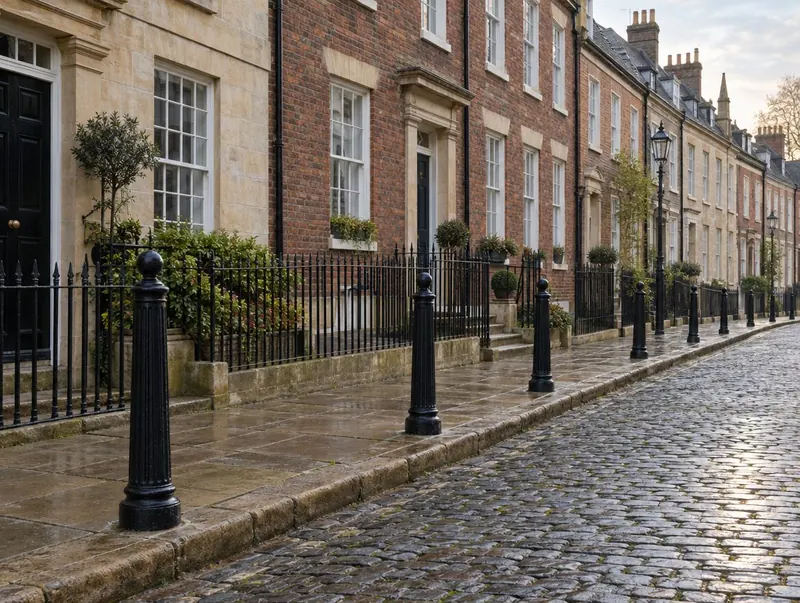 Computer-generated image
Enfield cast iron bollards
Traditional cast and ductile iron bollards for conservation areas, period streets and historic estates, installed and reset. In Enfield, that tends to mean sites such as mews courtyards, places of worship and station forecourts.
We work across EN1, EN2, N21, N9, EN3 and N13 — Enfield itself and places including Edmonton, Crews Hill and Botany Bay. We also cover neighbouring Cheshunt (4.2 miles), Haringey (4.3 miles), Waltham Abbey (4.3 miles) and Waltham Forest (4.4 miles) — distances are straight-line.
Key facts for this area
- Area
- London, England
- Highway authority
- Enfield Council (local roads)
- Planning authority
- Enfield Council
- Postcodes
- EN1, EN2, N21, N9, EN3, N13, N14 and N18
- Guide price
- Typically £515–£1,945 per bollard + VAT (£615–£2,345 inc VAT for homes); minimum job £855
- Survey
- Free, with a fixed written quote
- Nearby
- Cheshunt (4.2 mi), Haringey (4.3 mi), Waltham Abbey (4.3 mi), Waltham Forest (4.4 mi)
What cast iron bollards cost in Enfield
| Specification | Guide price | Includes |
|---|---|---|
| Standard | £515–£1,095 + VAT · £615–£1,295 inc VAT | Standard post, foundation, reinstatement |
| Upgraded | £945–£1,545 + VAT · £1,145–£1,845 inc VAT | Upgraded finish or fittings, reflective band, matched keys |
| Premium | £1,395–£1,945 + VAT · £1,645–£2,345 inc VAT | Heavy-duty or architectural spec, premium finish |
Per bollard, supplied and installed; +15% for London. Guide only — the fixed price follows a survey.
Typical cast iron bollards jobs in Enfield
Common uses in a place like Enfield:
- Conservation areas and historic town centres
- Streets and squares around listed buildings
- Resetting original bollards that have tilted or worked loose
Before we dig in Enfield
Enfield Council is the highway authority covering Enfield's local roads. Red routes are managed by Transport for London. If any post would stand on adopted highway rather than your land, that consent is the first thing we sort out.
Bollards on private land often don't need planning permission, but it depends on the council's view, the height and the location; in a conservation area, next to a listed building or under an Article 4 direction, ask the local planning authority (Enfield Council) first — we flag this at survey.
Excavation is by hand, positions are checked against service records and scanning, and anything unexpected is recorded rather than broken through. Reinstatement follows the original laying pattern and joint style, and on lime-bedded paving uses compatible materials so new work does not crack old stones around it.
- On public highway, agree positions and specification with the highway authority.
- Check whether existing bollards are of historic interest or listed before removing them; repair and resetting may be expected.
Installation, step by step
Record what is there
The free site survey records existing bollards, their pattern, spacing, height and condition, and the paving they sit in. You receive a fixed written quote covering new castings, resets and reinstatement.
Agree pattern and approvals
We source a matching pattern or close equivalent and, where needed, provide details for the conservation officer or planning authority before ordering.
Lift paving carefully
Natural stone flags, setts and kerbs are lifted by hand, numbered where needed and stored for relaying.
Options to consider
| Option | Detail |
|---|---|
| Steel cores and covers | Cast covers over root-fixed steel or crash-tested cores for strength without changing the look. |
| Grey cast iron | Traditional material with crisp detail and good corrosion resistance. Brittle under heavy impact, so suited to low-risk positions. |
| Contrast details | Painted bands or contrasting caps agreed with the conservation officer so posts are visible to partially sighted people. |
What moves the price in Enfield
Two Enfield jobs with the same number of posts can price quite differently. The usual reasons:
- Pattern complexity and whether a special casting is needed
- Resetting or repairing original bollards
- Painting, highlights and crest details
Keeping them working
Touch up damaged paint promptly and repaint fully when the finish has dulled or worn through. Grey iron that has been struck should be checked closely for hairline cracks, which can spread with frost.
We can also service, repair or replace existing posts anywhere in Enfield.
Common questions
Do you install cast iron bollards in Enfield?
We cover all of Enfield (EN1, EN2, N21, N9, EN3 and N13) and the rest of London. We also work in Cheshunt, Haringey and Waltham Abbey.
Do I need consent for cast iron bollards on a public footway in Enfield?
In Enfield, work on adopted pavements and verges needs consent from Enfield Council, the local highway authority. Red routes are managed by Transport for London. Car parks, forecourts and other private land only need the owner's permission.
How much do cast iron bollards cost in Enfield?
In Enfield, typically £515–£1,945 per bollard, supplied and installed, plus VAT (£615–£2,345 including VAT for homeowners), with a minimum job of £855 plus VAT, using our London guide prices. The fixed figure comes in writing after we've seen the site.
Can you match the old bollards on our street?
Often, yes. Many traditional patterns are still cast, and close equivalents exist for others. For rare patterns, a casting can sometimes be made from an existing post, though that takes longer.
Do we need consent for bollards in a conservation area?
Possibly. Consent requirements depend on where the bollards go, who installs them and whether nearby buildings are listed. Ask the local planning authority or conservation officer before ordering.
Cast iron bollards in nearby towns
- Cheshunt (4.2 mi)
- Haringey (4.3 mi)
- Waltham Abbey (4.3 mi)
- Waltham Forest (4.4 mi)
- Potters Bar (5.2 mi)
- Barnet (6.1 mi)