North Yorkshire · England
Cast iron and heritage bollards in Scarborough
Cast iron bollards for sites across Scarborough and the rest of North Yorkshire, from the first measurement to the last relaid paving block.
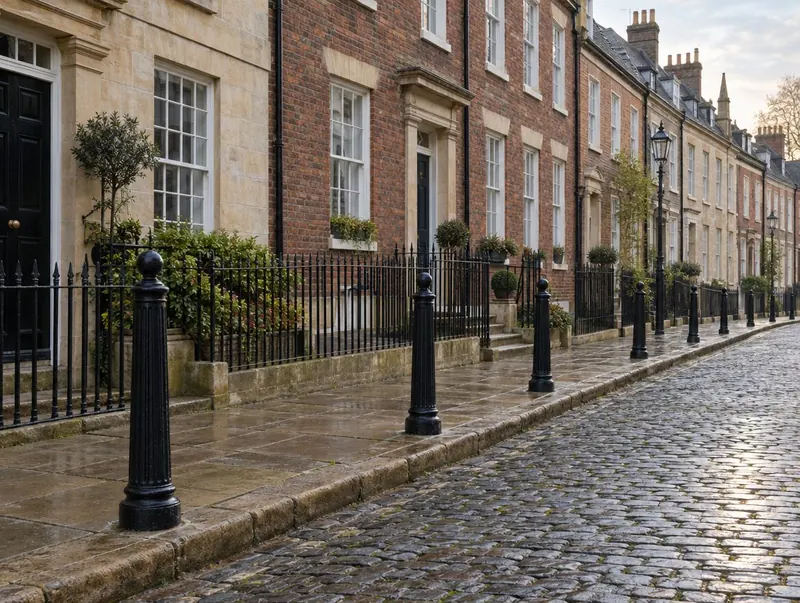 Computer-generated image
About cast iron bollards in Scarborough
In the town of Scarborough, cast iron bollards tend to go in at community buildings, high street shopfronts and filling-station forecourts. Traditional cast and ductile iron bollards for conservation areas, period streets and historic estates, installed and reset.
We cover Scarborough's YO12, YO11 and YO13 postcode districts, including places such as Seamer, Irton, Lebberston and Killerby. We also cover neighbouring Bridlington (16.1 miles) — distances are straight-line. It sits roughly 37 miles from Hull as the crow flies.
Key facts for this area
- Area
- North Yorkshire, England
- Highway authority
- North Yorkshire Council (local roads)
- Planning authority
- North Yorkshire Council
- Postcodes
- YO12, YO11 and YO13
- Guide price
- Typically £435–£1,645 per bollard + VAT (£515–£1,945 inc VAT for homes); minimum job £715
- Survey
- Free, with a fixed written quote
- Nearby
- Bridlington (16.1 mi)
Scarborough: typical cast iron bollard prices
| Specification | Guide price | Includes |
|---|---|---|
| Standard | £435–£945 + VAT · £515–£1,145 inc VAT | Standard post, foundation, reinstatement |
| Upgraded | £795–£1,295 + VAT · £945–£1,545 inc VAT | Upgraded finish or fittings, reflective band, matched keys |
| Premium | £1,145–£1,645 + VAT · £1,345–£1,945 inc VAT | Heavy-duty or architectural spec, premium finish |
Per bollard, supplied and installed; -3% for Yorkshire and the Humber. Guide only — the fixed price follows a survey.
What Scarborough sites use cast iron bollards for
Common uses in a place like Scarborough:
- Resetting original bollards that have tilted or worked loose
- Replacing lost or broken posts in an existing heritage line
- Period residential streets and mews
Consents, ground and services in Scarborough
In Scarborough, work on adopted pavements and verges needs consent from North Yorkshire Council, the local highway authority. Car parks, forecourts and other private land only need the owner's permission.
Bollards on private land often don't need planning permission, but it depends on the council's view, the height and the location; in a conservation area, next to a listed building or under an Article 4 direction, ask the local planning authority (North Yorkshire Council) first — we flag this at survey.
Excavation is by hand, positions are checked against service records and scanning, and anything unexpected is recorded rather than broken through. Reinstatement follows the original laying pattern and joint style, and on lime-bedded paving uses compatible materials so new work does not crack old stones around it.
- Avoid chains between posts on pedestrian routes, which can trip blind and partially sighted people.
- Check whether existing bollards are of historic interest or listed before removing them; repair and resetting may be expected.
What happens on site
Record what is there
The free site survey records existing bollards, their pattern, spacing, height and condition, and the paving they sit in. You receive a fixed written quote covering new castings, resets and reinstatement.
Agree pattern and approvals
We source a matching pattern or close equivalent and, where needed, provide details for the conservation officer or planning authority before ordering.
Lift paving carefully
Natural stone flags, setts and kerbs are lifted by hand, numbered where needed and stored for relaying.
Options to consider
| Option | Detail |
|---|---|
| Steel cores and covers | Cast covers over root-fixed steel or crash-tested cores for strength without changing the look. |
| Contrast details | Painted bands or contrasting caps agreed with the conservation officer so posts are visible to partially sighted people. |
| Grey cast iron | Traditional material with crisp detail and good corrosion resistance. Brittle under heavy impact, so suited to low-risk positions. |
What moves the price in Scarborough
Our Yorkshire and the Humber guide prices are a starting point; the survey in Scarborough firms them up. What tends to move them:
- Grey iron, ductile iron or cast aluminium
- Resetting or repairing original bollards
- Lifting and relaying natural stone paving
Keeping them working
Cast iron lasts well if its paint is kept intact. Keep a record of patterns and suppliers so that future replacements match; some patterns are made in small runs and can take time to source.
If posts in Scarborough are later hit or damaged, we can repair or replace them — see bollard repairs.
Common questions
Do you install cast iron bollards in Scarborough?
We cover all of Scarborough (YO12, YO11 and YO13) and the rest of North Yorkshire. We also work in Bridlington.
Do I need consent for cast iron bollards on a public footway in Scarborough?
North Yorkshire Council is the highway authority covering Scarborough's local roads. If any post would stand on adopted highway rather than your land, that consent is the first thing we sort out.
What's a typical price for cast iron bollards in Scarborough?
In Scarborough, typically £435–£1,645 per bollard, supplied and installed, plus VAT (£515–£1,945 including VAT for homeowners), with a minimum job of £715 plus VAT, using our Yorkshire and the Humber guide prices. The fixed figure comes in writing after we've seen the site.
Can heritage bollards give real vehicle protection?
On their own, untested cast bollards cannot be relied on for security. Where protection is needed, heritage covers designed for crash-tested cores give the traditional look over a tested product.
Can an old cast iron bollard be repaired?
Usually, if it is tilted, loose or has damaged paint: it can be lifted, cleaned, reset on a new foundation and repainted. Cracked grey iron is harder to repair and may need specialist work or a matching replacement.