Oxfordshire · England
Cast iron and heritage bollards in Didcot
Cast iron bollards for sites across Didcot and the rest of Oxfordshire, from the first measurement to the last relaid paving block.
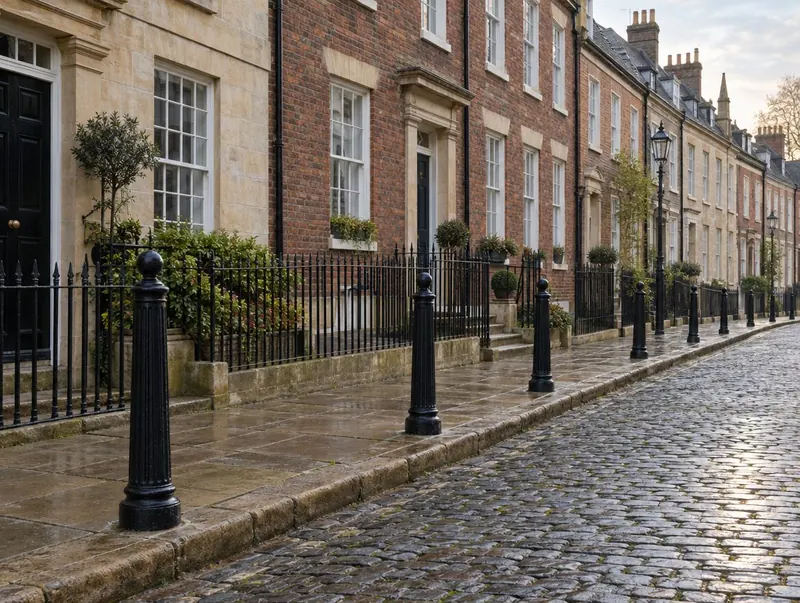 Computer-generated image
About cast iron bollards in Didcot
In the town of Didcot, cast iron bollards tend to go in at filling-station forecourts, schools and high street shopfronts. Traditional grey cast iron is hard but brittle, while modern ductile iron castings are tougher and bend before they break.
We cover Didcot's OX11, OX14 and OX10 postcode districts, including places such as East Hagbourne, Aston Upthorpe, South Moreton and Long Wittenham. Nearby, we also work in Abingdon (4.6 miles), Oxford (9.9 miles), Thatcham (14.2 miles) and Newbury (14.8 miles), measured as the crow flies. It sits roughly 16 miles from Reading as the crow flies.
Didcot at a glance
- Area
- Oxfordshire, England
- Highway authority
- Oxfordshire County Council (local roads)
- Planning authority
- the council for South Oxfordshire
- Postcodes
- OX11, OX14 and OX10
- Guide price
- Typically £475–£1,795 per bollard + VAT (£565–£2,145 inc VAT for homes); minimum job £785
- Survey
- Free, with a fixed written quote
Cast iron bollards in Didcot: common uses
Typical reasons Didcot sites choose cast iron bollards:
- Resetting original bollards that have tilted or worked loose
- Streets and squares around listed buildings
- Heritage-style covers over modern steel or tested cores
Didcot: typical cast iron bollard prices
| Specification | Guide price | Includes |
|---|---|---|
| Standard | £475–£1,045 + VAT · £565–£1,245 inc VAT | Standard post, foundation, reinstatement |
| Upgraded | £865–£1,445 + VAT · £1,045–£1,745 inc VAT | Upgraded finish or fittings, reflective band, matched keys |
| Premium | £1,245–£1,795 + VAT · £1,495–£2,145 inc VAT | Heavy-duty or architectural spec, premium finish |
Per bollard, supplied and installed; +6% for South East. Guide only — the fixed price follows a survey.
Before we dig in Didcot
Oxfordshire County Council is the highway authority covering Didcot's local roads. If any post would stand on adopted highway rather than your land, that consent is the first thing we sort out.
If your site in Didcot is listed or inside a conservation area, check with the local planning authority (the council for South Oxfordshire) before choosing a finish — heritage settings often favour cast iron or painted steel over stainless.
Reinstatement follows the original laying pattern and joint style, and on lime-bedded paving uses compatible materials so new work does not crack old stones around it. Historic streets were built in layers: modern services sit over older drains, coal holes and sometimes vaults, and the paving may be natural stone on a lime or sand bed rather than concrete.
- Avoid chains between posts on pedestrian routes, which can trip blind and partially sighted people.
- Ask the local planning authority whether consent is needed for new or replacement bollards in a conservation area or near a listed building.
What happens on site
Agree pattern and approvals
We source a matching pattern or close equivalent and, where needed, provide details for the conservation officer or planning authority before ordering.
Set the post
Each bollard is set plumb in concrete with its root, flange or core, at a height that matches its neighbours. Original posts being reset are cleaned and checked for cracks first.
Relay and finish
Stone is relaid in its original pattern with suitable mortar, and the bollard is painted or touched up after fixing.
Finishes and options
| Option | Detail |
|---|---|
| Steel cores and covers | Cast covers over root-fixed steel or crash-tested cores for strength without changing the look. |
| Contrast details | Painted bands or contrasting caps agreed with the conservation officer so posts are visible to partially sighted people. |
| Ductile iron | Same patterns with much greater toughness; bends before it breaks. The usual choice for new posts on trafficked streets. |
What affects the quote
When we price cast iron bollards in Didcot, these make the biggest difference:
- Pattern complexity and whether a special casting is needed
- Resetting or repairing original bollards
- Steel cores, concrete fill or tested cores beneath covers
After installation
Touch up damaged paint promptly and repaint fully when the finish has dulled or worn through. Inspect annually for chips, rust spots and cracks, particularly at the base where water and grit collect.
We can also service, repair or replace existing posts anywhere in Didcot.
Cast iron bollards in Didcot: FAQs
Do you install cast iron bollards in Didcot?
We cover all of Didcot (OX11, OX14 and OX10) and the rest of Oxfordshire. We also work in Abingdon, Oxford and Thatcham.
Do I need consent for cast iron bollards on a public footway in Didcot?
Oxfordshire County Council is the highway authority covering Didcot's local roads. If any post would stand on adopted highway rather than your land, that consent is the first thing we sort out.
What's a typical price for cast iron bollards in Didcot?
In Didcot, typically £475–£1,795 per bollard, supplied and installed, plus VAT (£565–£2,145 including VAT for homeowners), with a minimum job of £785 plus VAT, using our South East guide prices. The fixed figure comes in writing after we've seen the site.
Grey cast iron or ductile iron for new heritage bollards?
Ductile iron for any position that vehicles might strike, because it bends rather than shatters. Grey cast iron suits low-risk positions or matching existing grey iron posts exactly. Both take the same traditional patterns.
Do we need consent for bollards in a conservation area?
Possibly. Consent requirements depend on where the bollards go, who installs them and whether nearby buildings are listed. Ask the local planning authority or conservation officer before ordering.
Cast iron bollards near Didcot
- Abingdon (4.6 mi)
- Oxford (9.9 mi)
- Thatcham (14.2 mi)
- Newbury (14.8 mi)
- Reading (15.7 mi)
- Witney (15.9 mi)