Staffordshire · England
Cast iron and heritage bollards in Cannock
Cast iron bollards for sites across Cannock and the rest of Staffordshire, from the first measurement to the last relaid paving block.
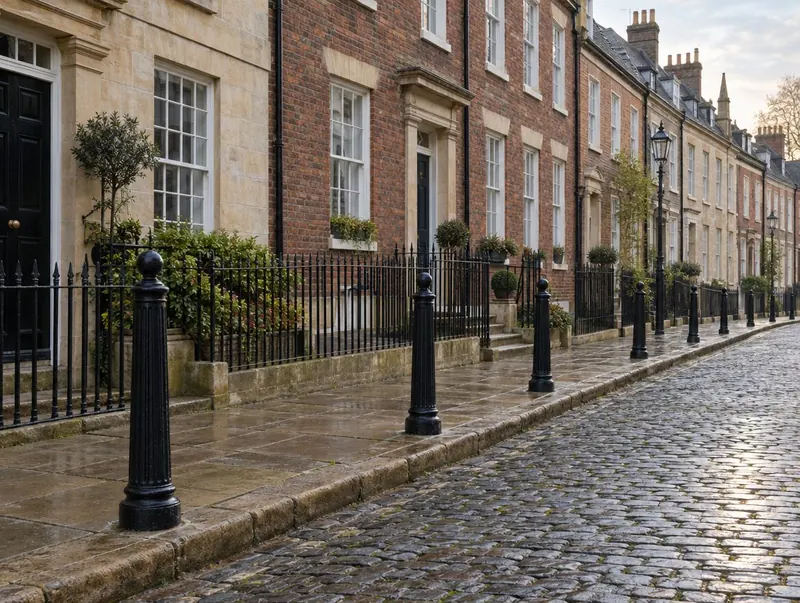 Computer-generated image
About cast iron bollards in Cannock
Across Cannock, typical sites for cast iron bollards include housing association car parks, industrial estates and business parks. Traditional cast and ductile iron bollards for conservation areas, period streets and historic estates, installed and reset.
Coverage in Cannock takes in the WS11 and WS12 postcode districts and nearby places like Norton Canes, Rawnsley, Hazelslade and Prospect Village. We also cover neighbouring Burntwood (4.4 miles), Bloxwich (5.1 miles), Rugeley (6.2 miles) and Wednesfield (6.9 miles) — distances are straight-line. Cannock is about 8 miles from Wolverhampton.
Key facts for this area
- Area
- Staffordshire, England
- Highway authority
- Staffordshire County Council (local roads)
- Planning authority
- the council for Cannock Chase
- Postcodes
- WS11 and WS12
- Guide price
- Typically £445–£1,695 per bollard + VAT (£525–£2,045 inc VAT for homes); minimum job £745
- Survey
- Free, with a fixed written quote
- Nearby
- Burntwood (4.4 mi), Bloxwich (5.1 mi), Rugeley (6.2 mi), Wednesfield (6.9 mi)
Cast iron bollards in Cannock: common uses
Around Cannock, cast iron bollards usually solve one of these:
- Resetting original bollards that have tilted or worked loose
- Streets and squares around listed buildings
- Replacing lost or broken posts in an existing heritage line
Cannock: typical cast iron bollard prices
| Specification | Guide price | Includes |
|---|---|---|
| Standard | £445–£975 + VAT · £525–£1,145 inc VAT | Standard post, foundation, reinstatement |
| Upgraded | £825–£1,345 + VAT · £985–£1,595 inc VAT | Upgraded finish or fittings, reflective band, matched keys |
| Premium | £1,195–£1,695 + VAT · £1,445–£2,045 inc VAT | Heavy-duty or architectural spec, premium finish |
Per bollard, supplied and installed; no regional adjustment. Guide only — the fixed price follows a survey.
Consents, ground and services in Cannock
Staffordshire County Council is the highway authority covering Cannock's local roads. If any post would stand on adopted highway rather than your land, that consent is the first thing we sort out.
Many private-land installations in Cannock need no planning application, but the rules don't clearly cover bollards, so listed buildings, conservation areas and prominent frontages are worth raising with the planning team at the council for Cannock Chase before posts go in.
Excavation is by hand, positions are checked against service records and scanning, and anything unexpected is recorded rather than broken through. Original stone flags and setts are reused wherever possible, because new stone rarely matches weathered material.
- Ask the local planning authority whether consent is needed for new or replacement bollards in a conservation area or near a listed building.
- On public highway, agree positions and specification with the highway authority.
How the job runs
Record what is there
The free site survey records existing bollards, their pattern, spacing, height and condition, and the paving they sit in. You receive a fixed written quote covering new castings, resets and reinstatement.
Lift paving carefully
Natural stone flags, setts and kerbs are lifted by hand, numbered where needed and stored for relaying.
Set the post
Each bollard is set plumb in concrete with its root, flange or core, at a height that matches its neighbours. Original posts being reset are cleaned and checked for cracks first.
Options to consider
| Option | Detail |
|---|---|
| Ductile iron | Same patterns with much greater toughness; bends before it breaks. The usual choice for new posts on trafficked streets. |
| Contrast details | Painted bands or contrasting caps agreed with the conservation officer so posts are visible to partially sighted people. |
| Steel cores and covers | Cast covers over root-fixed steel or crash-tested cores for strength without changing the look. |
What moves the price in Cannock
Two Cannock jobs with the same number of posts can price quite differently. The usual reasons:
- Grey iron, ductile iron or cast aluminium
- Lifting and relaying natural stone paving
- Pattern complexity and whether a special casting is needed
Keeping them working
Keep a record of patterns and suppliers so that future replacements match; some patterns are made in small runs and can take time to source. Inspect annually for chips, rust spots and cracks, particularly at the base where water and grit collect.
If posts in Cannock are later hit or damaged, we can repair or replace them — see bollard repairs.
Cast iron bollards in Cannock: FAQs
Do you install cast iron bollards in Cannock?
We cover all of Cannock (WS11 and WS12) and the rest of Staffordshire. We also work in Burntwood, Bloxwich and Rugeley.
Do I need consent for cast iron bollards on a public footway in Cannock?
Staffordshire County Council is the highway authority covering Cannock's local roads. If any post would stand on adopted highway rather than your land, that consent is the first thing we sort out.
How much do cast iron bollards cost in Cannock?
In Cannock, typically £445–£1,695 per bollard, supplied and installed, plus VAT (£525–£2,045 including VAT for homeowners), with a minimum job of £745 plus VAT, using our West Midlands guide prices. The fixed figure comes in writing after we've seen the site.
What colour should cast iron bollards be painted?
Black is the traditional choice in many places, sometimes with gold or white highlights on bands or crests. Some areas have their own historic colours. The conservation officer can confirm what suits the street.
Can heritage bollards give real vehicle protection?
On their own, untested cast bollards cannot be relied on for security. Where protection is needed, heritage covers designed for crash-tested cores give the traditional look over a tested product.
Cast iron bollards in nearby towns
- Burntwood (4.4 mi)
- Bloxwich (5.1 mi)
- Rugeley (6.2 mi)
- Wednesfield (6.9 mi)
- Willenhall (7.4 mi)
- Walsall (7.5 mi)