Bridgend · Wales
Concrete bollard installation in Pyle
Concrete bollards for sites across Pyle and the rest of Bridgend, from the first measurement to the last relaid paving block.
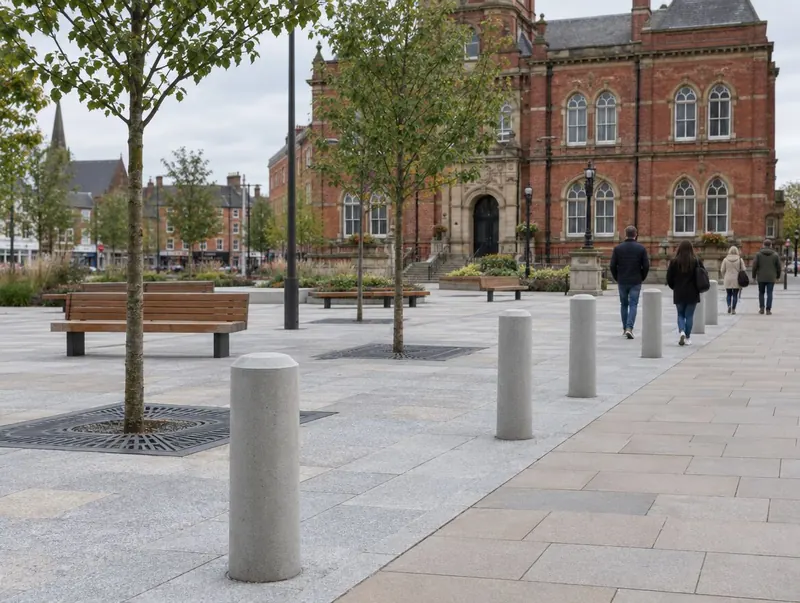 Computer-generated image
Concrete bollards in Pyle
Across Pyle, typical sites for concrete bollards include local parades, small industrial units and community buildings. Finishes range from plain grey concrete to exposed aggregate and stone-effect surfaces that suit civic and landscaped settings.
We cover Pyle's CF33 postcode district, including places such as South Cornelly and Mawdlam. Jobs in Pyle can be combined with work in Porthcawl (2.6 miles), Bridgend (5.3 miles), Maesteg (6.6 miles) and Port Talbot (6.6 miles) (straight-line distances). Swansea is around 13 miles away.
Key facts for this area
- Area
- Bridgend, Wales
- Highway authority
- Bridgend County Borough Council (local roads)
- Planning authority
- Bridgend County Borough Council
- Postcodes
- CF33
- Guide price
- Typically £165–£575 per bollard + VAT; minimum job £575
- Survey
- Free, with a fixed written quote
- Nearby
- Porthcawl (2.6 mi), Bridgend (5.3 mi), Maesteg (6.6 mi), Port Talbot (6.6 mi)
Concrete bollards in Pyle: common uses
Typical reasons Pyle sites choose concrete bollards:
- Town centre squares and pedestrianised streets
- Retail parks and landscaped car parks
- School, library and civic building forecourts
Guide prices for Pyle
| Specification | Guide price | Includes |
|---|---|---|
| Standard | £165–£345 + VAT | Standard post, foundation, reinstatement |
| Upgraded | £295–£465 + VAT | Upgraded finish or fittings, reflective band, matched keys |
| Premium | £415–£575 + VAT | Heavy-duty or architectural spec, premium finish |
Per bollard, supplied and installed; -3% for Wales. Guide only — the fixed price follows a survey.
What we check first in Pyle
In Pyle the highway authority for local roads is Bridgend County Borough Council. We confirm whether the ground is adopted highway before quoting, because concrete bollards on a public footway need its agreement first.
Bollards on private land often don't need planning permission, but it depends on the council's view, the height and the location; in a conservation area, next to a listed building or under an Article 4 direction, ask the local planning authority (Bridgend County Borough Council) first — we flag this at survey.
Access for the lifting vehicle matters: soft grass, paving and kerbs can be damaged by an outrigger, so ground protection mats are often laid before lifting begins. Because concrete bollards are heavy, a weak foundation shows itself quickly as a tilt.
- Do not present untested concrete bollards as crash-rated protection.
- Keep clear gaps of typically at least 1,000–1,200 mm where pedestrians pass, checking against Inclusive Mobility guidance.
Installation, step by step
Plan lifting
Each bollard's weight is checked, and a lifting method is chosen, such as a vacuum lifter or crane arm, with an exclusion zone set during lifts.
Excavate and cast foundations
Small foundations are excavated, checked for services and cast with a dowel hole or sleeve at the right position and level.
Reinstate and clean
Paving is made good around each base and the bollards are cleaned of mortar and handling marks.
Finishes and options
| Option | Detail |
|---|---|
| Precast concrete | Grey or coloured concrete in round, square, tapered or domed shapes, the economical public realm option. |
| Surface finishes | Smooth, exposed aggregate, acid-etched or shot-blasted, chosen to suit paving and resist visible weathering. |
| Reconstituted stone | Crushed natural stone in a concrete mix, giving a Portland, buff or granite-like appearance for civic and heritage settings. |
What affects the quote
When we price concrete bollards in Pyle, these make the biggest difference:
- Lifting equipment and access for delivery
- Foundation depth and ground conditions
- Number of bollards
Keeping them working
If a line is regularly struck by vehicles, consider whether steel cores, a tested product or a different layout would suit better. Small chips can be repaired with a colour-matched mortar, but a bollard that has cracked through or sheared at the dowel needs replacing.
We can also service, repair or replace existing posts anywhere in Pyle.
Questions about concrete bollards in Pyle
Which parts of Pyle do you cover for concrete bollards?
We cover all of Pyle (CF33) and the rest of Bridgend. We also work in Porthcawl, Bridgend and Maesteg.
Do I need consent for concrete bollards on a public footway in Pyle?
Before digging near the kerb in Pyle we establish who owns the ground: adopted footways are Bridgend County Borough Council's responsibility, trunk roads the Welsh Government's, and everything else belongs to the site owner.
What's a typical price for concrete bollards in Pyle?
In Pyle, typically £165–£575 per bollard, supplied and installed, plus VAT, with a minimum job of £575 plus VAT, using our Wales guide prices. The fixed figure comes in writing after we've seen the site.
Should we use concrete or steel bollards?
Concrete suits landscaped and public spaces where appearance and low maintenance matter and where impacts are rare. Steel suits car parks and yards where knocks are frequent, because it bends rather than shatters. Many schemes use both in different places.
Can concrete bollards be moved later?
Yes, though it takes lifting equipment. Dowel-fixed bollards can be lifted off once the grout is broken out, and the foundation removed or reused. Plan for it if you think the layout may change.
Concrete bollards near Pyle
- Porthcawl (2.6 mi)
- Bridgend (5.3 mi)
- Maesteg (6.6 mi)
- Port Talbot (6.6 mi)
- Neath (11.1 mi)
- Llantwit Major (11.8 mi)