Lincolnshire · England
Concrete bollard installation in Boston
Concrete bollards for sites across Boston and the rest of Lincolnshire, from the first measurement to the last relaid paving block.
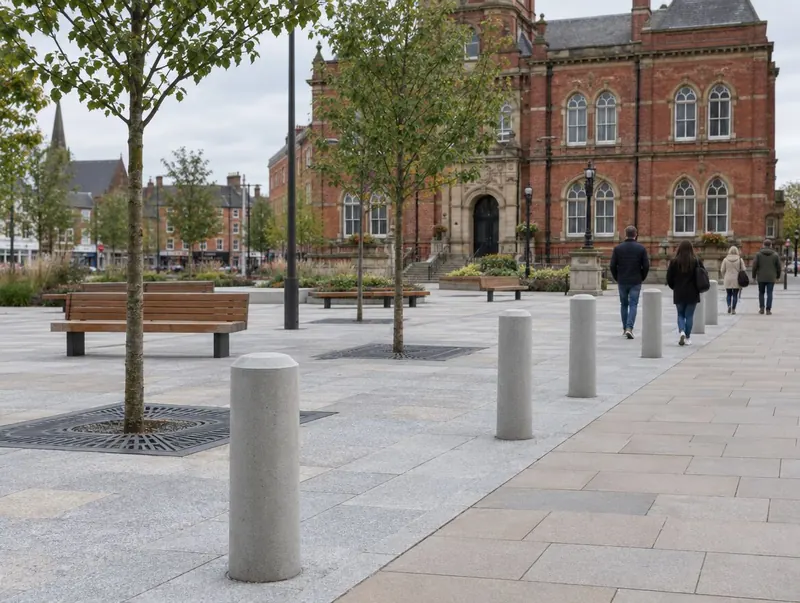 Computer-generated image
About concrete bollards in Boston
In the town of Boston, concrete bollards tend to go in at local parades, high street shopfronts and schools. Finishes range from plain grey concrete to exposed aggregate and stone-effect surfaces that suit civic and landscaped settings.
Coverage in Boston takes in the PE21, PE20 and PE22 postcode districts and nearby places like Fishtoft, Hall Hills, Sutterton and Bicker. We also cover neighbouring Spalding (14.1 miles) and Skegness (19 miles) — distances are straight-line.
Local details
- Area
- Lincolnshire, England
- Highway authority
- Lincolnshire County Council (local roads)
- Planning authority
- the council for Boston
- Postcodes
- PE21, PE20 and PE22
- Guide price
- Typically £185–£615 per bollard + VAT; minimum job £605
- Survey
- Free, with a fixed written quote
What concrete bollards cost in Boston
| Specification | Guide price | Includes |
|---|---|---|
| Standard | £185–£365 + VAT | Standard post, foundation, reinstatement |
| Upgraded | £315–£495 + VAT | Upgraded finish or fittings, reflective band, matched keys |
| Premium | £435–£615 + VAT | Heavy-duty or architectural spec, premium finish |
Per bollard, supplied and installed; +3% for East of England. Guide only — the fixed price follows a survey.
What Boston sites use concrete bollards for
Common uses in a place like Boston:
- Housing estates and communal areas
- Rural and coastal sites where steel would corrode
- Edges of open land and verges subject to unauthorised vehicle access
What we check first in Boston
Lincolnshire County Council is the highway authority covering Boston's local roads. If any post would stand on adopted highway rather than your land, that consent is the first thing we sort out.
Many private-land installations in Boston need no planning application, but the rules don't clearly cover bollards, so listed buildings, conservation areas and prominent frontages are worth raising with the planning team at the council for Boston before posts go in.
Services under footways are traced before excavation. Because concrete bollards are heavy, a weak foundation shows itself quickly as a tilt.
- Keep clear gaps of typically at least 1,000–1,200 mm where pedestrians pass, checking against Inclusive Mobility guidance.
- Do not present untested concrete bollards as crash-rated protection.
From survey to handover
Survey and choose
A free site survey looks at the setting, ground, delivery access and where a lifting vehicle can stand. You receive a fixed written quote with the product, finish and fixing.
Set the bollards
Each bollard is lowered onto a mortar bed with its dowel grouted in, checked plumb and aligned with its neighbours.
Protect while the grout cures
Bollards are left undisturbed until the grout and foundation have gained strength, with temporary barriers if vehicles use the area. Lines that need to open to traffic quickly can use faster-setting grouts where the product allows.
Finishes and options
| Option | Detail |
|---|---|
| Surface finishes | Smooth, exposed aggregate, acid-etched or shot-blasted, chosen to suit paving and resist visible weathering. |
| Reflective and contrasting details | Inset reflective bands, contrasting tops or rings for visibility to drivers and partially sighted pedestrians. |
| Reconstituted stone | Crushed natural stone in a concrete mix, giving a Portland, buff or granite-like appearance for civic and heritage settings. |
What affects the quote
Our East of England guide prices are a starting point; the survey in Boston firms them up. What tends to move them:
- Lifting equipment and access for delivery
- Precast concrete or reconstituted stone
- Number of bollards
Looking after them
In areas salted heavily in winter, check for surface spalling. Small chips can be repaired with a colour-matched mortar, but a bollard that has cracked through or sheared at the dowel needs replacing.
For damaged or loose posts in Boston, repairs and replacements are priced in writing first.
Concrete bollards in Boston: FAQs
Do you install concrete bollards in Boston?
We cover all of Boston (PE21, PE20 and PE22) and the rest of Lincolnshire. We also work in Spalding and Skegness.
Who gives permission for bollards on the pavement in Boston?
Lincolnshire County Council is the highway authority covering Boston's local roads. If any post would stand on adopted highway rather than your land, that consent is the first thing we sort out.
How much do concrete bollards cost in Boston?
In Boston, typically £185–£615 per bollard, supplied and installed, plus VAT, with a minimum job of £605 plus VAT, using our East of England guide prices. The fixed figure comes in writing after we've seen the site.
Can concrete bollards be moved later?
Yes, though it takes lifting equipment. Dowel-fixed bollards can be lifted off once the grout is broken out, and the foundation removed or reused. Plan for it if you think the layout may change.
How are concrete bollards fixed down?
Usually with a steel dowel at the base grouted into a small concrete foundation, so they cannot be pushed or rocked. Some designs have a root buried in the ground instead. Free-standing placement is used only for temporary layouts.