Oxfordshire · England
Concrete bollard installation in Oxford
Planning concrete bollards in Oxford? We check ownership, consents and buried services first, then quote a fixed price.
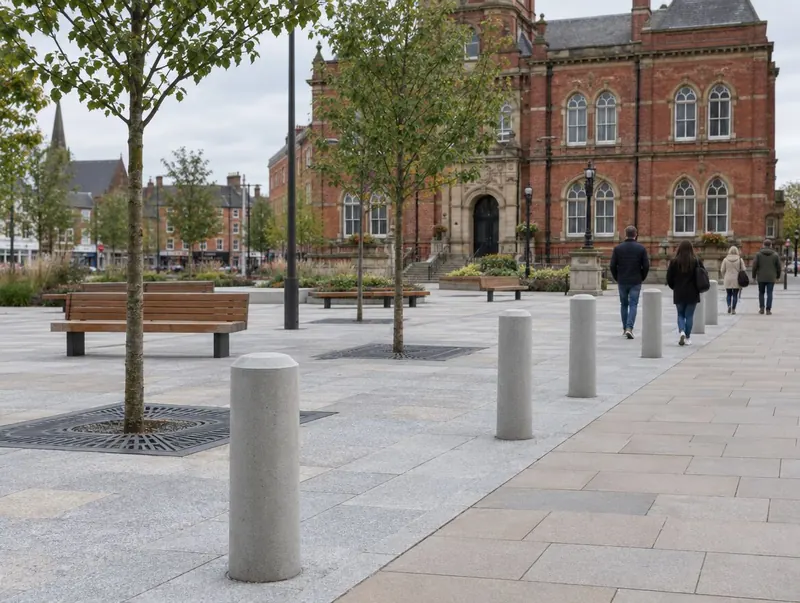 Computer-generated image
About concrete bollards in Oxford
Whether it's office forecourts, multi-storey car parks and city-centre plazas, concrete bollards in Oxford are planned around who needs to get through and who doesn't. Finishes range from plain grey concrete to exposed aggregate and stone-effect surfaces that suit civic and landscaped settings.
We work across OX1, OX2, OX3 and OX4 — Oxford itself and places including Wolvercote and Sandford-on-Thames. Jobs in Oxford can be combined with work in Abingdon (5.7 miles), Didcot (9.9 miles), Witney (10 miles) and Bicester (11.1 miles) (straight-line distances). Oxford is about 24 miles from Reading.
Key facts for this area
- Area
- Oxfordshire, England
- Highway authority
- Oxfordshire County Council (local roads)
- Planning authority
- Oxfordshire County Council
- Postcodes
- OX1, OX2, OX3 and OX4
- Guide price
- Typically £185–£635 per bollard + VAT; minimum job £625
- Survey
- Free, with a fixed written quote
What Oxford sites use concrete bollards for
Common uses in a place like Oxford:
- School, library and civic building forecourts
- Retail parks and landscaped car parks
- Town centre squares and pedestrianised streets
Guide prices for Oxford
| Specification | Guide price | Includes |
|---|---|---|
| Standard | £185–£375 + VAT | Standard post, foundation, reinstatement |
| Upgraded | £315–£505 + VAT | Upgraded finish or fittings, reflective band, matched keys |
| Premium | £455–£635 + VAT | Heavy-duty or architectural spec, premium finish |
Per bollard, supplied and installed; +6% for South East. Guide only — the fixed price follows a survey.
Consents, ground and services in Oxford
The highway authority for local roads in Oxford is Oxfordshire County Council; motorways and trunk roads sit with National Highways. Concrete bollards on the adopted footway are a matter for the highway authority, so we only install there with its written agreement.
Bollards on private land often don't need planning permission, but it depends on the council's view, the height and the location; in a conservation area, next to a listed building or under an Article 4 direction, ask the local planning authority (Oxfordshire County Council) first — we flag this at survey.
Access for the lifting vehicle matters: soft grass, paving and kerbs can be damaged by an outrigger, so ground protection mats are often laid before lifting begins. Each post sits on a concrete base on firm ground, and on soft verges or made ground the base is deepened or widened to suit.
- On public highway or council land, agree positions and specification with the highway authority or landowner.
- Use contrasting colours or bands so grey bollards stand out against grey paving.
What happens on site
Plan lifting
Each bollard's weight is checked, and a lifting method is chosen, such as a vacuum lifter or crane arm, with an exclusion zone set during lifts.
Excavate and cast foundations
Small foundations are excavated, checked for services and cast with a dowel hole or sleeve at the right position and level.
Set the bollards
Each bollard is lowered onto a mortar bed with its dowel grouted in, checked plumb and aligned with its neighbours.
Specification choices
| Option | Detail |
|---|---|
| Precast concrete | Grey or coloured concrete in round, square, tapered or domed shapes, the economical public realm option. |
| Surface finishes | Smooth, exposed aggregate, acid-etched or shot-blasted, chosen to suit paving and resist visible weathering. |
| Reflective and contrasting details | Inset reflective bands, contrasting tops or rings for visibility to drivers and partially sighted pedestrians. |
What affects the quote
When we price concrete bollards in Oxford, these make the biggest difference:
- Lifting equipment and access for delivery
- Size, shape and surface finish
- Precast concrete or reconstituted stone
Looking after them
Small chips can be repaired with a colour-matched mortar, but a bollard that has cracked through or sheared at the dowel needs replacing. Keep a note of the product name, finish and supplier, because matching a single damaged bollard years later is much easier when the original specification is known.
If posts in Oxford are later hit or damaged, we can repair or replace them — see bollard repairs.
Concrete bollards in Oxford: FAQs
Do you install concrete bollards in Oxford?
We cover all of Oxford (OX1, OX2, OX3 and OX4) and the rest of Oxfordshire. We also work in Abingdon, Didcot and Witney.
Who gives permission for bollards on the pavement in Oxford?
Oxfordshire County Council is the highway authority covering Oxford's local roads. If any post would stand on adopted highway rather than your land, that consent is the first thing we sort out.
How much do concrete bollards cost in Oxford?
In Oxford, typically £185–£635 per bollard, supplied and installed, plus VAT, with a minimum job of £625 plus VAT, using our South East guide prices. The fixed figure comes in writing after we've seen the site.
How heavy are concrete bollards?
Often well over a hundred kilograms each, and larger designs several times that. The exact weight depends on size and shape. It means they are delivered and set using lifting equipment rather than by hand.
How are concrete bollards fixed down?
Usually with a steel dowel at the base grouted into a small concrete foundation, so they cannot be pushed or rocked. Some designs have a root buried in the ground instead. Free-standing placement is used only for temporary layouts.
Concrete bollards near Oxford
- Abingdon (5.7 mi)
- Didcot (9.9 mi)
- Witney (10 mi)
- Bicester (11.1 mi)
- Aylesbury (19.4 mi)
- Banbury (21.8 mi)