Suffolk · England
Concrete bollard installation in Lowestoft
Local installation of concrete bollards in Lowestoft — free survey, fixed written price, and posts set to the right spacing for people and vehicles.
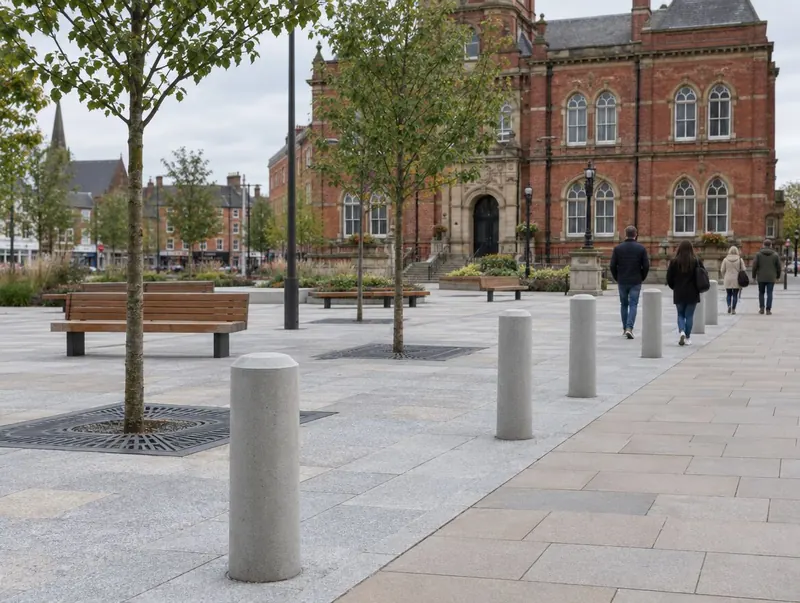 Computer-generated image
Lowestoft concrete bollards
In the town of Lowestoft, concrete bollards tend to go in at filling-station forecourts, local parades and community car parks. Finishes range from plain grey concrete to exposed aggregate and stone-effect surfaces that suit civic and landscaped settings.
We cover Lowestoft's NR32 and NR33 postcode districts, including places such as Blundeston, Corton, Somerleyton and Camps Heath. Jobs in Lowestoft can be combined with work in Great Yarmouth (9.2 miles) and Norwich (21.8 miles) (straight-line distances).
Lowestoft at a glance
- Area
- Suffolk, England
- Highway authority
- Suffolk County Council (local roads)
- Planning authority
- the council for East Suffolk
- Postcodes
- NR32 and NR33
- Guide price
- Typically £185–£615 per bollard + VAT; minimum job £605
- Survey
- Free, with a fixed written quote
- Nearby
- Great Yarmouth (9.2 mi), Norwich (21.8 mi)
Guide prices for Lowestoft
| Specification | Guide price | Includes |
|---|---|---|
| Standard | £185–£365 + VAT | Standard post, foundation, reinstatement |
| Upgraded | £315–£495 + VAT | Upgraded finish or fittings, reflective band, matched keys |
| Premium | £435–£615 + VAT | Heavy-duty or architectural spec, premium finish |
Per bollard, supplied and installed; +3% for East of England. Guide only — the fixed price follows a survey.
What Lowestoft sites use concrete bollards for
Common uses in a place like Lowestoft:
- Park entrances and greens where vehicles should not drive
- Edges of open land and verges subject to unauthorised vehicle access
- Housing estates and communal areas
Permissions and groundwork in Lowestoft
Suffolk County Council is the highway authority covering Lowestoft's local roads. If any post would stand on adopted highway rather than your land, that consent is the first thing we sort out.
If your site in Lowestoft is listed or inside a conservation area, check with the local planning authority (the council for East Suffolk) before choosing a finish — heritage settings often favour cast iron or painted steel over stainless.
Services under footways are traced before excavation. Access for the lifting vehicle matters: soft grass, paving and kerbs can be damaged by an outrigger, so ground protection mats are often laid before lifting begins.
- Do not present untested concrete bollards as crash-rated protection.
- On public highway or council land, agree positions and specification with the highway authority or landowner.
What happens on site
Survey and choose
A free site survey looks at the setting, ground, delivery access and where a lifting vehicle can stand. You receive a fixed written quote with the product, finish and fixing.
Plan lifting
Each bollard's weight is checked, and a lifting method is chosen, such as a vacuum lifter or crane arm, with an exclusion zone set during lifts.
Set the bollards
Each bollard is lowered onto a mortar bed with its dowel grouted in, checked plumb and aligned with its neighbours.
Options to consider
| Option | Detail |
|---|---|
| Dowel-fixed or root-set | Dowels grouted into a foundation for most installations; root-set posts buried in the ground on softer sites. |
| Planters and blocks | Concrete planters and seating blocks used in place of bollards where a softer look is wanted. |
| Reflective and contrasting details | Inset reflective bands, contrasting tops or rings for visibility to drivers and partially sighted pedestrians. |
Pricing concrete bollards in Lowestoft
Two Lowestoft jobs with the same number of posts can price quite differently. The usual reasons:
- Precast concrete or reconstituted stone
- Number of bollards
- Size, shape and surface finish
Keeping them working
In areas salted heavily in winter, check for surface spalling. Keep a note of the product name, finish and supplier, because matching a single damaged bollard years later is much easier when the original specification is known.
We can also service, repair or replace existing posts anywhere in Lowestoft.
Questions about concrete bollards in Lowestoft
Can you install concrete bollards anywhere in Lowestoft?
We cover all of Lowestoft (NR32 and NR33) and the rest of Suffolk. We also work in Great Yarmouth and Norwich.
Do I need consent for concrete bollards on a public footway in Lowestoft?
In Lowestoft, work on adopted pavements and verges needs consent from Suffolk County Council, the local highway authority. Car parks, forecourts and other private land only need the owner's permission.
What's a typical price for concrete bollards in Lowestoft?
In Lowestoft, typically £185–£615 per bollard, supplied and installed, plus VAT, with a minimum job of £605 plus VAT, using our East of England guide prices. The fixed figure comes in writing after we've seen the site.
How are concrete bollards fixed down?
Usually with a steel dowel at the base grouted into a small concrete foundation, so they cannot be pushed or rocked. Some designs have a root buried in the ground instead. Free-standing placement is used only for temporary layouts.
Should we use concrete or steel bollards?
Concrete suits landscaped and public spaces where appearance and low maintenance matter and where impacts are rare. Steel suits car parks and yards where knocks are frequent, because it bends rather than shatters. Many schemes use both in different places.