Tyne and Wear · England
Concrete bollard installation in Whitley Bay
Planning concrete bollards in Whitley Bay? We check ownership, consents and buried services first, then quote a fixed price.
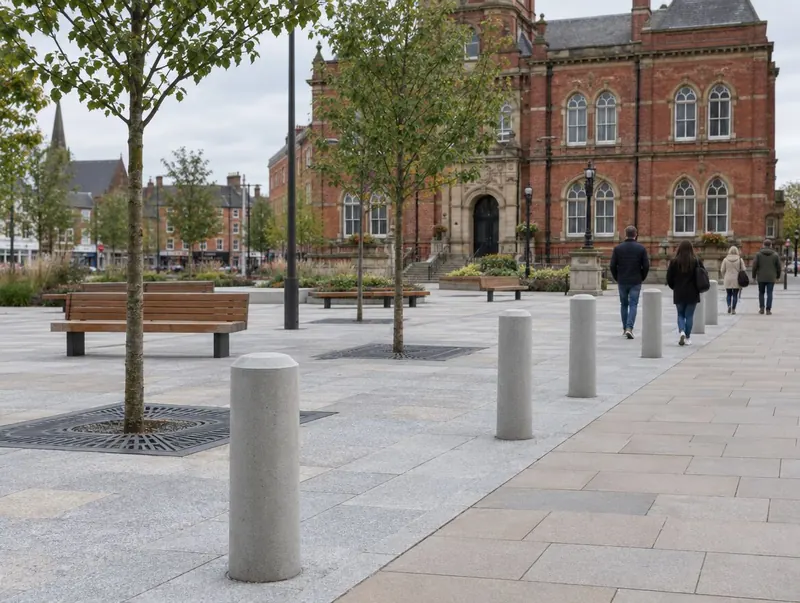 Computer-generated image
About concrete bollards in Whitley Bay
Across Whitley Bay, typical sites for concrete bollards include local parades, community buildings and community car parks. Finishes range from plain grey concrete to exposed aggregate and stone-effect surfaces that suit civic and landscaped settings.
We work across NE26, NE25 and NE27 — Whitley Bay itself and places including Earsdon, Shiremoor and Backworth. Nearby, we also work in North Shields (1.6 miles), Tynemouth (1.7 miles), South Shields (2.9 miles) and Jarrow (4.4 miles), measured as the crow flies. Whitley Bay is about 8 miles from Newcastle upon Tyne.
Whitley Bay at a glance
- Area
- Tyne and Wear, England
- Highway authority
- North Tyneside Council (local roads)
- Planning authority
- North Tyneside Council
- Postcodes
- NE26, NE25 and NE27
- Guide price
- Typically £165–£575 per bollard + VAT; minimum job £565
- Survey
- Free, with a fixed written quote
- Nearby
- North Shields (1.6 mi), Tynemouth (1.7 mi), South Shields (2.9 mi), Jarrow (4.4 mi)
Guide prices for Whitley Bay
| Specification | Guide price | Includes |
|---|---|---|
| Standard | £165–£335 + VAT | Standard post, foundation, reinstatement |
| Upgraded | £285–£455 + VAT | Upgraded finish or fittings, reflective band, matched keys |
| Premium | £405–£575 + VAT | Heavy-duty or architectural spec, premium finish |
Per bollard, supplied and installed; -4% for North East. Guide only — the fixed price follows a survey.
What Whitley Bay sites use concrete bollards for
Around Whitley Bay, concrete bollards usually solve one of these:
- Rural and coastal sites where steel would corrode
- Park entrances and greens where vehicles should not drive
- Town centre squares and pedestrianised streets
Before we dig in Whitley Bay
In Whitley Bay, work on adopted pavements and verges needs consent from North Tyneside Council, the local highway authority. Car parks, forecourts and other private land only need the owner's permission.
Bollards on private land often don't need planning permission, but it depends on the council's view, the height and the location; in a conservation area, next to a listed building or under an Article 4 direction, ask the local planning authority (North Tyneside Council) first — we flag this at survey.
Park and verge locations often have tree roots nearby, which need protecting and can push bollards over time if set too close. Access for the lifting vehicle matters: soft grass, paving and kerbs can be damaged by an outrigger, so ground protection mats are often laid before lifting begins.
- Use contrasting colours or bands so grey bollards stand out against grey paving.
- Do not present untested concrete bollards as crash-rated protection.
Installation, step by step
Excavate and cast foundations
Small foundations are excavated, checked for services and cast with a dowel hole or sleeve at the right position and level.
Set the bollards
Each bollard is lowered onto a mortar bed with its dowel grouted in, checked plumb and aligned with its neighbours.
Protect while the grout cures
Bollards are left undisturbed until the grout and foundation have gained strength, with temporary barriers if vehicles use the area. Lines that need to open to traffic quickly can use faster-setting grouts where the product allows.
Choosing the right spec
| Option | Detail |
|---|---|
| Reflective and contrasting details | Inset reflective bands, contrasting tops or rings for visibility to drivers and partially sighted pedestrians. |
| Precast concrete | Grey or coloured concrete in round, square, tapered or domed shapes, the economical public realm option. |
| Planters and blocks | Concrete planters and seating blocks used in place of bollards where a softer look is wanted. |
What affects the quote
Our North East guide prices are a starting point; the survey in Whitley Bay firms them up. What tends to move them:
- Foundation depth and ground conditions
- Number of bollards
- Lifting equipment and access for delivery
Looking after them
Keep a note of the product name, finish and supplier, because matching a single damaged bollard years later is much easier when the original specification is known. If a line is regularly struck by vehicles, consider whether steel cores, a tested product or a different layout would suit better.
If posts in Whitley Bay are later hit or damaged, we can repair or replace them — see bollard repairs.
Common questions
Which parts of Whitley Bay do you cover for concrete bollards?
We cover all of Whitley Bay (NE26, NE25 and NE27) and the rest of Tyne and Wear. We also work in North Shields, Tynemouth and South Shields.
Do I need consent for concrete bollards on a public footway in Whitley Bay?
North Tyneside Council is the highway authority covering Whitley Bay's local roads. If any post would stand on adopted highway rather than your land, that consent is the first thing we sort out.
What's a typical price for concrete bollards in Whitley Bay?
In Whitley Bay, typically £165–£575 per bollard, supplied and installed, plus VAT, with a minimum job of £565 plus VAT, using our North East guide prices. The fixed figure comes in writing after we've seen the site.
How heavy are concrete bollards?
Often well over a hundred kilograms each, and larger designs several times that. The exact weight depends on size and shape. It means they are delivered and set using lifting equipment rather than by hand.
How are concrete bollards fixed down?
Usually with a steel dowel at the base grouted into a small concrete foundation, so they cannot be pushed or rocked. Some designs have a root buried in the ground instead. Free-standing placement is used only for temporary layouts.
Concrete bollards near Whitley Bay
- North Shields (1.6 mi)
- Tynemouth (1.7 mi)
- South Shields (2.9 mi)
- Jarrow (4.4 mi)
- Wallsend (4.8 mi)
- Hebburn (5.3 mi)