West Lothian · Scotland
Concrete bollard installation in Linlithgow
Concrete bollards for sites across Linlithgow and the rest of West Lothian, from the first measurement to the last relaid paving block.
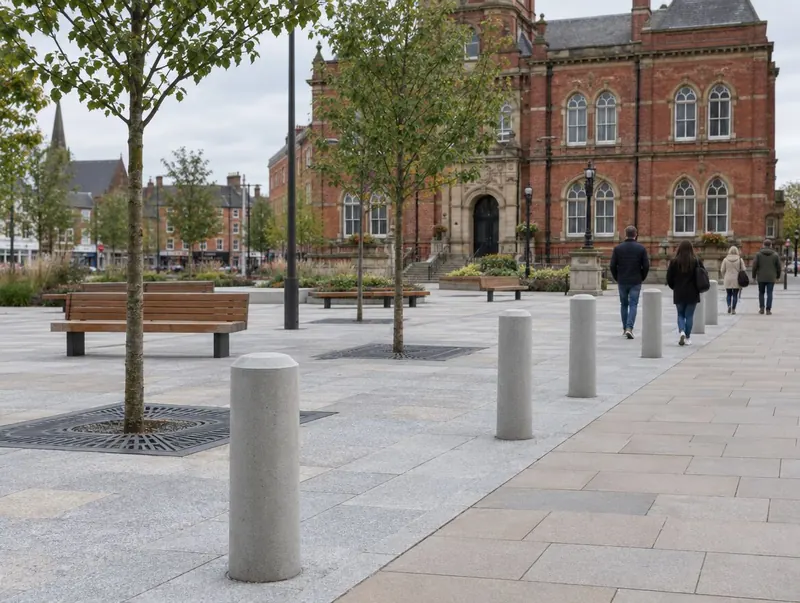 Computer-generated image
Concrete bollards in Linlithgow
We supply and fit concrete bollards throughout Linlithgow, typically for sites such as small industrial units, local parades and community car parks. Precast concrete and reconstituted stone bollards for public realm, parks, boundaries and estates, dowelled or bedded in place.
Coverage in Linlithgow takes in the EH49 postcode district and nearby places like Philpstoun and Old Philpstoun. Jobs in Linlithgow can be combined with work in Bo'ness (2.8 miles), Grangemouth (5.2 miles), Bathgate (5.4 miles) and Broxburn (5.9 miles) (straight-line distances). Linlithgow is about 16 miles from Edinburgh.
Local details
- Area
- West Lothian, Scotland
- Roads authority
- West Lothian Council (local roads)
- Planning authority
- West Lothian Council
- Postcodes
- EH49
- Guide price
- Typically £175–£595 per bollard + VAT; minimum job £595
- Survey
- Free, with a fixed written quote
- Nearby
- Bo'ness (2.8 mi), Grangemouth (5.2 mi), Bathgate (5.4 mi), Broxburn (5.9 mi)
Concrete bollards in Linlithgow: common uses
Around Linlithgow, concrete bollards usually solve one of these:
- Housing estates and communal areas
- Town centre squares and pedestrianised streets
- School, library and civic building forecourts
Concrete bollard prices in Linlithgow
| Specification | Guide price | Includes |
|---|---|---|
| Standard | £175–£355 + VAT | Standard post, foundation, reinstatement |
| Upgraded | £305–£475 + VAT | Upgraded finish or fittings, reflective band, matched keys |
| Premium | £425–£595 + VAT | Heavy-duty or architectural spec, premium finish |
Per bollard, supplied and installed; no regional adjustment. Guide only — the fixed price follows a survey.
What we check first in Linlithgow
In Scotland the council is the roads authority for local roads, which in Linlithgow means West Lothian Council. Concrete bollards on an adopted footway need its consent; trunk roads sit with Transport Scotland.
Bollards on private land often need no planning application, but listed buildings and conservation areas are different; the planning service at West Lothian Council can confirm before anything is ordered.
Because concrete bollards are heavy, a weak foundation shows itself quickly as a tilt. Services under footways are traced before excavation.
- On public highway or council land, agree positions and specification with the roads authority or landowner.
- Plan lifts with an exclusion zone and suitable lifting equipment, and record the method for the site.
What happens on site
Plan lifting
Each bollard's weight is checked, and a lifting method is chosen, such as a vacuum lifter or crane arm, with an exclusion zone set during lifts.
Reinstate and clean
Paving is made good around each base and the bollards are cleaned of mortar and handling marks.
Protect while the grout cures
Bollards are left undisturbed until the grout and foundation have gained strength, with temporary barriers if vehicles use the area. Lines that need to open to traffic quickly can use faster-setting grouts where the product allows.
Choosing the right spec
| Option | Detail |
|---|---|
| Planters and blocks | Concrete planters and seating blocks used in place of bollards where a softer look is wanted. |
| Reflective and contrasting details | Inset reflective bands, contrasting tops or rings for visibility to drivers and partially sighted pedestrians. |
| Reconstituted stone | Crushed natural stone in a concrete mix, giving a Portland, buff or granite-like appearance for civic and heritage settings. |
Pricing concrete bollards in Linlithgow
Our Scotland guide prices are a starting point; the survey in Linlithgow firms them up. What tends to move them:
- Precast concrete or reconstituted stone
- Size, shape and surface finish
- Reinstatement of paving or turf
Keeping them working
Small chips can be repaired with a colour-matched mortar, but a bollard that has cracked through or sheared at the dowel needs replacing. Concrete bollards need very little: occasional washing, removal of graffiti with suitable cleaners, and checks for chips, cracks and lean.
For damaged or loose posts in Linlithgow, repairs and replacements are priced in writing first.
Common questions
Do you install concrete bollards in Linlithgow?
We cover all of Linlithgow (EH49) and the rest of West Lothian. We also work in Bo'ness, Grangemouth and Bathgate.
Who gives permission for bollards on the pavement in Linlithgow?
In Scotland the council is the roads authority for local roads, which in Linlithgow means West Lothian Council. Concrete bollards on an adopted footway need its consent; trunk roads sit with Transport Scotland.
What's a typical price for concrete bollards in Linlithgow?
In Linlithgow, typically £175–£595 per bollard, supplied and installed, plus VAT, with a minimum job of £595 plus VAT, using our Scotland guide prices. The fixed figure comes in writing after we've seen the site.
How are concrete bollards fixed down?
Usually with a steel dowel at the base grouted into a small concrete foundation, so they cannot be pushed or rocked. Some designs have a root buried in the ground instead. Free-standing placement is used only for temporary layouts.
How heavy are concrete bollards?
Often well over a hundred kilograms each, and larger designs several times that. The exact weight depends on size and shape. It means they are delivered and set using lifting equipment rather than by hand.
Concrete bollards in nearby towns
- Bo'ness (2.8 mi)
- Grangemouth (5.2 mi)
- Bathgate (5.4 mi)
- Broxburn (5.9 mi)
- Livingston (6 mi)
- Falkirk (7.2 mi)