Fife · Scotland
Crash-rated bollard installation in Rosyth
Local installation of crash-rated bollards in Rosyth — free survey, fixed written price, and posts set to the right spacing for people and vehicles.
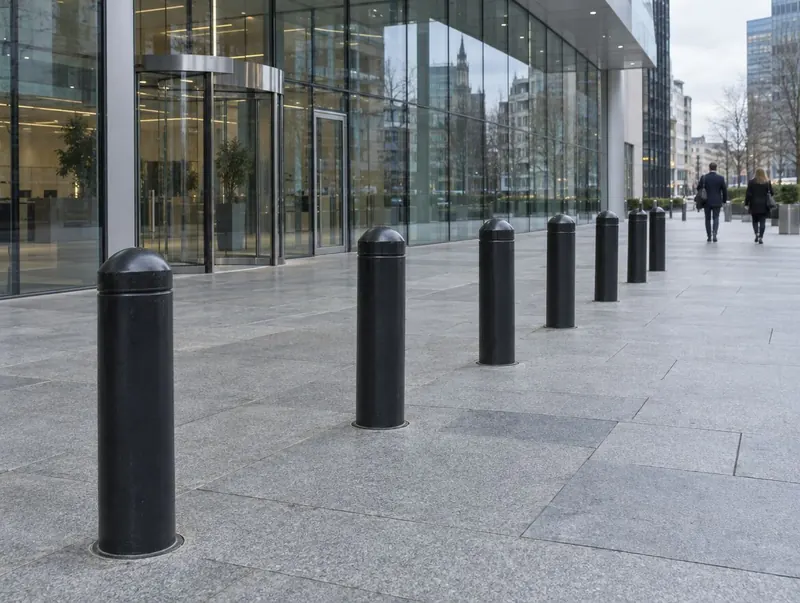 Computer-generated image
About crash-rated bollards in Rosyth
The rating only holds when the bollard is installed to the same foundation design that was tested. In Rosyth, that tends to mean sites such as town-centre squares, filling-station forecourts and small industrial units.
We cover Rosyth's KY11 postcode district, including places such as Dalgety Bay, Inverkeithing, Limekilns and North Queensferry. Jobs in Rosyth can be combined with work in Dunfermline (2.5 miles), Cowdenbeath (6.3 miles), Kirkcaldy (12.1 miles) and Alloa (14.6 miles) (straight-line distances).
Local details
- Area
- Fife, Scotland
- Roads authority
- Fife Council (local roads)
- Planning authority
- Fife Council
- Postcodes
- KY11
- Guide price
- Typically £1,995–£9,995 per bollard + VAT; minimum job £3,995
- Survey
- Free, with a fixed written quote
- Nearby
- Dunfermline (2.5 mi), Cowdenbeath (6.3 mi), Kirkcaldy (12.1 mi), Alloa (14.6 mi)
Crash-rated bollard prices in Rosyth
| Specification | Guide price | Includes |
|---|---|---|
| Standard | £1,995–£5,345 + VAT | Rated for a 7.5 t vehicle at 30 mph (48 km/h), tested foundation |
| Upgraded | £4,395–£7,745 + VAT | Rated for 7.5 t at 40 mph (64 km/h), tested foundation |
| Premium | £6,795–£9,995 + VAT | Rated for 7.5 t at 50 mph (80 km/h), or a specialist foundation |
Per bollard, supplied and installed on a standard tested foundation; no regional adjustment. Guide only — the fixed price follows a survey.
What Rosyth sites use crash-rated bollards for
Around Rosyth, crash-rated bollards usually solve one of these:
- Glazed frontages on corporate and public buildings
- Data centres, utilities and critical infrastructure perimeters
- Stadiums, arenas and event venues with predictable crowd flows
What we check first in Rosyth
Rosyth falls under Fife Council as roads authority. If the line of posts crosses onto adopted road or pavement, permission comes before excavation; on private land it does not.
Bollards on private land often need no planning application, but listed buildings and conservation areas are different; the planning service at Fife Council can confirm before anything is ordered.
Utility records, radar scanning and hand-dug trial holes come before any machine work, and service diversions can take longer than the bollard installation itself. Reinstatement matches paving, tactile surfaces and kerbs.
- Agree how emergency vehicles will get through, and refer to guidance on selecting and installing vehicle security barriers such as PAS 69 or ISO 22343-2.
- Balance the gaps: narrow enough to stop a vehicle, typically no more than about 1,200 mm, but wide enough for wheelchair users and buggies — check against Inclusive Mobility guidance.
What happens on site
Free site survey and ground checks
A free site survey looks at access, surfaces and likely services, followed by utility searches, radar scanning and trial holes where needed. You then receive a fixed written quote based on what the survey found.
Set out and excavate
Positions are set out to the drawing and excavated to the tested depth and width, with shoring where the ground needs it. Spoil is removed as work progresses.
Fix reinforcement and set the posts
The reinforcement cage is built to the drawing and the bollards are held to line and level in templates. Concrete is poured to the specified grade, with samples taken for testing if the specification calls for them.
Choosing the right spec
| Option | Detail |
|---|---|
| Static rated bollards | Fixed posts for permanent lines where vehicles never need to pass. They are a straightforward rated option to install and maintain. |
| Heights and diameters | Exposed heights are commonly around 800 to 1,000 mm, with core diameters varying by model and rating. Larger diameters are not always needed to achieve a given rating. |
| Finishes and visibility bands | Galvanised and powder-coated finishes in RAL colours, with contrasting or reflective bands near the top so the posts are visible to pedestrians and drivers. |
What moves the price in Rosyth
Our Scotland guide prices are a starting point; the survey in Rosyth firms them up. What tends to move them:
- Traffic management, restricted working hours or night work in occupied sites
- Buried services, diversions and ground investigation
- The rating required and the product range that achieves it
After installation
A rated bollard that has stopped a vehicle has done its job and should be assessed with the manufacturer; in most cases the post, and sometimes the foundation insert, is replaced rather than straightened. Static rated bollards need little routine work, but they should be inspected periodically and always after any impact.
If posts in Rosyth are later hit or damaged, we can repair or replace them — see bollard repairs.
Common questions
Can you install crash-rated bollards anywhere in Rosyth?
We cover all of Rosyth (KY11) and the rest of Fife. We also work in Dunfermline, Cowdenbeath and Kirkcaldy.
Who gives permission for bollards on the pavement in Rosyth?
In Scotland the council is the roads authority for local roads, which in Rosyth means Fife Council. Crash-rated bollards on an adopted footway need its consent; trunk roads sit with Transport Scotland.
What's a typical price for crash-rated bollards in Rosyth?
In Rosyth, typically £1,995–£9,995 per bollard, supplied and installed on a standard tested foundation, plus VAT, with a minimum job of £3,995 plus VAT, using our Scotland guide prices. The fixed figure comes in writing after we've seen the site.
Why can't the foundation be adjusted to suit our ground?
Because the rating belongs to the bollard and foundation as tested together. Making the hole shallower, narrower or lighter on steel changes how the system behaves on impact. If site conditions force a change, the manufacturer has to approve it in writing, and some changes mean choosing a different product such as a shallow-mount system.
What does a crash rating code actually tell me?
It tells you the vehicle used in the test, how fast it was travelling, the angle it hit at and how far it got past the bollard line. Your security adviser compares those figures with the vehicle and speed achievable on your approach. A rating that does not match the site's real risk is either more than you need or not enough.
Crash-rated bollards in nearby towns
- Dunfermline (2.5 mi)
- Cowdenbeath (6.3 mi)
- Kirkcaldy (12.1 mi)
- Alloa (14.6 mi)
- Glenrothes (15 mi)
- Tullibody (16.8 mi)