Greater Manchester · England
Crash-rated bollard installation in Denton
Local installation of crash-rated bollards in Denton — free survey, fixed written price, and posts set to the right spacing for people and vehicles.
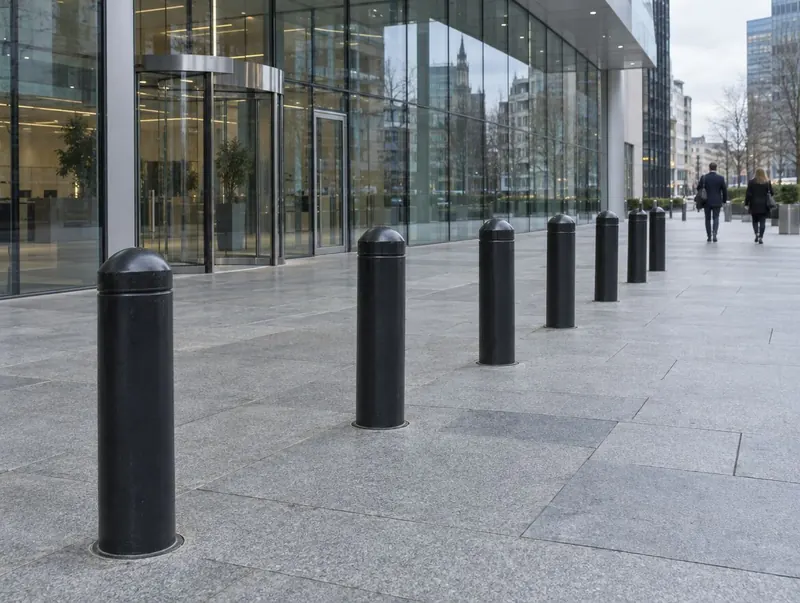 Computer-generated image
Crash-rated bollards in Denton
We supply and fit crash-rated bollards throughout Denton, typically for sites such as small industrial units, town-centre squares and schools. The rating only holds when the bollard is installed to the same foundation design that was tested.
We cover every part of Denton in the M34 postcode district. We also cover neighbouring Hyde (1.6 miles), Dukinfield (1.8 miles), Droylsden (2 miles) and Ashton-under-Lyne (2.3 miles) — distances are straight-line. Manchester is around 5 miles away.
Local details
- Area
- Greater Manchester, England
- Highway authority
- Tameside Council (local roads)
- Planning authority
- Tameside Council
- Postcodes
- M34
- Guide price
- Typically £1,945–£9,795 per bollard + VAT; minimum job £3,895
- Survey
- Free, with a fixed written quote
- Nearby
- Hyde (1.6 mi), Dukinfield (1.8 mi), Droylsden (2 mi), Ashton-under-Lyne (2.3 mi)
Crash-rated bollards in Denton: common uses
Around Denton, crash-rated bollards usually solve one of these:
- Data centres, utilities and critical infrastructure perimeters
- Glazed frontages on corporate and public buildings
- Building entrances and forecourts flagged in a security risk assessment
Crash-rated bollard prices in Denton
| Specification | Guide price | Includes |
|---|---|---|
| Standard | £1,945–£5,245 + VAT | Rated for a 7.5 t vehicle at 30 mph (48 km/h), tested foundation |
| Upgraded | £4,295–£7,595 + VAT | Rated for 7.5 t at 40 mph (64 km/h), tested foundation |
| Premium | £6,645–£9,795 + VAT | Rated for 7.5 t at 50 mph (80 km/h), or a specialist foundation |
Per bollard, supplied and installed on a standard tested foundation; -2% for North West. Guide only — the fixed price follows a survey.
Consents, ground and services in Denton
The highway authority for local roads in Denton is Tameside Council; motorways and trunk roads sit with National Highways. Crash-rated bollards on the adopted footway are a matter for the highway authority, so we only install there with its written agreement.
Many private-land installations in Denton need no planning application, but the rules don't clearly cover bollards, so listed buildings, conservation areas and prominent frontages are worth raising with the planning team at Tameside Council before posts go in.
Footways and forecourts in towns are usually crowded with cables, gas mains, water pipes and old drainage, and a single unexpected duct can stop a bollard position. Made ground, a high water table or soft clay may need an engineer to confirm the tested design suits the site; any change to depth, width or reinforcement must be agreed in writing by the manufacturer, or the rating may no longer apply.
- Confirm who owns the land: works on public highway usually need the highway authority's agreement, and permanent street furniture there may need a licence.
- Ask the local planning authority whether consent is needed, particularly in conservation areas or near listed buildings.
How the job runs
Free site survey and ground checks
A free site survey looks at access, surfaces and likely services, followed by utility searches, radar scanning and trial holes where needed. You then receive a fixed written quote based on what the survey found.
Fix reinforcement and set the posts
The reinforcement cage is built to the drawing and the bollards are held to line and level in templates. Concrete is poured to the specified grade, with samples taken for testing if the specification calls for them.
Cure, protect and reinstate
The posts are protected while the concrete gains strength, and the surface is reinstated to match. The line should not be treated as fully effective until the specified curing period has passed.
Choosing the right spec
| Option | Detail |
|---|---|
| Deep or standard foundation designs | Deep foundations suit open ground where excavation is unrestricted. Where services or slabs get in the way, shallow-mount tested designs may be a better fit. |
| Finishes and visibility bands | Galvanised and powder-coated finishes in RAL colours, with contrasting or reflective bands near the top so the posts are visible to pedestrians and drivers. |
| Decorative covers | Stainless steel, cast or polymer sleeves can be fitted over the steel core to suit a streetscape. Use covers supplied or approved by the manufacturer so the tested product is not altered. |
What affects the quote
When we price crash-rated bollards in Denton, these make the biggest difference:
- Depth and volume of excavation, reinforcement and concrete
- Buried services, diversions and ground investigation
- Covers, finishes and any integrated lighting
After installation
Keep inspection records with the original test certificate so the line's condition can be shown to insurers or a security adviser. Static rated bollards need little routine work, but they should be inspected periodically and always after any impact.
We can also service, repair or replace existing posts anywhere in Denton.
Common questions
Do you install crash-rated bollards in Denton?
We cover all of Denton (M34) and the rest of Greater Manchester. We also work in Hyde, Dukinfield and Droylsden.
Who gives permission for bollards on the pavement in Denton?
In Denton, work on adopted pavements and verges needs consent from Tameside Council, the local highway authority. Car parks, forecourts and other private land only need the owner's permission.
What's a typical price for crash-rated bollards in Denton?
In Denton, typically £1,945–£9,795 per bollard, supplied and installed on a standard tested foundation, plus VAT, with a minimum job of £3,895 plus VAT, using our North West guide prices. The fixed figure comes in writing after we've seen the site.
Why can't the foundation be adjusted to suit our ground?
Because the rating belongs to the bollard and foundation as tested together. Making the hole shallower, narrower or lighter on steel changes how the system behaves on impact. If site conditions force a change, the manufacturer has to approve it in writing, and some changes mean choosing a different product such as a shallow-mount system.
When can we rely on the new bollards?
Only once the concrete has reached the strength set in the specification. The posts are physically in place as soon as the pour is finished, but the rated performance depends on the foundation, and full design strength is commonly taken at around 28 days. Your adviser may arrange temporary measures to cover the gap.
Crash-rated bollards near Denton
- Hyde (1.6 mi)
- Dukinfield (1.8 mi)
- Droylsden (2 mi)
- Ashton-under-Lyne (2.3 mi)
- Stalybridge (3.1 mi)
- Stockport (3.6 mi)