Herefordshire · England
Crash-rated bollard installation in Leominster
Crash-rated bollards supplied and fitted in Leominster, Herefordshire: surveyed, scanned for services, set in proper foundations and finished to match the ground.
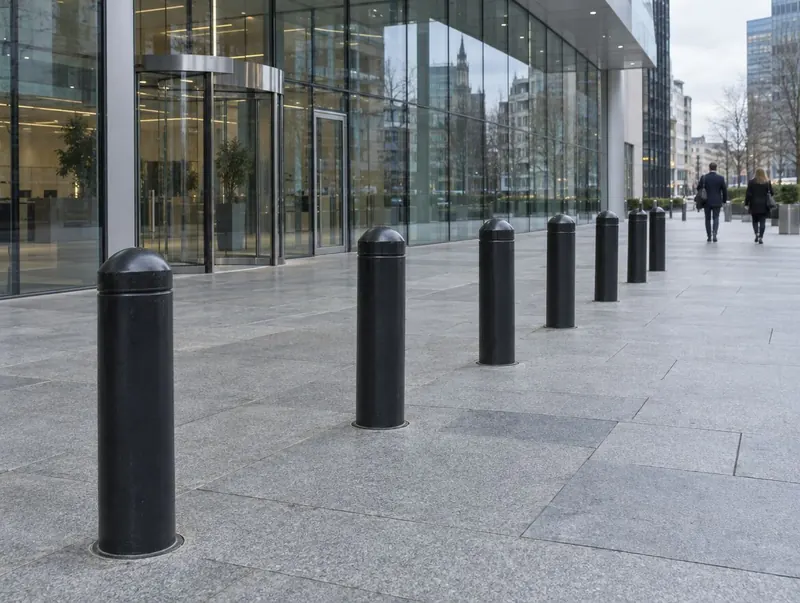 Computer-generated image
About crash-rated bollards in Leominster
We supply and fit crash-rated bollards throughout Leominster, typically for sites such as filling-station forecourts, town-centre squares and small industrial units. The rating only holds when the bollard is installed to the same foundation design that was tested.
Coverage in Leominster takes in the HR6 postcode district and nearby places like Kingsland, Pembridge, Shobdon and Wigmore. Jobs in Leominster can be combined with work in Hereford (11.7 miles), Great Malvern (19.5 miles) and Stourport-on-Severn (21.2 miles) (straight-line distances). Wolverhampton is around 36 miles away.
Key facts for this area
- Area
- Herefordshire, England
- Highway authority
- Herefordshire Council (local roads)
- Planning authority
- Herefordshire Council
- Postcodes
- HR6
- Guide price
- Typically £1,995–£9,995 per bollard + VAT; minimum job £3,995
- Survey
- Free, with a fixed written quote
- Nearby
- Hereford (11.7 mi), Great Malvern (19.5 mi), Stourport-on-Severn (21.2 mi)
Typical crash-rated bollards jobs in Leominster
Around Leominster, crash-rated bollards usually solve one of these:
- Data centres, utilities and critical infrastructure perimeters
- Stadiums, arenas and event venues with predictable crowd flows
- Sites where a vehicle dynamics assessment shows a long straight run-up
Crash-rated bollard prices in Leominster
| Specification | Guide price | Includes |
|---|---|---|
| Standard | £1,995–£5,345 + VAT | Rated for a 7.5 t vehicle at 30 mph (48 km/h), tested foundation |
| Upgraded | £4,395–£7,745 + VAT | Rated for 7.5 t at 40 mph (64 km/h), tested foundation |
| Premium | £6,795–£9,995 + VAT | Rated for 7.5 t at 50 mph (80 km/h), or a specialist foundation |
Per bollard, supplied and installed on a standard tested foundation; no regional adjustment. Guide only — the fixed price follows a survey.
What we check first in Leominster
In Leominster, work on adopted pavements and verges needs consent from Herefordshire Council, the local highway authority. Car parks, forecourts and other private land only need the owner's permission.
If your site in Leominster is listed or inside a conservation area, check with the local planning authority (Herefordshire Council) before choosing a finish — heritage settings often favour cast iron or painted steel over stainless.
Rated foundations are large, and excavation is often where projects run into trouble. Utility records, radar scanning and hand-dug trial holes come before any machine work, and service diversions can take longer than the bollard installation itself.
- Ask the local planning authority whether consent is needed, particularly in conservation areas or near listed buildings.
- Balance the gaps: narrow enough to stop a vehicle, typically no more than about 1,200 mm, but wide enough for wheelchair users and buggies — check against Inclusive Mobility guidance.
Installation, step by step
Set out and excavate
Positions are set out to the drawing and excavated to the tested depth and width, with shoring where the ground needs it. Spoil is removed as work progresses.
Fix reinforcement and set the posts
The reinforcement cage is built to the drawing and the bollards are held to line and level in templates. Concrete is poured to the specified grade, with samples taken for testing if the specification calls for them.
Cure, protect and reinstate
The posts are protected while the concrete gains strength, and the surface is reinstated to match. The line should not be treated as fully effective until the specified curing period has passed.
Specification choices
| Option | Detail |
|---|---|
| Finishes and visibility bands | Galvanised and powder-coated finishes in RAL colours, with contrasting or reflective bands near the top so the posts are visible to pedestrians and drivers. |
| Deep or standard foundation designs | Deep foundations suit open ground where excavation is unrestricted. Where services or slabs get in the way, shallow-mount tested designs may be a better fit. |
| Static rated bollards | Fixed posts for permanent lines where vehicles never need to pass. They are a straightforward rated option to install and maintain. |
Pricing crash-rated bollards in Leominster
Our West Midlands guide prices are a starting point; the survey in Leominster firms them up. What tends to move them:
- The rating required and the product range that achieves it
- Number of posts and whether a linked beam system is needed
- Traffic management, restricted working hours or night work in occupied sites
Looking after them
Keep inspection records with the original test certificate so the line's condition can be shown to insurers or a security adviser. Static rated bollards need little routine work, but they should be inspected periodically and always after any impact.
We can also service, repair or replace existing posts anywhere in Leominster.
Common questions
Do you install crash-rated bollards in Leominster?
We cover all of Leominster (HR6) and the rest of Herefordshire. We also work in Hereford, Great Malvern and Stourport-on-Severn.
Who gives permission for bollards on the pavement in Leominster?
Herefordshire Council is the highway authority covering Leominster's local roads. If any post would stand on adopted highway rather than your land, that consent is the first thing we sort out.
How much do crash-rated bollards cost in Leominster?
In Leominster, typically £1,995–£9,995 per bollard, supplied and installed on a standard tested foundation, plus VAT, with a minimum job of £3,995 plus VAT, using our West Midlands guide prices. The fixed figure comes in writing after we've seen the site.
Is a heavy unrated steel post good enough instead?
Not where the risk is a deliberate vehicle attack. An unrated post may look solid, but nobody can say what it will stop because it has never been tested with its foundation. Unrated steel suits nuisance parking and low-speed knocks, not crowds or buildings flagged in a security assessment.
Why can't the foundation be adjusted to suit our ground?
Because the rating belongs to the bollard and foundation as tested together. Making the hole shallower, narrower or lighter on steel changes how the system behaves on impact. If site conditions force a change, the manufacturer has to approve it in writing, and some changes mean choosing a different product such as a shallow-mount system.