Midlothian · Scotland
Crash-rated bollard installation in Dalkeith
Planning crash-rated bollards in Dalkeith? We check ownership, consents and buried services first, then quote a fixed price.
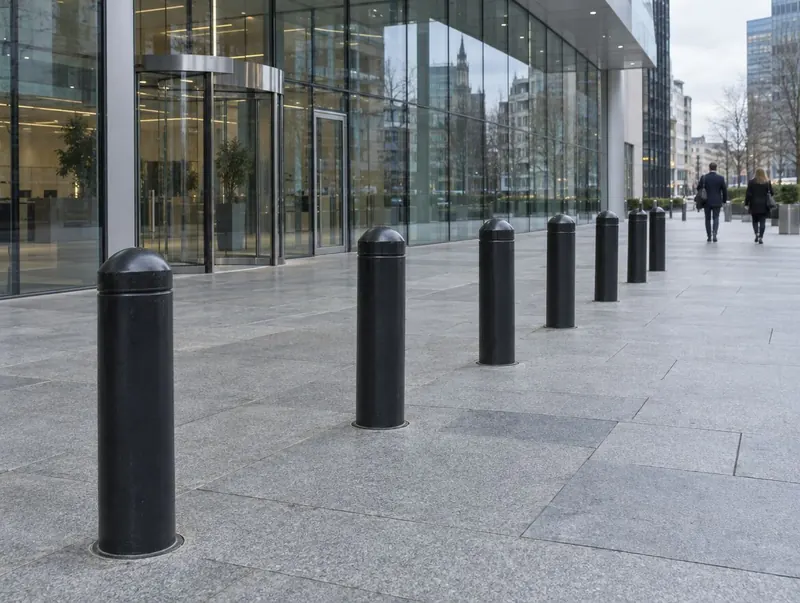 Computer-generated image
Dalkeith crash-rated bollards
From high street shopfronts, town-centre squares and small industrial units, Dalkeith has plenty of places where crash-rated bollards earn their keep. The rating only holds when the bollard is installed to the same foundation design that was tested.
We work across EH22 and EH37 — Dalkeith itself and places including Newtongrange, Danderhall, Easthouses and Millerhill. Jobs in Dalkeith can be combined with work in Bonnyrigg (2 miles), Musselburgh (3.4 miles), Tranent (5.7 miles) and Edinburgh (6.4 miles) (straight-line distances). It sits roughly 6 miles from Edinburgh as the crow flies.
Key facts for this area
- Area
- Midlothian, Scotland
- Roads authority
- Midlothian Council (local roads)
- Planning authority
- Midlothian Council
- Postcodes
- EH22 and EH37
- Guide price
- Typically £1,995–£9,995 per bollard + VAT; minimum job £3,995
- Survey
- Free, with a fixed written quote
- Nearby
- Bonnyrigg (2 mi), Musselburgh (3.4 mi), Tranent (5.7 mi), Edinburgh (6.4 mi)
Dalkeith: typical crash-rated bollard prices
| Specification | Guide price | Includes |
|---|---|---|
| Standard | £1,995–£5,345 + VAT | Rated for a 7.5 t vehicle at 30 mph (48 km/h), tested foundation |
| Upgraded | £4,395–£7,745 + VAT | Rated for 7.5 t at 40 mph (64 km/h), tested foundation |
| Premium | £6,795–£9,995 + VAT | Rated for 7.5 t at 50 mph (80 km/h), or a specialist foundation |
Per bollard, supplied and installed on a standard tested foundation; no regional adjustment. Guide only — the fixed price follows a survey.
Typical crash-rated bollards jobs in Dalkeith
Common uses in a place like Dalkeith:
- Data centres, utilities and critical infrastructure perimeters
- Transport interchanges, taxi ranks and drop-off zones
- Sites where a vehicle dynamics assessment shows a long straight run-up
Before we dig in Dalkeith
Dalkeith falls under Midlothian Council as roads authority. If the line of posts crosses onto adopted road or pavement, permission comes before excavation; on private land it does not.
Many private-land installations in Dalkeith need no planning application, but the rules don't clearly cover bollards, so listed buildings, conservation areas and prominent frontages are worth raising with the planning team at Midlothian Council before posts go in.
Rated foundations are large, and excavation is often where projects run into trouble. Reinstatement matches paving, tactile surfaces and kerbs.
- Ask the local planning authority whether consent is needed, particularly in conservation areas or near listed buildings.
- Check that the test certificate matches the exact model, configuration and foundation being installed, and keep it with the site records.
How the job runs
Start from the specification
We work from the specification issued by your security adviser or the manufacturer: product, rating, positions and foundation drawing. If no specification exists yet, we can put you in touch with the manufacturer's technical team, but we do not set the threat level ourselves.
Set out and excavate
Positions are set out to the drawing and excavated to the tested depth and width, with shoring where the ground needs it. Spoil is removed as work progresses.
Cure, protect and reinstate
The posts are protected while the concrete gains strength, and the surface is reinstated to match. The line should not be treated as fully effective until the specified curing period has passed.
Specification choices
| Option | Detail |
|---|---|
| Heights and diameters | Exposed heights are commonly around 800 to 1,000 mm, with core diameters varying by model and rating. Larger diameters are not always needed to achieve a given rating. |
| Deep or standard foundation designs | Deep foundations suit open ground where excavation is unrestricted. Where services or slabs get in the way, shallow-mount tested designs may be a better fit. |
| Decorative covers | Stainless steel, cast or polymer sleeves can be fitted over the steel core to suit a streetscape. Use covers supplied or approved by the manufacturer so the tested product is not altered. |
Pricing crash-rated bollards in Dalkeith
Our Scotland guide prices are a starting point; the survey in Dalkeith firms them up. What tends to move them:
- The rating required and the product range that achieves it
- Depth and volume of excavation, reinforcement and concrete
- Traffic management, restricted working hours or night work in occupied sites
Keeping them working
Static rated bollards need little routine work, but they should be inspected periodically and always after any impact. Look for cracked surfacing at the base, movement, damaged covers and faded bands.
For damaged or loose posts in Dalkeith, repairs and replacements are priced in writing first.
Questions about crash-rated bollards in Dalkeith
Do you install crash-rated bollards in Dalkeith?
We cover all of Dalkeith (EH22 and EH37) and the rest of Midlothian. We also work in Bonnyrigg, Musselburgh and Tranent.
Do I need consent for crash-rated bollards on a public footway in Dalkeith?
In Scotland the council is the roads authority for local roads, which in Dalkeith means Midlothian Council. Crash-rated bollards on an adopted footway need its consent; trunk roads sit with Transport Scotland.
How much do crash-rated bollards cost in Dalkeith?
In Dalkeith, typically £1,995–£9,995 per bollard, supplied and installed on a standard tested foundation, plus VAT, with a minimum job of £3,995 plus VAT, using our Scotland guide prices. The fixed figure comes in writing after we've seen the site.
Is a heavy unrated steel post good enough instead?
Not where the risk is a deliberate vehicle attack. An unrated post may look solid, but nobody can say what it will stop because it has never been tested with its foundation. Unrated steel suits nuisance parking and low-speed knocks, not crowds or buildings flagged in a security assessment.
Why can't the foundation be adjusted to suit our ground?
Because the rating belongs to the bollard and foundation as tested together. Making the hole shallower, narrower or lighter on steel changes how the system behaves on impact. If site conditions force a change, the manufacturer has to approve it in writing, and some changes mean choosing a different product such as a shallow-mount system.
Crash-rated bollards in nearby towns
- Bonnyrigg (2 mi)
- Musselburgh (3.4 mi)
- Tranent (5.7 mi)
- Edinburgh (6.4 mi)
- Penicuik (7.5 mi)
- South Queensferry (14.5 mi)