Moray · Scotland
Crash-rated bollard installation in Forres
Planning crash-rated bollards in Forres? We check ownership, consents and buried services first, then quote a fixed price.
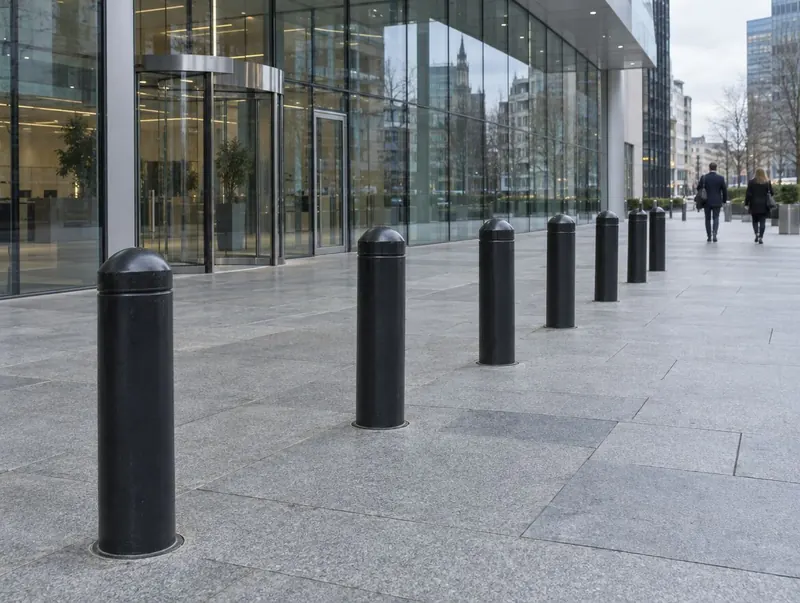 Computer-generated image
Forres crash-rated bollards
We supply and fit crash-rated bollards throughout Forres, typically for sites such as community car parks, town-centre squares and schools. The rating only holds when the bollard is installed to the same foundation design that was tested.
We work across IV36 — Forres itself and places including Kinloss, Findhorn, Mundole and Red Craig. Jobs in Forres can be combined with work in Nairn (9.8 miles) and Elgin (11.5 miles) (straight-line distances).
Key facts for this area
- Area
- Moray, Scotland
- Roads authority
- Moray Council (local roads)
- Planning authority
- Moray Council
- Postcodes
- IV36
- Guide price
- Typically £1,995–£9,995 per bollard + VAT; minimum job £3,995
- Survey
- Free, with a fixed written quote
Guide prices for Forres
| Specification | Guide price | Includes |
|---|---|---|
| Standard | £1,995–£5,345 + VAT | Rated for a 7.5 t vehicle at 30 mph (48 km/h), tested foundation |
| Upgraded | £4,395–£7,745 + VAT | Rated for 7.5 t at 40 mph (64 km/h), tested foundation |
| Premium | £6,795–£9,995 + VAT | Rated for 7.5 t at 50 mph (80 km/h), or a specialist foundation |
Per bollard, supplied and installed on a standard tested foundation; no regional adjustment. Guide only — the fixed price follows a survey.
What Forres sites use crash-rated bollards for
Typical reasons Forres sites choose crash-rated bollards:
- Building entrances and forecourts flagged in a security risk assessment
- Stadiums, arenas and event venues with predictable crowd flows
- Transport interchanges, taxi ranks and drop-off zones
Permissions and groundwork in Forres
For anything on the public footway in Forres we check with the roads authority first — Moray Council for local roads, Transport Scotland on trunk routes. Private ground such as a car park or forecourt only needs the owner's go-ahead.
Bollards on private land often need no planning application, but listed buildings and conservation areas are different; the planning service at Moray Council can confirm before anything is ordered.
Reinstatement matches paving, tactile surfaces and kerbs. Made ground, a high water table or soft clay may need an engineer to confirm the tested design suits the site; any change to depth, width or reinforcement must be agreed in writing by the manufacturer, or the rating may no longer apply.
- Balance the gaps: narrow enough to stop a vehicle, typically no more than about 1,200 mm, but wide enough for wheelchair users and buggies — check against Inclusive Mobility guidance.
- Check that the test certificate matches the exact model, configuration and foundation being installed, and keep it with the site records.
How the job runs
Set out and excavate
Positions are set out to the drawing and excavated to the tested depth and width, with shoring where the ground needs it. Spoil is removed as work progresses.
Fix reinforcement and set the posts
The reinforcement cage is built to the drawing and the bollards are held to line and level in templates. Concrete is poured to the specified grade, with samples taken for testing if the specification calls for them.
Hand over a build record
You receive photographs of the reinforcement and excavation before each pour, concrete delivery tickets, as-built positions and the manufacturer's product certification, ready for your adviser and insurers.
Finishes and options
| Option | Detail |
|---|---|
| Decorative covers | Stainless steel, cast or polymer sleeves can be fitted over the steel core to suit a streetscape. Use covers supplied or approved by the manufacturer so the tested product is not altered. |
| Deep or standard foundation designs | Deep foundations suit open ground where excavation is unrestricted. Where services or slabs get in the way, shallow-mount tested designs may be a better fit. |
| Heights and diameters | Exposed heights are commonly around 800 to 1,000 mm, with core diameters varying by model and rating. Larger diameters are not always needed to achieve a given rating. |
What affects the quote
Our Scotland guide prices are a starting point; the survey in Forres firms them up. What tends to move them:
- Depth and volume of excavation, reinforcement and concrete
- The rating required and the product range that achieves it
- Number of posts and whether a linked beam system is needed
Looking after them
Keep inspection records with the original test certificate so the line's condition can be shown to insurers or a security adviser. Static rated bollards need little routine work, but they should be inspected periodically and always after any impact.
For damaged or loose posts in Forres, repairs and replacements are priced in writing first.
Crash-rated bollards in Forres: FAQs
Do you install crash-rated bollards in Forres?
We cover all of Forres (IV36) and the rest of Moray. We also work in Nairn and Elgin.
Do I need consent for crash-rated bollards on a public footway in Forres?
In Scotland the council is the roads authority for local roads, which in Forres means Moray Council. Crash-rated bollards on an adopted footway need its consent; trunk roads sit with Transport Scotland.
How much do crash-rated bollards cost in Forres?
In Forres, typically £1,995–£9,995 per bollard, supplied and installed on a standard tested foundation, plus VAT, with a minimum job of £3,995 plus VAT, using our Scotland guide prices. The fixed figure comes in writing after we've seen the site.
What does a crash rating code actually tell me?
It tells you the vehicle used in the test, how fast it was travelling, the angle it hit at and how far it got past the bollard line. Your security adviser compares those figures with the vehicle and speed achievable on your approach. A rating that does not match the site's real risk is either more than you need or not enough.
Is a heavy unrated steel post good enough instead?
Not where the risk is a deliberate vehicle attack. An unrated post may look solid, but nobody can say what it will stop because it has never been tested with its foundation. Unrated steel suits nuisance parking and low-speed knocks, not crowds or buildings flagged in a security assessment.