West Yorkshire · England
Crash-rated bollard installation in Castleford
Local installation of crash-rated bollards in Castleford — free survey, fixed written price, and posts set to the right spacing for people and vehicles.
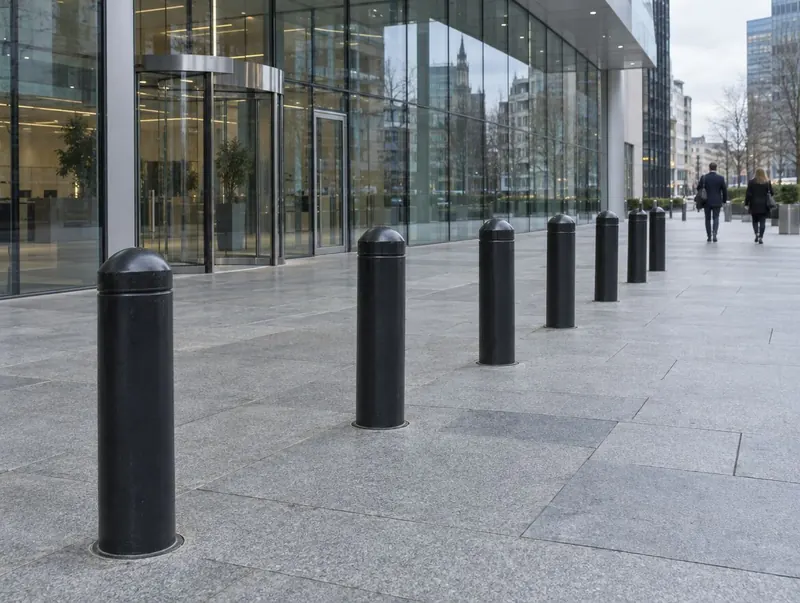 Computer-generated image
Castleford crash-rated bollards
Whether it's schools, filling-station forecourts and town-centre squares, crash-rated bollards in Castleford are planned around who needs to get through and who doesn't. The rating only holds when the bollard is installed to the same foundation design that was tested.
We work across WF10 and WF6 — Castleford itself and places including Normanton. We also cover neighbouring Pontefract (3.2 miles), Wakefield (6.3 miles), Leeds (9 miles) and Ossett (9.4 miles) — distances are straight-line. Castleford is about 9 miles from Leeds.
Castleford at a glance
- Area
- West Yorkshire, England
- Highway authority
- Wakefield Council (local roads)
- Planning authority
- Wakefield Council
- Postcodes
- WF10 and WF6
- Guide price
- Typically £1,945–£9,695 per bollard + VAT; minimum job £3,895
- Survey
- Free, with a fixed written quote
- Nearby
- Pontefract (3.2 mi), Wakefield (6.3 mi), Leeds (9 mi), Ossett (9.4 mi)
Where crash-rated bollards go in around Castleford
Typical reasons Castleford sites choose crash-rated bollards:
- Sites where a vehicle dynamics assessment shows a long straight run-up
- Pedestrianised streets, plazas and crowded public spaces
- Data centres, utilities and critical infrastructure perimeters
Guide prices for Castleford
| Specification | Guide price | Includes |
|---|---|---|
| Standard | £1,945–£5,195 + VAT | Rated for a 7.5 t vehicle at 30 mph (48 km/h), tested foundation |
| Upgraded | £4,245–£7,545 + VAT | Rated for 7.5 t at 40 mph (64 km/h), tested foundation |
| Premium | £6,595–£9,695 + VAT | Rated for 7.5 t at 50 mph (80 km/h), or a specialist foundation |
Per bollard, supplied and installed on a standard tested foundation; -3% for Yorkshire and the Humber. Guide only — the fixed price follows a survey.
What we check first in Castleford
Wakefield Council is the highway authority covering Castleford's local roads. If any post would stand on adopted highway rather than your land, that consent is the first thing we sort out.
Many private-land installations in Castleford need no planning application, but the rules don't clearly cover bollards, so listed buildings, conservation areas and prominent frontages are worth raising with the planning team at Wakefield Council before posts go in.
Reinstatement matches paving, tactile surfaces and kerbs. Utility records, radar scanning and hand-dug trial holes come before any machine work, and service diversions can take longer than the bollard installation itself.
- Ask the local planning authority whether consent is needed, particularly in conservation areas or near listed buildings.
- Agree how emergency vehicles will get through, and refer to guidance on selecting and installing vehicle security barriers such as PAS 69 or ISO 22343-2.
Installation, step by step
Fix reinforcement and set the posts
The reinforcement cage is built to the drawing and the bollards are held to line and level in templates. Concrete is poured to the specified grade, with samples taken for testing if the specification calls for them.
Cure, protect and reinstate
The posts are protected while the concrete gains strength, and the surface is reinstated to match. The line should not be treated as fully effective until the specified curing period has passed.
Hand over a build record
You receive photographs of the reinforcement and excavation before each pour, concrete delivery tickets, as-built positions and the manufacturer's product certification, ready for your adviser and insurers.
Options to consider
| Option | Detail |
|---|---|
| Decorative covers | Stainless steel, cast or polymer sleeves can be fitted over the steel core to suit a streetscape. Use covers supplied or approved by the manufacturer so the tested product is not altered. |
| Heights and diameters | Exposed heights are commonly around 800 to 1,000 mm, with core diameters varying by model and rating. Larger diameters are not always needed to achieve a given rating. |
| Deep or standard foundation designs | Deep foundations suit open ground where excavation is unrestricted. Where services or slabs get in the way, shallow-mount tested designs may be a better fit. |
What affects the quote
Two Castleford jobs with the same number of posts can price quite differently. The usual reasons:
- Traffic management, restricted working hours or night work in occupied sites
- Covers, finishes and any integrated lighting
- Reinstatement of natural stone, tactile paving or specialist surfaces
Keeping them working
A rated bollard that has stopped a vehicle has done its job and should be assessed with the manufacturer; in most cases the post, and sometimes the foundation insert, is replaced rather than straightened. Static rated bollards need little routine work, but they should be inspected periodically and always after any impact.
If posts in Castleford are later hit or damaged, we can repair or replace them — see bollard repairs.
Crash-rated bollards in Castleford: FAQs
Which parts of Castleford do you cover for crash-rated bollards?
We cover all of Castleford (WF10 and WF6) and the rest of West Yorkshire. We also work in Pontefract, Wakefield and Leeds.
Do I need consent for crash-rated bollards on a public footway in Castleford?
Wakefield Council is the highway authority covering Castleford's local roads. If any post would stand on adopted highway rather than your land, that consent is the first thing we sort out.
What's a typical price for crash-rated bollards in Castleford?
In Castleford, typically £1,945–£9,695 per bollard, supplied and installed on a standard tested foundation, plus VAT, with a minimum job of £3,895 plus VAT, using our Yorkshire and the Humber guide prices. The fixed figure comes in writing after we've seen the site.
What does a crash rating code actually tell me?
It tells you the vehicle used in the test, how fast it was travelling, the angle it hit at and how far it got past the bollard line. Your security adviser compares those figures with the vehicle and speed achievable on your approach. A rating that does not match the site's real risk is either more than you need or not enough.
What happens if a rated bollard is struck?
Make the area safe and have the post assessed before relying on it again. A rated bollard that has absorbed a serious impact is usually replaced, and the manufacturer may need to check the foundation or insert. We can install the replacement to the original tested detail.