Berkshire · England
Flexible bollard installation in Reading
Local installation of flexible bollards in Reading — free survey, fixed written price, and posts set to the right spacing for people and vehicles.
 Computer-generated image
Reading flexible bollards
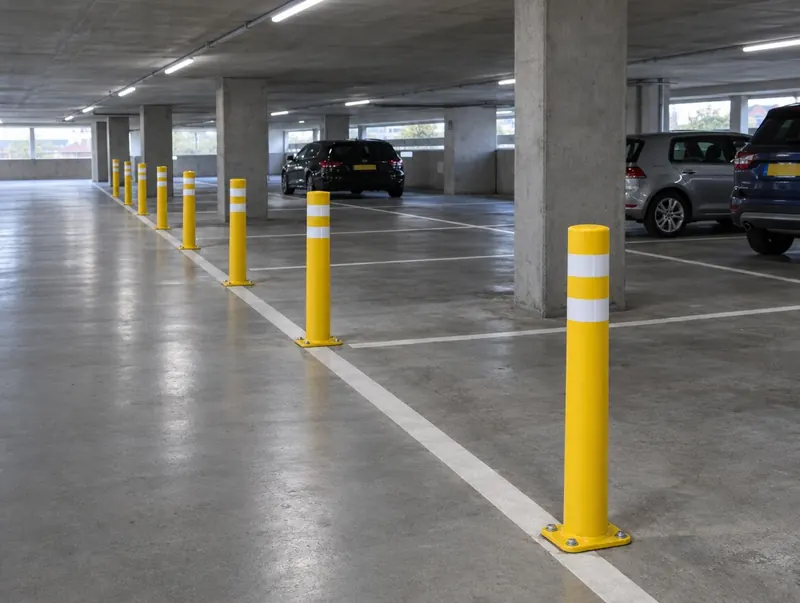
Whether it's industrial estates, supermarket frontages and high streets, flexible bollards in Reading are planned around who needs to get through and who doesn't. Polyurethane and spring-based bollards that bend when hit and return upright, for car parks, depots and lane separation.
Coverage in Reading takes in the RG1, RG30, RG6, RG2, RG31 and RG4 postcode districts. Jobs in Reading can be combined with work in Wokingham (6.6 miles), Crowthorne (9.7 miles), Bracknell (9.9 miles) and Yateley (9.9 miles) (straight-line distances). Swindon is around 36 miles away.
Local details
- Area
- Berkshire, England
- Highway authority
- Reading Council (local roads)
- Planning authority
- Reading Council
- Postcodes
- RG1, RG30, RG6, RG2, RG31 and RG4
- Guide price
- Typically £205–£635 per bollard + VAT; minimum job £465
- Survey
- Free, with a fixed written quote
- Nearby
- Wokingham (6.6 mi), Crowthorne (9.7 mi), Bracknell (9.9 mi), Yateley (9.9 mi)
Reading: typical flexible bollard prices
| Specification | Guide price | Includes |
|---|---|---|
| Standard | £205–£385 + VAT | Standard post, foundation, reinstatement |
| Upgraded | £335–£515 + VAT | Upgraded finish or fittings, reflective band, matched keys |
| Premium | £465–£635 + VAT | Heavy-duty or architectural spec, premium finish |
Per bollard, supplied and fixed; +6% for South East. Guide only — the fixed price follows a survey.
Where flexible bollards go in around Reading
Typical reasons Reading sites choose flexible bollards:
- Drive-thru lanes and fuel forecourts
- Depot and yard routes where vehicles knock posts daily
- Bus stations and coach parks
Consents, ground and services in Reading
The highway authority for local roads in Reading is Reading Council; motorways and trunk roads sit with National Highways. Flexible bollards on the adopted footway are a matter for the highway authority, so we only install there with its written agreement.
Many private-land installations in Reading need no planning application, but the rules don't clearly cover bollards, so listed buildings, conservation areas and prominent frontages are worth raising with the planning team at Reading Council before posts go in.
Anchors therefore need sound concrete with enough edge distance; anchoring into thin, cracked or weak surfaces means the base works loose within weeks. Multi-storey and rooftop decks are a special case: slabs may be post-tensioned or carry waterproofing and heating, so drilling depth and positions are agreed with the building owner and scanned first.
- Keep pedestrian gaps and routes clear, referring to Inclusive Mobility guidance where people walk through the line.
- Check drilling into car park decks or podium slabs with the building owner before fixing.
What happens on site
Set out the line
Posts are set out to guide vehicles along the intended path, with spacing that reads as a line to drivers.
Fix the bases
Holes are drilled and cleaned, resin anchors or bolts are set and the bases fixed and torqued once cured. Socket bases are set flush in concrete.
Fit posts and test
Posts are fitted and bent by hand to confirm they return upright, and reflective sleeves are applied.
Choosing the right spec
| Option | Detail |
|---|---|
| Heights and diameters | Commonly 750–1,000 mm high and around 80–200 mm diameter, with slimmer wand-style posts for lane lines. |
| Bolt-down or socket bases | Bolt-down for existing slabs; socket bases allow posts to be replaced without new fixings. |
| Low-profile deck bases | Shallow fixings for multi-storey decks where deep drilling is not permitted. |
What moves the price in Reading
Two Reading jobs with the same number of posts can price quite differently. The usual reasons:
- Polymer posts or sprung-base bollards
- Deck scanning and restrictions on drilling
- Bolt-down or socket base
After installation
After resurfacing or line repainting, check that the bases were not disturbed or painted over, and that posts still line up with the new markings. Posts exposed to strong sunlight slowly lose flexibility and colour, and eventually crack; replacing the post on its existing base is usually quick.
If posts in Reading are later hit or damaged, we can repair or replace them — see bollard repairs.
Flexible bollards in Reading: FAQs
Do you install flexible bollards in Reading?
We cover all of Reading (RG1, RG30, RG6, RG2, RG31 and RG4) and the rest of Berkshire. We also work in Wokingham, Crowthorne and Bracknell.
Do I need consent for flexible bollards on a public footway in Reading?
In Reading, work on adopted pavements and verges needs consent from Reading Council, the local highway authority. Car parks, forecourts and other private land only need the owner's permission.
How much do flexible bollards cost in Reading?
In Reading, typically £205–£635 per bollard, supplied and fixed, plus VAT, with a minimum job of £465 plus VAT, using our South East guide prices. The fixed figure comes in writing after we've seen the site.
Can flexible bollards go in a multi-storey car park?
Yes, often with low-profile bases. The deck has to be checked first, as some slabs contain tendons or waterproofing that must not be drilled. The building owner usually needs to agree the fixing method.
How many times can a flexible bollard be hit?
Many times in normal use, as long as the impacts are the low-speed bumps it is designed for. A heavy vehicle running right over it, or a high-speed strike, can tear it. Manufacturers give guidance for their products.
Flexible bollards in nearby towns
- Wokingham (6.6 mi)
- Crowthorne (9.7 mi)
- Bracknell (9.9 mi)
- Yateley (9.9 mi)
- Sandhurst (11 mi)
- Maidenhead (11.7 mi)