Causeway Coast and Glens · Northern Ireland
Flexible bollard installation in Limavady
Flexible bollards supplied and fitted in Limavady, Causeway Coast and Glens: surveyed, scanned for services, set in proper foundations and finished to match the ground.
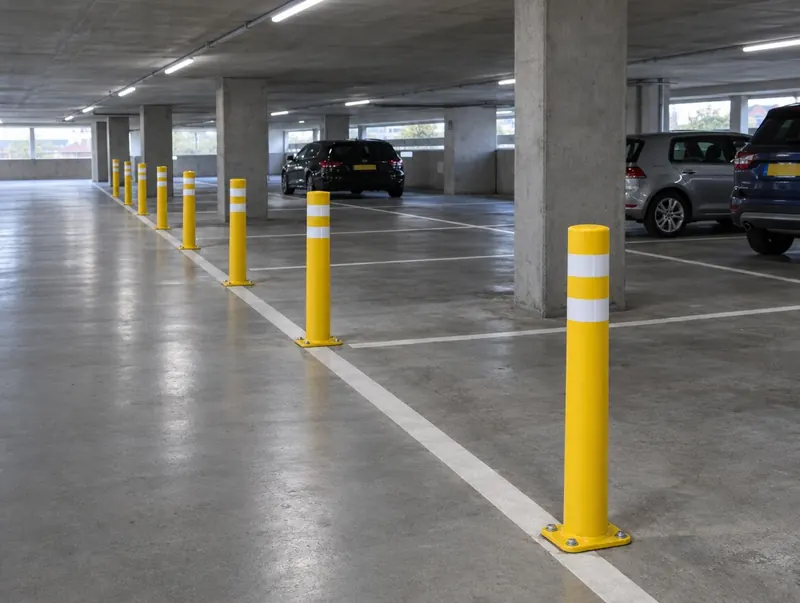 Computer-generated image
Limavady flexible bollards
Whether it's local parades, schools and high street shopfronts, flexible bollards in Limavady are planned around who needs to get through and who doesn't. Polyurethane and spring-based bollards that bend when hit and return upright, for car parks, depots and lane separation.
Coverage in Limavady takes in the BT49 postcode district. We also cover neighbouring Coleraine (12.6 miles) and Derry/Londonderry (14.7 miles) — distances are straight-line.
Key facts for this area
- Area
- Causeway Coast and Glens, Northern Ireland
- Roads authority
- the Department for Infrastructure (DfI Roads)
- Planning authority
- Causeway Coast and Glens Borough Council
- Postcodes
- BT49
- Guide price
- Typically £195–£585 per bollard + VAT; minimum job £435
- Survey
- Free, with a fixed written quote
- Nearby
- Coleraine (12.6 mi), Derry/Londonderry (14.7 mi)
What Limavady sites use flexible bollards for
Typical reasons Limavady sites choose flexible bollards:
- Lane separation at car park entrances and exits
- Marking pedestrian routes inside multi-storey car parks
- Bus stations and coach parks
What flexible bollards cost in Limavady
| Specification | Guide price | Includes |
|---|---|---|
| Standard | £195–£355 + VAT | Standard post, foundation, reinstatement |
| Upgraded | £305–£475 + VAT | Upgraded finish or fittings, reflective band, matched keys |
| Premium | £425–£585 + VAT | Heavy-duty or architectural spec, premium finish |
Per bollard, supplied and fixed; -2% for Northern Ireland. Guide only — the fixed price follows a survey.
Permissions and groundwork in Limavady
Kerbside work in Limavady is a DfI Roads question: the Department for Infrastructure is the roads authority for Northern Ireland, and its permission is needed for anything placed in the public road or footway.
Many private-land installations in Limavady need no planning application, but the rules don't clearly cover bollards, so listed buildings, conservation areas and prominent frontages are worth raising with the planning team at Causeway Coast and Glens Borough Council before posts go in.
Where posts go in a line across a drainage fall, positions avoid channels and gullies. Multi-storey and rooftop decks are a special case: slabs may be post-tensioned or carry waterproofing and heating, so drilling depth and positions are agreed with the building owner and scanned first.
- Keep pedestrian gaps and routes clear, referring to Inclusive Mobility guidance where people walk through the line.
- Check drilling into car park decks or podium slabs with the building owner before fixing.
What happens on site
Check the surface
Slabs and decks are checked for thickness, reinforcement and waterproofing before drilling. Weak tarmac may need a concrete pad or socket base.
Set out the line
Posts are set out to guide vehicles along the intended path, with spacing that reads as a line to drivers.
Fit posts and test
Posts are fitted and bent by hand to confirm they return upright, and reflective sleeves are applied.
Options to consider
| Option | Detail |
|---|---|
| Polyurethane posts | Flex along their length and return to shape. Gentle on vehicles and common in car parks and on forecourts. |
| Bolt-down or socket bases | Bolt-down for existing slabs; socket bases allow posts to be replaced without new fixings. |
| Heights and diameters | Commonly 750–1,000 mm high and around 80–200 mm diameter, with slimmer wand-style posts for lane lines. |
What moves the price in Limavady
Our Northern Ireland guide prices are a starting point; the survey in Limavady firms them up. What tends to move them:
- Surface condition and need for concrete pads
- Bolt-down or socket base
- Number of posts and length of line
After installation
Check flexible bollards for splits, permanent bends and loose bases, and tighten or replace fixings that have worked loose. After resurfacing or line repainting, check that the bases were not disturbed or painted over, and that posts still line up with the new markings.
If posts in Limavady are later hit or damaged, we can repair or replace them — see bollard repairs.
Common questions
Can you install flexible bollards anywhere in Limavady?
We cover all of Limavady (BT49) and the rest of Causeway Coast and Glens. We also work in Coleraine and Derry/Londonderry.
Who gives permission for bollards on the pavement in Limavady?
In Limavady, as everywhere in Northern Ireland, public roads and footways are looked after by DfI Roads rather than the council. If a post would sit on adopted footway, that consent comes first; private forecourts and car parks are a matter for the owner.
What's a typical price for flexible bollards in Limavady?
In Limavady, typically £195–£585 per bollard, supplied and fixed, plus VAT, with a minimum job of £435 plus VAT, using our Northern Ireland guide prices. The fixed figure comes in writing after we've seen the site.
Do flexible bollards damage vehicles?
Typically very little in a low-speed knock, which is a large part of their appeal. They may leave a scuff on paintwork. A rigid post in the same position would usually dent the vehicle and bend itself.
Will a flexible bollard stop a car?
No. It is designed to bend and recover, so a car can push past it. It marks the line and discourages drivers from crossing it. Where a vehicle must be physically stopped, use a rigid bollard.