Cumbria · England
Flexible bollard installation in Workington
Flexible bollards supplied and fitted in Workington, Cumbria: surveyed, scanned for services, set in proper foundations and finished to match the ground.
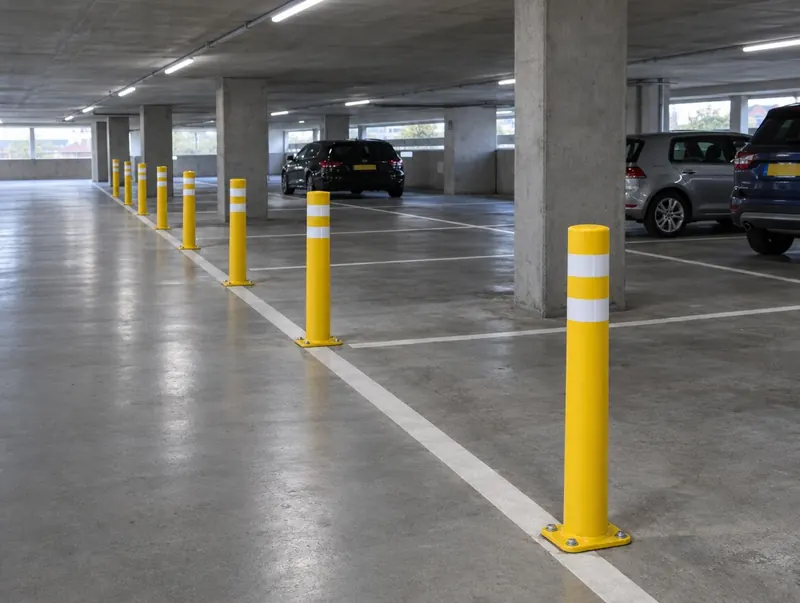 Computer-generated image
About flexible bollards in Workington
Across Workington, typical sites for flexible bollards include community car parks, high street shopfronts and filling-station forecourts. Polyurethane and spring-based bollards that bend when hit and return upright, for car parks, depots and lane separation.
We work across CA14 and CA15 — Workington itself and places including High Harrington, Stainburn, Great Clifton and Winscales. Nearby, we also work in Whitehaven (6.7 miles), measured as the crow flies.
Local details
- Area
- Cumbria, England
- Highway authority
- Cumberland Council (local roads)
- Planning authority
- Cumberland Council
- Postcodes
- CA14 and CA15
- Guide price
- Typically £195–£585 per bollard + VAT; minimum job £435
- Survey
- Free, with a fixed written quote
- Nearby
- Whitehaven (6.7 mi)
Guide prices for Workington
| Specification | Guide price | Includes |
|---|---|---|
| Standard | £195–£355 + VAT | Standard post, foundation, reinstatement |
| Upgraded | £305–£475 + VAT | Upgraded finish or fittings, reflective band, matched keys |
| Premium | £425–£585 + VAT | Heavy-duty or architectural spec, premium finish |
Per bollard, supplied and fixed; -2% for North West. Guide only — the fixed price follows a survey.
What Workington sites use flexible bollards for
Common uses in a place like Workington:
- Bus stations and coach parks
- Drive-thru lanes and fuel forecourts
- Temporary or trial layouts before permanent kerbs
Before we dig in Workington
Cumberland Council is the highway authority covering Workington's local roads. If any post would stand on adopted highway rather than your land, that consent is the first thing we sort out.
Many private-land installations in Workington need no planning application, but the rules don't clearly cover bollards, so listed buildings, conservation areas and prominent frontages are worth raising with the planning team at Cumberland Council before posts go in.
Multi-storey and rooftop decks are a special case: slabs may be post-tensioned or carry waterproofing and heating, so drilling depth and positions are agreed with the building owner and scanned first. Anchors therefore need sound concrete with enough edge distance; anchoring into thin, cracked or weak surfaces means the base works loose within weeks.
- On public highway, including cycle lane segregation, the highway authority's agreement and specification are needed.
- Do not use flexible bollards where a physical barrier is needed to protect people or buildings; they guide rather than stop.
What happens on site
Survey traffic movements
The free site survey looks at vehicle sizes, turning paths and where drivers currently clip posts or kerbs. You receive a fixed written quote with post type and fixing.
Check the surface
Slabs and decks are checked for thickness, reinforcement and waterproofing before drilling. Weak tarmac may need a concrete pad or socket base.
Fit posts and test
Posts are fitted and bent by hand to confirm they return upright, and reflective sleeves are applied.
Options to consider
| Option | Detail |
|---|---|
| Bolt-down or socket bases | Bolt-down for existing slabs; socket bases allow posts to be replaced without new fixings. |
| Heights and diameters | Commonly 750–1,000 mm high and around 80–200 mm diameter, with slimmer wand-style posts for lane lines. |
| Colours and reflective sleeves | Yellow, black, red, white or orange, with reflective sleeves for visibility in low light. |
What affects the quote
When we price flexible bollards in Workington, these make the biggest difference:
- Out-of-hours working in busy car parks
- Deck scanning and restrictions on drilling
- Bolt-down or socket base
Keeping them working
Clean reflective sleeves so they stay visible, and replace them when they fade or peel. Keep a few spare posts on site where knocks are frequent, so a damaged one can be swapped before the line develops a gap.
We can also service, repair or replace existing posts anywhere in Workington.
Flexible bollards in Workington: FAQs
Do you install flexible bollards in Workington?
We cover all of Workington (CA14 and CA15) and the rest of Cumbria. We also work in Whitehaven.
Who gives permission for bollards on the pavement in Workington?
In Workington, work on adopted pavements and verges needs consent from Cumberland Council, the local highway authority. Car parks, forecourts and other private land only need the owner's permission.
What's a typical price for flexible bollards in Workington?
In Workington, typically £195–£585 per bollard, supplied and fixed, plus VAT, with a minimum job of £435 plus VAT, using our North West guide prices. The fixed figure comes in writing after we've seen the site.
Can flexible bollards go in a multi-storey car park?
Yes, often with low-profile bases. The deck has to be checked first, as some slabs contain tendons or waterproofing that must not be drilled. The building owner usually needs to agree the fixing method.
Do flexible bollards damage vehicles?
Typically very little in a low-speed knock, which is a large part of their appeal. They may leave a scuff on paintwork. A rigid post in the same position would usually dent the vehicle and bend itself.