Dumfries and Galloway · Scotland
Flexible bollard installation in Dumfries
Flexible bollards for sites across Dumfries and the rest of Dumfries and Galloway, from the first measurement to the last relaid paving block.
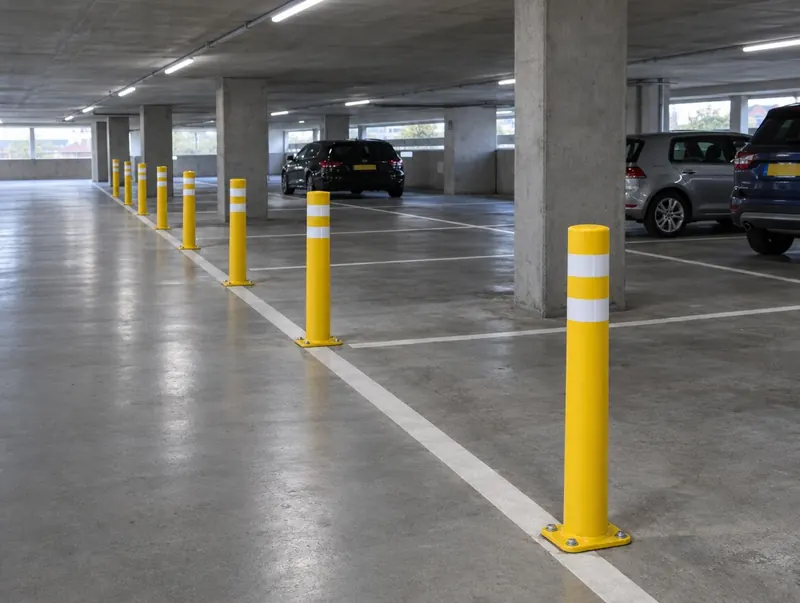 Computer-generated image
About flexible bollards in Dumfries
In the town of Dumfries, flexible bollards tend to go in at filling-station forecourts, community buildings and high street shopfronts. Polyurethane and spring-based bollards that bend when hit and return upright, for car parks, depots and lane separation.
We work across DG1 and DG2 — Dumfries itself and places including Heathhall, Locharbriggs, Collin and Torthorwald. Dumfries is fairly self-contained, with no other large town within about 20 miles.
Dumfries at a glance
- Area
- Dumfries and Galloway, Scotland
- Roads authority
- Dumfries and Galloway Council (local roads)
- Planning authority
- Dumfries and Galloway Council
- Postcodes
- DG1 and DG2
- Guide price
- Typically £195–£595 per bollard + VAT; minimum job £445
- Survey
- Free, with a fixed written quote
Dumfries: typical flexible bollard prices
| Specification | Guide price | Includes |
|---|---|---|
| Standard | £195–£365 + VAT | Standard post, foundation, reinstatement |
| Upgraded | £315–£485 + VAT | Upgraded finish or fittings, reflective band, matched keys |
| Premium | £435–£595 + VAT | Heavy-duty or architectural spec, premium finish |
Per bollard, supplied and fixed; no regional adjustment. Guide only — the fixed price follows a survey.
Where flexible bollards go in around Dumfries
Typical reasons Dumfries sites choose flexible bollards:
- Temporary or trial layouts before permanent kerbs
- Lane separation at car park entrances and exits
- Drive-thru lanes and fuel forecourts
Permissions and groundwork in Dumfries
Dumfries falls under Dumfries and Galloway Council as roads authority. If the line of posts crosses onto adopted road or pavement, permission comes before excavation; on private land it does not.
Bollards on private land often need no planning application, but listed buildings and conservation areas are different; the planning service at Dumfries and Galloway Council can confirm before anything is ordered.
On tarmac, a small concrete pad or a socket base cast in concrete is the reliable option. Flexible bollards put repeated load on their fixings, because every knock rocks the base.
- Check drilling into car park decks or podium slabs with the building owner before fixing.
- Do not use flexible bollards where a physical barrier is needed to protect people or buildings; they guide rather than stop.
What happens on site
Set out the line
Posts are set out to guide vehicles along the intended path, with spacing that reads as a line to drivers.
Fix the bases
Holes are drilled and cleaned, resin anchors or bolts are set and the bases fixed and torqued once cured. Socket bases are set flush in concrete.
Fit posts and test
Posts are fitted and bent by hand to confirm they return upright, and reflective sleeves are applied.
Finishes and options
| Option | Detail |
|---|---|
| Low-profile deck bases | Shallow fixings for multi-storey decks where deep drilling is not permitted. |
| Colours and reflective sleeves | Yellow, black, red, white or orange, with reflective sleeves for visibility in low light. |
| Polyurethane posts | Flex along their length and return to shape. Gentle on vehicles and common in car parks and on forecourts. |
What affects the quote
Two Dumfries jobs with the same number of posts can price quite differently. The usual reasons:
- Surface condition and need for concrete pads
- Number of posts and length of line
- Deck scanning and restrictions on drilling
Keeping them working
Check flexible bollards for splits, permanent bends and loose bases, and tighten or replace fixings that have worked loose. Keep a few spare posts on site where knocks are frequent, so a damaged one can be swapped before the line develops a gap.
For damaged or loose posts in Dumfries, repairs and replacements are priced in writing first.
Questions about flexible bollards in Dumfries
Which parts of Dumfries do you cover for flexible bollards?
We cover all of Dumfries (DG1 and DG2) and the rest of Dumfries and Galloway.
Who gives permission for bollards on the pavement in Dumfries?
For anything on the public footway in Dumfries we check with the roads authority first — Dumfries and Galloway Council for local roads, Transport Scotland on trunk routes. Private ground such as a car park or forecourt only needs the owner's go-ahead.
What's a typical price for flexible bollards in Dumfries?
In Dumfries, typically £195–£595 per bollard, supplied and fixed, plus VAT, with a minimum job of £445 plus VAT, using our Scotland guide prices. The fixed figure comes in writing after we've seen the site.
Will a flexible bollard stop a car?
No. It is designed to bend and recover, so a car can push past it. It marks the line and discourages drivers from crossing it. Where a vehicle must be physically stopped, use a rigid bollard.
Do flexible bollards damage vehicles?
Typically very little in a low-speed knock, which is a large part of their appeal. They may leave a scuff on paintwork. A rigid post in the same position would usually dent the vehicle and bend itself.