Essex · England
Flexible bollard installation in Clacton-on-Sea
Local installation of flexible bollards in Clacton-on-Sea — free survey, fixed written price, and posts set to the right spacing for people and vehicles.
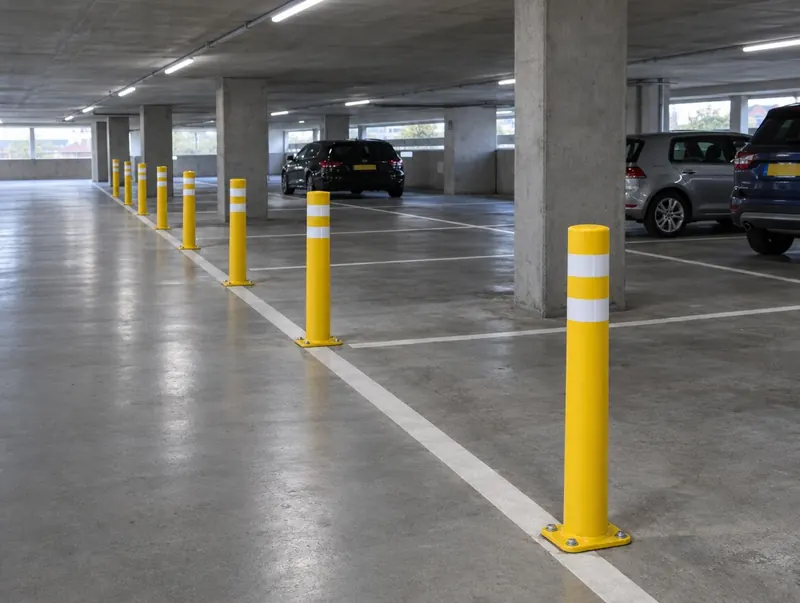 Computer-generated image
About flexible bollards in Clacton-on-Sea
Whether it's filling-station forecourts, community car parks and small industrial units, flexible bollards in Clacton-on-Sea are planned around who needs to get through and who doesn't. Flexible bollards are traffic management products, not barriers, and will not stop a vehicle that is driven at them.
Coverage in Clacton-on-Sea takes in the CO15, CO16 and CO13 postcode districts and nearby places like Jaywick, Little Clacton, Thorpe-le-Soken and St Osyth. Nearby, we also work in Harwich (11.9 miles), Colchester (12.8 miles), Felixstowe (14.6 miles) and Ipswich (18.6 miles), measured as the crow flies. Southend-on-Sea is around 26 miles away.
Clacton-on-Sea at a glance
- Area
- Essex, England
- Highway authority
- Essex County Council (local roads)
- Planning authority
- the council for Tendring
- Postcodes
- CO15, CO16 and CO13
- Guide price
- Typically £205–£615 per bollard + VAT; minimum job £455
- Survey
- Free, with a fixed written quote
- Nearby
- Harwich (11.9 mi), Colchester (12.8 mi), Felixstowe (14.6 mi), Ipswich (18.6 mi)
What Clacton-on-Sea sites use flexible bollards for
Common uses in a place like Clacton-on-Sea:
- Temporary or trial layouts before permanent kerbs
- Lane separation at car park entrances and exits
- Approaches to barriers, pay stations and ticket machines
Guide prices for Clacton-on-Sea
| Specification | Guide price | Includes |
|---|---|---|
| Standard | £205–£375 + VAT | Standard post, foundation, reinstatement |
| Upgraded | £325–£495 + VAT | Upgraded finish or fittings, reflective band, matched keys |
| Premium | £445–£615 + VAT | Heavy-duty or architectural spec, premium finish |
Per bollard, supplied and fixed; +3% for East of England. Guide only — the fixed price follows a survey.
Before we dig in Clacton-on-Sea
The highway authority for local roads in Clacton-on-Sea is Essex County Council; motorways and trunk roads sit with National Highways. Flexible bollards on the adopted footway are a matter for the highway authority, so we only install there with its written agreement.
If your site in Clacton-on-Sea is listed or inside a conservation area, check with the local planning authority (the council for Tendring) before choosing a finish — heritage settings often favour cast iron or painted steel over stainless.
Anchors therefore need sound concrete with enough edge distance; anchoring into thin, cracked or weak surfaces means the base works loose within weeks. On tarmac, a small concrete pad or a socket base cast in concrete is the reliable option.
- Check drilling into car park decks or podium slabs with the building owner before fixing.
- On public highway, including cycle lane segregation, the highway authority's agreement and specification are needed.
What happens on site
Check the surface
Slabs and decks are checked for thickness, reinforcement and waterproofing before drilling. Weak tarmac may need a concrete pad or socket base.
Set out the line
Posts are set out to guide vehicles along the intended path, with spacing that reads as a line to drivers.
Hand over spares and records
Post and base details are recorded so replacements match, and spare posts can be left on site for busy locations. Staff are shown how a post is swapped on its base.
Finishes and options
| Option | Detail |
|---|---|
| Heights and diameters | Commonly 750–1,000 mm high and around 80–200 mm diameter, with slimmer wand-style posts for lane lines. |
| Polyurethane posts | Flex along their length and return to shape. Gentle on vehicles and common in car parks and on forecourts. |
| Bolt-down or socket bases | Bolt-down for existing slabs; socket bases allow posts to be replaced without new fixings. |
What moves the price in Clacton-on-Sea
When we price flexible bollards in Clacton-on-Sea, these make the biggest difference:
- Number of posts and length of line
- Surface condition and need for concrete pads
- Deck scanning and restrictions on drilling
Keeping them working
After resurfacing or line repainting, check that the bases were not disturbed or painted over, and that posts still line up with the new markings. Check flexible bollards for splits, permanent bends and loose bases, and tighten or replace fixings that have worked loose.
We can also service, repair or replace existing posts anywhere in Clacton-on-Sea.
Flexible bollards in Clacton-on-Sea: FAQs
Do you install flexible bollards in Clacton-on-Sea?
We cover all of Clacton-on-Sea (CO15, CO16 and CO13) and the rest of Essex. We also work in Harwich, Colchester and Felixstowe.
Do I need consent for flexible bollards on a public footway in Clacton-on-Sea?
In Clacton-on-Sea, work on adopted pavements and verges needs consent from Essex County Council, the local highway authority. Car parks, forecourts and other private land only need the owner's permission.
What's a typical price for flexible bollards in Clacton-on-Sea?
In Clacton-on-Sea, typically £205–£615 per bollard, supplied and fixed, plus VAT, with a minimum job of £455 plus VAT, using our East of England guide prices. The fixed figure comes in writing after we've seen the site.
Can a damaged flexible post be replaced on the same base?
Usually, yes, especially with socket bases designed for it. The post is removed and a new one fitted. If the base itself is damaged or loose, it is re-fixed or replaced at the same time.
Do flexible bollards work in cold weather?
They do, but polymers become stiffer in cold conditions and recover more slowly after a knock. Sprung-base designs are less affected. Neither type is damaged by normal UK winter temperatures.