Kent · England
Flexible bollard installation in Tunbridge Wells
Flexible bollards supplied and fitted in Tunbridge Wells, Kent: surveyed, scanned for services, set in proper foundations and finished to match the ground.
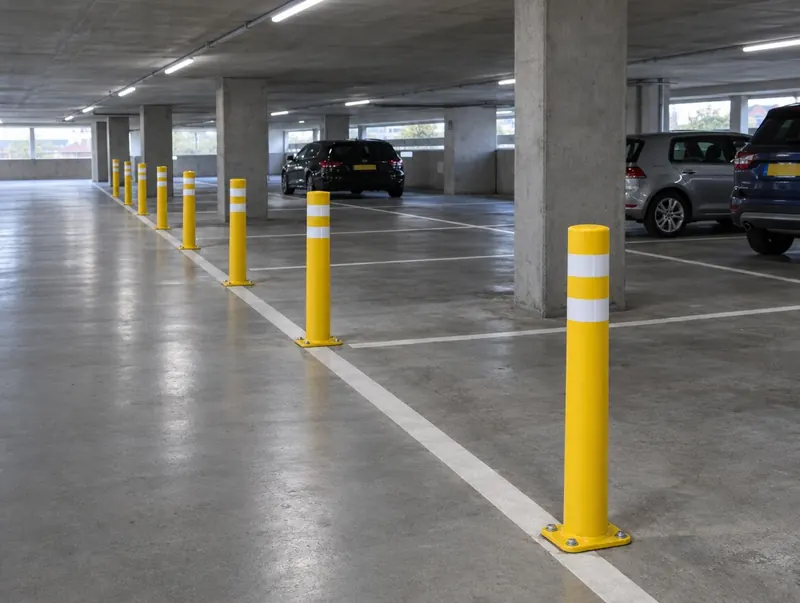 Computer-generated image
Flexible bollards in Tunbridge Wells
We supply and fit flexible bollards throughout Tunbridge Wells, typically for sites such as filling-station forecourts, community buildings and local parades. Polyurethane and spring-based bollards that bend when hit and return upright, for car parks, depots and lane separation.
We work across TN1, TN2, TN4 and TN3 — Tunbridge Wells itself and places including Pembury, Southborough, Rusthall and Bidborough. We also cover neighbouring Tonbridge (4.3 miles), Crowborough (6.6 miles), Sevenoaks (10.2 miles) and East Grinstead (11.7 miles) — distances are straight-line. Brighton is around 27 miles away.
Local details
- Area
- Kent, England
- Highway authority
- Kent County Council (local roads)
- Planning authority
- the council for Tunbridge Wells
- Postcodes
- TN1, TN2, TN4 and TN3
- Guide price
- Typically £205–£635 per bollard + VAT; minimum job £465
- Survey
- Free, with a fixed written quote
- Nearby
- Tonbridge (4.3 mi), Crowborough (6.6 mi), Sevenoaks (10.2 mi), East Grinstead (11.7 mi)
What flexible bollards cost in Tunbridge Wells
| Specification | Guide price | Includes |
|---|---|---|
| Standard | £205–£385 + VAT | Standard post, foundation, reinstatement |
| Upgraded | £335–£515 + VAT | Upgraded finish or fittings, reflective band, matched keys |
| Premium | £465–£635 + VAT | Heavy-duty or architectural spec, premium finish |
Per bollard, supplied and fixed; +6% for South East. Guide only — the fixed price follows a survey.
What Tunbridge Wells sites use flexible bollards for
Typical reasons Tunbridge Wells sites choose flexible bollards:
- Drive-thru lanes and fuel forecourts
- Temporary or trial layouts before permanent kerbs
- Approaches to barriers, pay stations and ticket machines
Consents, ground and services in Tunbridge Wells
Kent County Council is the highway authority covering Tunbridge Wells's local roads. If any post would stand on adopted highway rather than your land, that consent is the first thing we sort out.
Many private-land installations in Tunbridge Wells need no planning application, but the rules don't clearly cover bollards, so listed buildings, conservation areas and prominent frontages are worth raising with the planning team at the council for Tunbridge Wells before posts go in.
Multi-storey and rooftop decks are a special case: slabs may be post-tensioned or carry waterproofing and heating, so drilling depth and positions are agreed with the building owner and scanned first. Flexible bollards put repeated load on their fixings, because every knock rocks the base.
- Check drilling into car park decks or podium slabs with the building owner before fixing.
- On public highway, including cycle lane segregation, the highway authority's agreement and specification are needed.
Installation, step by step
Check the surface
Slabs and decks are checked for thickness, reinforcement and waterproofing before drilling. Weak tarmac may need a concrete pad or socket base.
Fix the bases
Holes are drilled and cleaned, resin anchors or bolts are set and the bases fixed and torqued once cured. Socket bases are set flush in concrete.
Fit posts and test
Posts are fitted and bent by hand to confirm they return upright, and reflective sleeves are applied.
Choosing the right spec
| Option | Detail |
|---|---|
| Heights and diameters | Commonly 750–1,000 mm high and around 80–200 mm diameter, with slimmer wand-style posts for lane lines. |
| Sprung-base bollards | A rigid post on a heavy spring or elastomer base that tilts and returns. Looks like a conventional bollard. |
| Bolt-down or socket bases | Bolt-down for existing slabs; socket bases allow posts to be replaced without new fixings. |
Pricing flexible bollards in Tunbridge Wells
Our South East guide prices are a starting point; the survey in Tunbridge Wells firms them up. What tends to move them:
- Polymer posts or sprung-base bollards
- Out-of-hours working in busy car parks
- Number of posts and length of line
Looking after them
Clean reflective sleeves so they stay visible, and replace them when they fade or peel. Posts exposed to strong sunlight slowly lose flexibility and colour, and eventually crack; replacing the post on its existing base is usually quick.
For damaged or loose posts in Tunbridge Wells, repairs and replacements are priced in writing first.
Questions about flexible bollards in Tunbridge Wells
Do you install flexible bollards in Tunbridge Wells?
We cover all of Tunbridge Wells (TN1, TN2, TN4 and TN3) and the rest of Kent. We also work in Tonbridge, Crowborough and Sevenoaks.
Who gives permission for bollards on the pavement in Tunbridge Wells?
Kent County Council is the highway authority covering Tunbridge Wells's local roads. If any post would stand on adopted highway rather than your land, that consent is the first thing we sort out.
How much do flexible bollards cost in Tunbridge Wells?
In Tunbridge Wells, typically £205–£635 per bollard, supplied and fixed, plus VAT, with a minimum job of £465 plus VAT, using our South East guide prices. The fixed figure comes in writing after we've seen the site.
Can a damaged flexible post be replaced on the same base?
Usually, yes, especially with socket bases designed for it. The post is removed and a new one fitted. If the base itself is damaged or loose, it is re-fixed or replaced at the same time.
Will a flexible bollard stop a car?
No. It is designed to bend and recover, so a car can push past it. It marks the line and discourages drivers from crossing it. Where a vehicle must be physically stopped, use a rigid bollard.
Flexible bollards near Tunbridge Wells
- Tonbridge (4.3 mi)
- Crowborough (6.6 mi)
- Sevenoaks (10.2 mi)
- East Grinstead (11.7 mi)
- Maidstone (14.4 mi)
- Caterham (18 mi)