Surrey · England
Flexible bollard installation in Walton-on-Thames
Flexible bollards supplied and fitted in Walton-on-Thames, Surrey: surveyed, scanned for services, set in proper foundations and finished to match the ground.
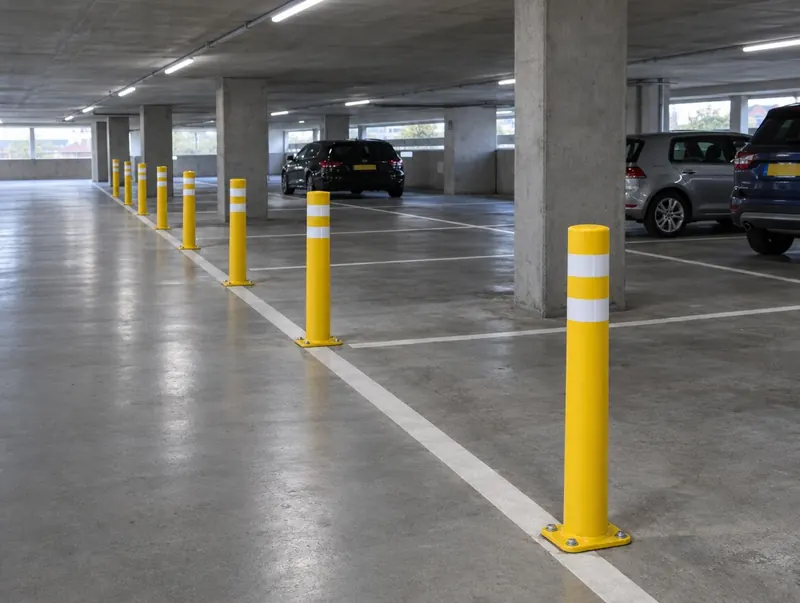 Computer-generated image
Flexible bollards in Walton-on-Thames
In the town of Walton-on-Thames, flexible bollards tend to go in at community car parks, high street shopfronts and local parades. Polyurethane and spring-based bollards that bend when hit and return upright, for car parks, depots and lane separation.
We work across KT12 and KT13 — Walton-on-Thames itself and places including Hersham, Burwood Park, Whiteley Village and St George's Hill. Jobs in Walton-on-Thames can be combined with work in Sunbury-on-Thames (1.2 miles), Esher (2.3 miles), Ashford, Surrey (3.6 miles) and Staines (5 miles) (straight-line distances). Walton-on-Thames is about 25 miles from Reading.
Local details
- Area
- Surrey, England
- Highway authority
- Surrey County Council (local roads)
- Planning authority
- the council for Elmbridge
- Postcodes
- KT12 and KT13
- Guide price
- Typically £205–£635 per bollard + VAT; minimum job £465
- Survey
- Free, with a fixed written quote
- Nearby
- Sunbury-on-Thames (1.2 mi), Esher (2.3 mi), Ashford, Surrey (3.6 mi), Staines (5 mi)
Typical flexible bollards jobs in Walton-on-Thames
Common uses in a place like Walton-on-Thames:
- Marking pedestrian routes inside multi-storey car parks
- Lane separation at car park entrances and exits
- Drive-thru lanes and fuel forecourts
Flexible bollard prices in Walton-on-Thames
| Specification | Guide price | Includes |
|---|---|---|
| Standard | £205–£385 + VAT | Standard post, foundation, reinstatement |
| Upgraded | £335–£515 + VAT | Upgraded finish or fittings, reflective band, matched keys |
| Premium | £465–£635 + VAT | Heavy-duty or architectural spec, premium finish |
Per bollard, supplied and fixed; +6% for South East. Guide only — the fixed price follows a survey.
Permissions and groundwork in Walton-on-Thames
In Walton-on-Thames, work on adopted pavements and verges needs consent from Surrey County Council, the local highway authority. Car parks, forecourts and other private land only need the owner's permission.
Bollards on private land often don't need planning permission, but it depends on the council's view, the height and the location; in a conservation area, next to a listed building or under an Article 4 direction, ask the local planning authority (the council for Elmbridge) first — we flag this at survey.
Multi-storey and rooftop decks are a special case: slabs may be post-tensioned or carry waterproofing and heating, so drilling depth and positions are agreed with the building owner and scanned first. Where posts go in a line across a drainage fall, positions avoid channels and gullies.
- Keep pedestrian gaps and routes clear, referring to Inclusive Mobility guidance where people walk through the line.
- Check drilling into car park decks or podium slabs with the building owner before fixing.
What happens on site
Set out the line
Posts are set out to guide vehicles along the intended path, with spacing that reads as a line to drivers.
Fix the bases
Holes are drilled and cleaned, resin anchors or bolts are set and the bases fixed and torqued once cured. Socket bases are set flush in concrete.
Hand over spares and records
Post and base details are recorded so replacements match, and spare posts can be left on site for busy locations. Staff are shown how a post is swapped on its base.
Options to consider
| Option | Detail |
|---|---|
| Bolt-down or socket bases | Bolt-down for existing slabs; socket bases allow posts to be replaced without new fixings. |
| Polyurethane posts | Flex along their length and return to shape. Gentle on vehicles and common in car parks and on forecourts. |
| Colours and reflective sleeves | Yellow, black, red, white or orange, with reflective sleeves for visibility in low light. |
What affects the quote
Our South East guide prices are a starting point; the survey in Walton-on-Thames firms them up. What tends to move them:
- Number of posts and length of line
- Polymer posts or sprung-base bollards
- Out-of-hours working in busy car parks
After installation
Clean reflective sleeves so they stay visible, and replace them when they fade or peel. Posts exposed to strong sunlight slowly lose flexibility and colour, and eventually crack; replacing the post on its existing base is usually quick.
For damaged or loose posts in Walton-on-Thames, repairs and replacements are priced in writing first.
Common questions
Which parts of Walton-on-Thames do you cover for flexible bollards?
We cover all of Walton-on-Thames (KT12 and KT13) and the rest of Surrey. We also work in Sunbury-on-Thames, Esher and Ashford, Surrey.
Do I need consent for flexible bollards on a public footway in Walton-on-Thames?
The highway authority for local roads in Walton-on-Thames is Surrey County Council; motorways and trunk roads sit with National Highways. Flexible bollards on the adopted footway are a matter for the highway authority, so we only install there with its written agreement.
What's a typical price for flexible bollards in Walton-on-Thames?
In Walton-on-Thames, typically £205–£635 per bollard, supplied and fixed, plus VAT, with a minimum job of £465 plus VAT, using our South East guide prices. The fixed figure comes in writing after we've seen the site.
Will a flexible bollard stop a car?
No. It is designed to bend and recover, so a car can push past it. It marks the line and discourages drivers from crossing it. Where a vehicle must be physically stopped, use a rigid bollard.
Do flexible bollards work in cold weather?
They do, but polymers become stiffer in cold conditions and recover more slowly after a knock. Sprung-base designs are less affected. Neither type is damaged by normal UK winter temperatures.
Flexible bollards in nearby towns
- Sunbury-on-Thames (1.2 mi)
- Esher (2.3 mi)
- Ashford, Surrey (3.6 mi)
- Staines (5 mi)
- Hounslow (5.5 mi)
- Kingston upon Thames (5.9 mi)