Devon · England
Lighting bollard installation in Plymstock
Planning lighting bollards in Plymstock? We check ownership, consents and buried services first, then quote a fixed price.
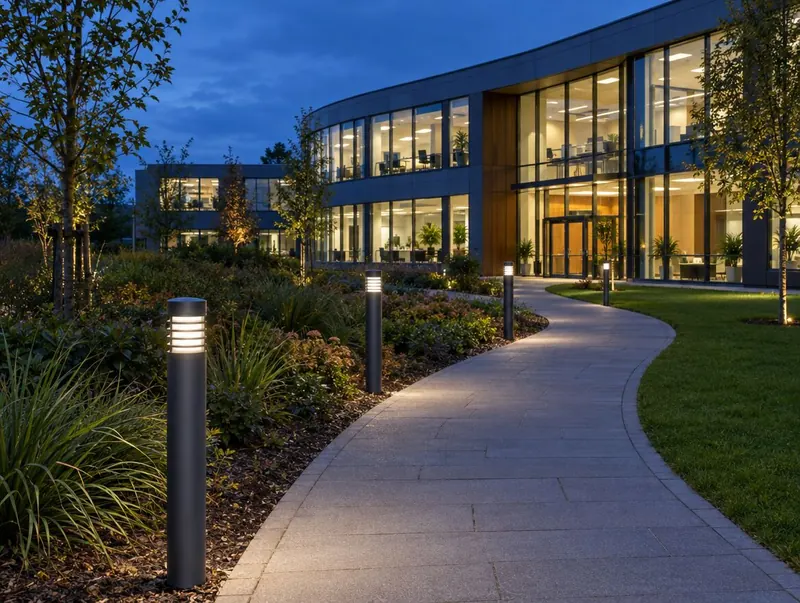 Computer-generated image
Lighting bollards in Plymstock
We supply and fit lighting bollards throughout Plymstock, typically for sites such as community buildings, local parades and filling-station forecourts. Outdoor lighting bollards need weatherproof and impact-resistant construction and must be connected and tested by a qualified electrician.
We cover Plymstock's PL9 postcode district, including places such as Staddiscombe. Jobs in Plymstock can be combined with work in Plymouth (2.4 miles) (straight-line distances).
Local details
- Area
- Devon, England
- Highway authority
- Plymouth City Council (local roads)
- Planning authority
- Plymouth City Council
- Postcodes
- PL9
- Guide price
- Typically £345–£1,195 per bollard + VAT (£405–£1,445 inc VAT for homes); minimum job £845
- Survey
- Free, with a fixed written quote
- Nearby
- Plymouth (2.4 mi)
Guide prices for Plymstock
| Specification | Guide price | Includes |
|---|---|---|
| Standard | £345–£705 + VAT · £405–£845 inc VAT | Standard post, foundation, reinstatement |
| Upgraded | £605–£955 + VAT · £725–£1,145 inc VAT | Upgraded finish or fittings, reflective band, matched keys |
| Premium | £855–£1,195 + VAT · £1,045–£1,445 inc VAT | Heavy-duty or architectural spec, premium finish |
Per bollard, installed with a qualified electrician (supply run extra); no regional adjustment. Guide only — the fixed price follows a survey.
Where lighting bollards go in around Plymstock
Common uses in a place like Plymstock:
- Parks and areas where tall columns would be intrusive
- Hotel, restaurant and pub frontages
- Footpaths through housing developments and campuses
Consents, ground and services in Plymstock
Plymouth City Council is the highway authority covering Plymstock's local roads. If any post would stand on adopted highway rather than your land, that consent is the first thing we sort out.
Bollards on private land often don't need planning permission, but it depends on the council's view, the height and the location; in a conservation area, next to a listed building or under an Article 4 direction, ask the local planning authority (Plymouth City Council) first — we flag this at survey.
Cable trenches run between every position and back to the supply, often crossing paths, drives and planting, so the routes are planned to minimise cuts through hard surfaces and to avoid existing gas, water and telecoms services. Cable is protected by armour or duct, buried deep enough to avoid garden tools and future paving works, and marked with warning tape.
- In homes, new outdoor circuits are often notifiable building work; a registered electrician can usually self-certify it.
- Choose IP and IK ratings that suit the location, and do not rely on lighting bollards as vehicle barriers.
Installation, step by step
Dig cable routes
Trenches are dug between bollard positions and the supply point, avoiding existing services, with cable or duct laid at a suitable depth and warning tape above.
Set the bases
Anchor cages or foundations are cast at each position with the cable entry in the right place, set level so each bollard stands plumb.
Electrical connection
A qualified electrician installs the circuit protection, makes the connections in weatherproof enclosures and fits controls such as a photocell or timer.
Finishes and options
| Option | Detail |
|---|---|
| Body materials and finishes | Powder-coated aluminium or steel, or stainless steel, in colours to suit the building. |
| Light distribution | 360-degree, asymmetric or louvred heads to light paths while limiting glare and light spill. |
| Solar bollards | Self-contained with panel and battery; no cabling. Suited to markers and low-use routes where lower output is acceptable. |
Pricing lighting bollards in Plymstock
Our South West guide prices are a starting point; the survey in Plymstock firms them up. What tends to move them:
- Mains or solar bollards
- Length of cable routes and surfaces to be cut
- Controls such as photocells, timers or sensors
Keeping them working
Photocells and timers need resetting when the clocks change unless they adjust automatically. If a run of bollards trips the circuit after rain, water ingress at a connection is the usual cause and needs an electrician.
We can also service, repair or replace existing posts anywhere in Plymstock.
Lighting bollards in Plymstock: FAQs
Do you install lighting bollards in Plymstock?
We cover all of Plymstock (PL9) and the rest of Devon. We also work in Plymouth.
Do I need consent for lighting bollards on a public footway in Plymstock?
In Plymstock, work on adopted pavements and verges needs consent from Plymouth City Council, the local highway authority. Car parks, forecourts and other private land only need the owner's permission.
What's a typical price for lighting bollards in Plymstock?
In Plymstock, typically £345–£1,195 per bollard, installed with a qualified electrician (supply run extra), plus VAT (£405–£1,445 including VAT for homeowners), with a minimum job of £845 plus VAT, using our South West guide prices. The fixed figure comes in writing after we've seen the site.
Are solar bollard lights worth it?
For marking edges and low-use paths, they can be, because there is no cabling to install. They give less light than mains bollards and perform poorly in shaded spots and short winter days. For lighting a route properly, mains bollards are more dependable.
What IP rating do outdoor bollard lights need?
Usually at least IP65 for rain and splashing, and higher where water may collect or fittings are hosed down. Ask for the rating of the complete fitting, not just the LED module.