Essex · England
Lighting bollard installation in Harwich
Lighting bollards for sites across Harwich and the rest of Essex, from the first measurement to the last relaid paving block.
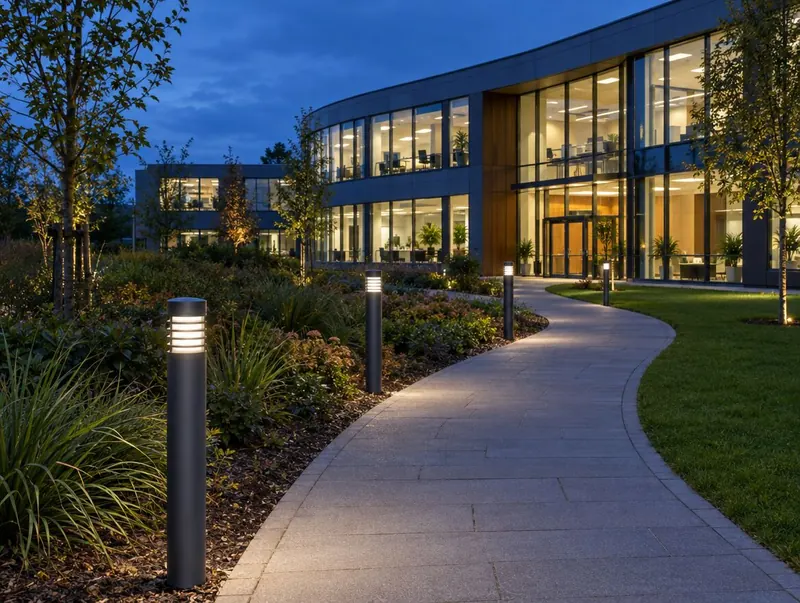 Computer-generated image
About lighting bollards in Harwich
Across Harwich, typical sites for lighting bollards include small industrial units, community buildings and residential driveways. Outdoor lighting bollards need weatherproof and impact-resistant construction and must be connected and tested by a qualified electrician.
We cover Harwich's CO12 postcode district, including places such as Great Oakley, Parkeston, Little Oakley and Stones Green. Nearby, we also work in Felixstowe (3.2 miles), Ipswich (9.8 miles), Clacton-on-Sea (11.9 miles) and Colchester (16.6 miles), measured as the crow flies. It sits roughly 37 miles from Southend-on-Sea as the crow flies.
Harwich at a glance
- Area
- Essex, England
- Highway authority
- Essex County Council (local roads)
- Planning authority
- the council for Tendring
- Postcodes
- CO12
- Guide price
- Typically £355–£1,245 per bollard + VAT (£425–£1,495 inc VAT for homes); minimum job £865
- Survey
- Free, with a fixed written quote
- Nearby
- Felixstowe (3.2 mi), Ipswich (9.8 mi), Clacton-on-Sea (11.9 mi), Colchester (16.6 mi)
Lighting bollard prices in Harwich
| Specification | Guide price | Includes |
|---|---|---|
| Standard | £355–£725 + VAT · £425–£865 inc VAT | Standard post, foundation, reinstatement |
| Upgraded | £615–£985 + VAT · £735–£1,195 inc VAT | Upgraded finish or fittings, reflective band, matched keys |
| Premium | £885–£1,245 + VAT · £1,045–£1,495 inc VAT | Heavy-duty or architectural spec, premium finish |
Per bollard, installed with a qualified electrician (supply run extra); +3% for East of England. Guide only — the fixed price follows a survey.
What Harwich sites use lighting bollards for
Around Harwich, lighting bollards usually solve one of these:
- Steps, ramps and changes in level
- Footpaths through housing developments and campuses
- Car park walkways and pedestrian crossings
Before we dig in Harwich
The highway authority for local roads in Harwich is Essex County Council; motorways and trunk roads sit with National Highways. Lighting bollards on the adopted footway are a matter for the highway authority, so we only install there with its written agreement.
Bollards on private land often don't need planning permission, but it depends on the council's view, the height and the location; in a conservation area, next to a listed building or under an Article 4 direction, ask the local planning authority (the council for Tendring) first — we flag this at survey.
Cable trenches run between every position and back to the supply, often crossing paths, drives and planting, so the routes are planned to minimise cuts through hard surfaces and to avoid existing gas, water and telecoms services. Most of the work in a lighting bollard scheme is underground.
- Have the electrical installation designed, installed, tested and certified by a qualified electrician to BS 7671.
- In homes, new outdoor circuits are often notifiable building work; a registered electrician can usually self-certify it.
How the job runs
Survey and lighting layout
A free site survey looks at the routes to be lit, where power can come from, surfaces and buried services. Bollard spacing is set from the product's light data, and you receive a fixed written quote.
Dig cable routes
Trenches are dug between bollard positions and the supply point, avoiding existing services, with cable or duct laid at a suitable depth and warning tape above.
Test, aim and certify
The circuit is tested and certified, bollards are checked at night for coverage and glare, and asymmetric heads are turned to face the path.
Finishes and options
| Option | Detail |
|---|---|
| Mains LED bollards | Wired from a dedicated circuit for reliable lighting of paths and car parks. Needs cable routes and electrical certification. |
| Colour temperature | Warm white for residential and amenity areas; warmer or amber options near sensitive wildlife habitats. |
| Solar bollards | Self-contained with panel and battery; no cabling. Suited to markers and low-use routes where lower output is acceptable. |
What moves the price in Harwich
When we price lighting bollards in Harwich, these make the biggest difference:
- Mains or solar bollards
- Controls such as photocells, timers or sensors
- Length of cable routes and surfaces to be cut
Looking after them
Clean diffusers so dirt and algae do not dim the light, check seals and fixings, and look for impact damage, especially in car parks. LED lighting bollards need far less maintenance than older lamp types, but they are not maintenance-free.
If posts in Harwich are later hit or damaged, we can repair or replace them — see bollard repairs.
Questions about lighting bollards in Harwich
Can you install lighting bollards anywhere in Harwich?
We cover all of Harwich (CO12) and the rest of Essex. We also work in Felixstowe, Ipswich and Clacton-on-Sea.
Who gives permission for bollards on the pavement in Harwich?
Essex County Council is the highway authority covering Harwich's local roads. If any post would stand on adopted highway rather than your land, that consent is the first thing we sort out.
How much do lighting bollards cost in Harwich?
In Harwich, typically £355–£1,245 per bollard, installed with a qualified electrician (supply run extra), plus VAT (£425–£1,495 including VAT for homeowners), with a minimum job of £865 plus VAT, using our East of England guide prices. The fixed figure comes in writing after we've seen the site.
Do lighting bollards need an electrician to install?
Yes, mains lighting bollards must be connected by a qualified electrician, who tests and certifies the circuit. We arrange that as part of the job. Solar bollards avoid mains work but provide less light.
Are solar bollard lights worth it?
For marking edges and low-use paths, they can be, because there is no cabling to install. They give less light than mains bollards and perform poorly in shaded spots and short winter days. For lighting a route properly, mains bollards are more dependable.