Fife · Scotland
Lighting bollard installation in Kirkcaldy
Local installation of lighting bollards in Kirkcaldy — free survey, fixed written price, and posts set to the right spacing for people and vehicles.
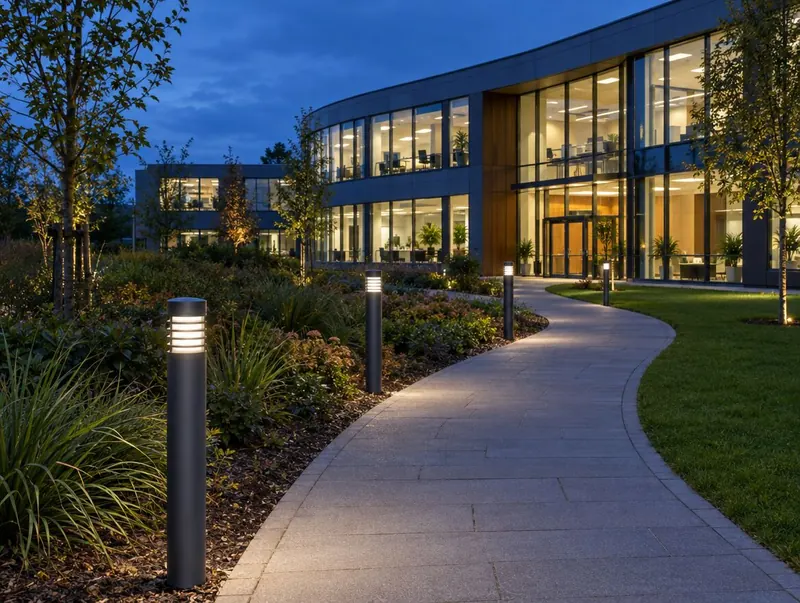 Computer-generated image
About lighting bollards in Kirkcaldy
Low-level LED bollard lights for paths, car parks, entrances and gardens, installed with a qualified electrician. In Kirkcaldy, that tends to mean sites such as residential driveways, community buildings and local parades.
We work across KY2, KY1 and KY3 — Kirkcaldy itself and places including Auchtertool, Cluny, East Wemyss and Coaltown of Wemyss. We also cover neighbouring Glenrothes (5.4 miles), Cowdenbeath (7.1 miles), Methil (7.1 miles) and Dunfermline (11.9 miles) — distances are straight-line.
Local details
- Area
- Fife, Scotland
- Roads authority
- Fife Council (local roads)
- Planning authority
- Fife Council
- Postcodes
- KY2, KY1 and KY3
- Guide price
- Typically £345–£1,195 per bollard + VAT (£405–£1,445 inc VAT for homes); minimum job £845
- Survey
- Free, with a fixed written quote
- Nearby
- Glenrothes (5.4 mi), Cowdenbeath (7.1 mi), Methil (7.1 mi), Dunfermline (11.9 mi)
Kirkcaldy: typical lighting bollard prices
| Specification | Guide price | Includes |
|---|---|---|
| Standard | £345–£705 + VAT · £405–£845 inc VAT | Standard post, foundation, reinstatement |
| Upgraded | £605–£955 + VAT · £725–£1,145 inc VAT | Upgraded finish or fittings, reflective band, matched keys |
| Premium | £855–£1,195 + VAT · £1,045–£1,445 inc VAT | Heavy-duty or architectural spec, premium finish |
Per bollard, installed with a qualified electrician (supply run extra); no regional adjustment. Guide only — the fixed price follows a survey.
Typical lighting bollards jobs in Kirkcaldy
Common uses in a place like Kirkcaldy:
- Steps, ramps and changes in level
- Parks and areas where tall columns would be intrusive
- Footpaths through housing developments and campuses
Consents, ground and services in Kirkcaldy
Kirkcaldy falls under Fife Council as roads authority. If the line of posts crosses onto adopted road or pavement, permission comes before excavation; on private land it does not.
Bollards on private land often need no planning application, but listed buildings and conservation areas are different; the planning service at Fife Council can confirm before anything is ordered.
Cable is protected by armour or duct, buried deep enough to avoid garden tools and future paving works, and marked with warning tape. Most of the work in a lighting bollard scheme is underground.
- In homes, new outdoor circuits are often notifiable building work; a registered electrician can usually self-certify it.
- Have the electrical installation designed, installed, tested and certified by a qualified electrician to BS 7671.
Installation, step by step
Dig cable routes
Trenches are dug between bollard positions and the supply point, avoiding existing services, with cable or duct laid at a suitable depth and warning tape above.
Electrical connection
A qualified electrician installs the circuit protection, makes the connections in weatherproof enclosures and fits controls such as a photocell or timer.
Test, aim and certify
The circuit is tested and certified, bollards are checked at night for coverage and glare, and asymmetric heads are turned to face the path.
Options to consider
| Option | Detail |
|---|---|
| Solar bollards | Self-contained with panel and battery; no cabling. Suited to markers and low-use routes where lower output is acceptable. |
| Fixings | Anchor cages cast in concrete, base plates on existing slabs, or ground spikes for garden models. |
| Mains LED bollards | Wired from a dedicated circuit for reliable lighting of paths and car parks. Needs cable routes and electrical certification. |
Pricing lighting bollards in Kirkcaldy
Our Scotland guide prices are a starting point; the survey in Kirkcaldy firms them up. What tends to move them:
- Mains or solar bollards
- Distance from the supply and circuit requirements
- Reinstatement of paving, tarmac or planting
Looking after them
Photocells and timers need resetting when the clocks change unless they adjust automatically. A periodic electrical inspection checks that connections and protection are still sound.
For damaged or loose posts in Kirkcaldy, repairs and replacements are priced in writing first.
Lighting bollards in Kirkcaldy: FAQs
Do you install lighting bollards in Kirkcaldy?
We cover all of Kirkcaldy (KY2, KY1 and KY3) and the rest of Fife. We also work in Glenrothes, Cowdenbeath and Methil.
Do I need consent for lighting bollards on a public footway in Kirkcaldy?
In Scotland the council is the roads authority for local roads, which in Kirkcaldy means Fife Council. Lighting bollards on an adopted footway need its consent; trunk roads sit with Transport Scotland.
What's a typical price for lighting bollards in Kirkcaldy?
In Kirkcaldy, typically £345–£1,195 per bollard, installed with a qualified electrician (supply run extra), plus VAT (£405–£1,445 including VAT for homeowners), with a minimum job of £845 plus VAT, using our Scotland guide prices. The fixed figure comes in writing after we've seen the site.
How far apart should lighting bollards be?
That depends on the light output, beam pattern and how evenly the path needs to be lit. Spacing is worked out from the product's light data rather than a fixed distance. Too far apart leaves dark patches between pools of light.
Can bollard lights work on a timer or motion sensor?
Yes. Photocells switch them on at dusk, timers switch them off or dim them late at night and motion sensors bring them up when someone approaches. Combining controls saves energy and reduces light pollution.
Lighting bollards in nearby towns
- Glenrothes (5.4 mi)
- Cowdenbeath (7.1 mi)
- Methil (7.1 mi)
- Dunfermline (11.9 mi)
- Rosyth (12.1 mi)
- St Andrews (20.7 mi)