Newry, Mourne and Down · Northern Ireland
Lighting bollard installation in Newry
Local installation of lighting bollards in Newry — free survey, fixed written price, and posts set to the right spacing for people and vehicles.
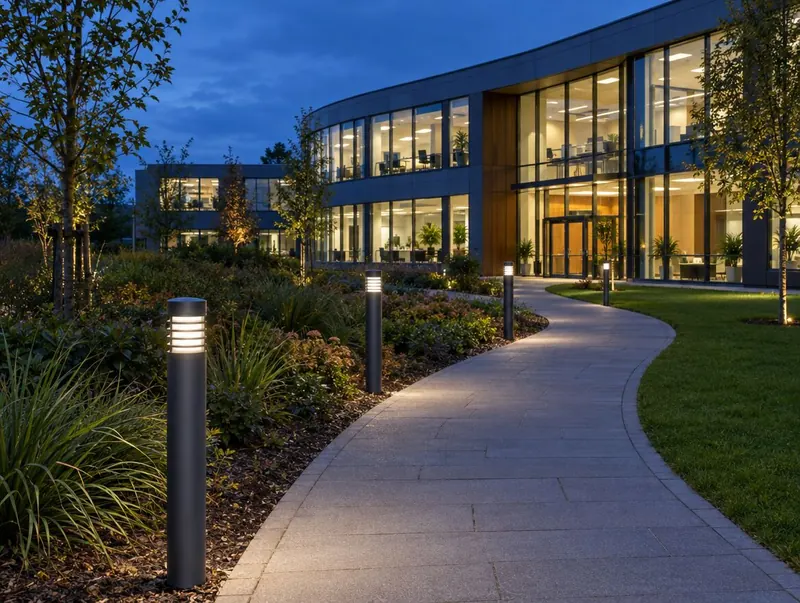 Computer-generated image
About lighting bollards in Newry
Across Newry, typical sites for lighting bollards include community car parks, small industrial units and schools. Low-level LED bollard lights for paths, car parks, entrances and gardens, installed with a qualified electrician.
We cover every part of Newry in the BT35 postcode district. We also cover neighbouring Banbridge (12.1 miles), Portadown (17.4 miles), Armagh (17.8 miles) and Craigavon (18.7 miles) — distances are straight-line. It sits roughly 33 miles from Belfast as the crow flies.
Key facts for this area
- Area
- Newry, Mourne and Down, Northern Ireland
- Roads authority
- the Department for Infrastructure (DfI Roads)
- Planning authority
- Newry, Mourne and Down District Council
- Postcodes
- BT35
- Guide price
- Typically £335–£1,195 per bollard + VAT (£395–£1,445 inc VAT for homes); minimum job £825
- Survey
- Free, with a fixed written quote
What lighting bollards cost in Newry
| Specification | Guide price | Includes |
|---|---|---|
| Standard | £335–£685 + VAT · £395–£815 inc VAT | Standard post, foundation, reinstatement |
| Upgraded | £585–£935 + VAT · £695–£1,095 inc VAT | Upgraded finish or fittings, reflective band, matched keys |
| Premium | £835–£1,195 + VAT · £995–£1,445 inc VAT | Heavy-duty or architectural spec, premium finish |
Per bollard, installed with a qualified electrician (supply run extra); -2% for Northern Ireland. Guide only — the fixed price follows a survey.
What Newry sites use lighting bollards for
Around Newry, lighting bollards usually solve one of these:
- Parks and areas where tall columns would be intrusive
- Private gardens and long driveways
- Hotel, restaurant and pub frontages
Permissions and groundwork in Newry
In Newry, as everywhere in Northern Ireland, public roads and footways are looked after by DfI Roads rather than the council. If a post would sit on adopted footway, that consent comes first; private forecourts and car parks are a matter for the owner.
If your site in Newry is listed or inside a conservation area, check with the local planning authority (Newry, Mourne and Down District Council) before choosing a finish — heritage settings often favour cast iron or painted steel over stainless.
Bases are set in firm ground with the cable entry facing the right way, and on paved routes the bollards are positioned so cables can be pulled through ducts rather than requiring surfaces to be lifted again later. Cable trenches run between every position and back to the supply, often crossing paths, drives and planting, so the routes are planned to minimise cuts through hard surfaces and to avoid existing gas, water and telecoms services.
- Have the electrical installation designed, installed, tested and certified by a qualified electrician to BS 7671.
- Choose IP and IK ratings that suit the location, and do not rely on lighting bollards as vehicle barriers.
Installation, step by step
Dig cable routes
Trenches are dug between bollard positions and the supply point, avoiding existing services, with cable or duct laid at a suitable depth and warning tape above.
Set the bases
Anchor cages or foundations are cast at each position with the cable entry in the right place, set level so each bollard stands plumb.
Test, aim and certify
The circuit is tested and certified, bollards are checked at night for coverage and glare, and asymmetric heads are turned to face the path.
Choosing the right spec
| Option | Detail |
|---|---|
| Fixings | Anchor cages cast in concrete, base plates on existing slabs, or ground spikes for garden models. |
| Light distribution | 360-degree, asymmetric or louvred heads to light paths while limiting glare and light spill. |
| Body materials and finishes | Powder-coated aluminium or steel, or stainless steel, in colours to suit the building. |
Pricing lighting bollards in Newry
Our Northern Ireland guide prices are a starting point; the survey in Newry firms them up. What tends to move them:
- Mains or solar bollards
- Distance from the supply and circuit requirements
- Length of cable routes and surfaces to be cut
After installation
Photocells and timers need resetting when the clocks change unless they adjust automatically. If a run of bollards trips the circuit after rain, water ingress at a connection is the usual cause and needs an electrician.
If posts in Newry are later hit or damaged, we can repair or replace them — see bollard repairs.
Questions about lighting bollards in Newry
Do you install lighting bollards in Newry?
We cover all of Newry (BT35) and the rest of Newry, Mourne and Down. We also work in Banbridge, Portadown and Armagh.
Who gives permission for bollards on the pavement in Newry?
In Newry, as everywhere in Northern Ireland, public roads and footways are looked after by DfI Roads rather than the council. If a post would sit on adopted footway, that consent comes first; private forecourts and car parks are a matter for the owner.
How much do lighting bollards cost in Newry?
In Newry, typically £335–£1,195 per bollard, installed with a qualified electrician (supply run extra), plus VAT (£395–£1,445 including VAT for homeowners), with a minimum job of £825 plus VAT, using our Northern Ireland guide prices. The fixed figure comes in writing after we've seen the site.
Are solar bollard lights worth it?
For marking edges and low-use paths, they can be, because there is no cabling to install. They give less light than mains bollards and perform poorly in shaded spots and short winter days. For lighting a route properly, mains bollards are more dependable.
What IP rating do outdoor bollard lights need?
Usually at least IP65 for rain and splashing, and higher where water may collect or fittings are hosed down. Ask for the rating of the complete fitting, not just the LED module.