Cumbria · England
Pedestrian protection bollards in Barrow-in-Furness
Local installation of pedestrian protection bollards in Barrow-in-Furness — free survey, fixed written price, and posts set to the right spacing for people and vehicles.
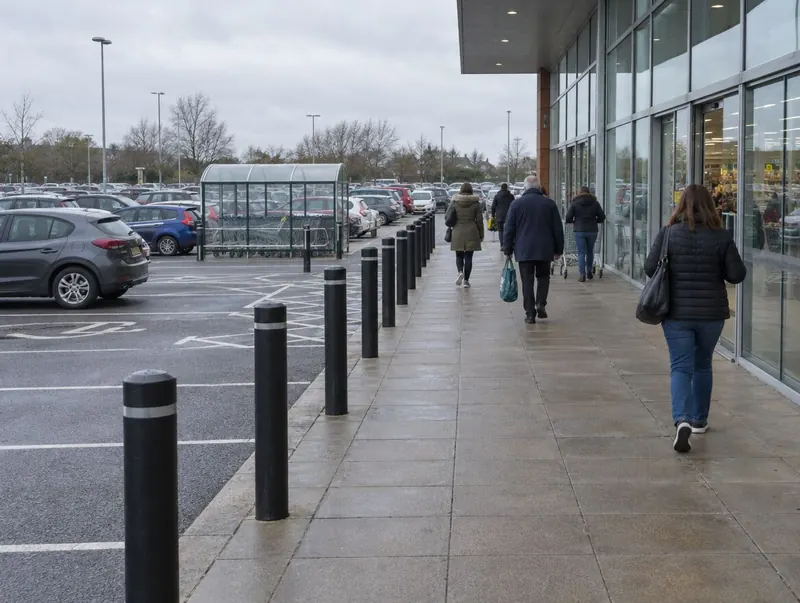 Computer-generated image
Barrow-in-Furness pedestrian protection bollards
Across Barrow-in-Furness, typical sites for pedestrian protection bollards include filling-station forecourts, community buildings and local parades. Products range from unrated steel posts to bollards tested against low-speed impacts under PAS 170-1.
Coverage in Barrow-in-Furness takes in the LA14, LA13, LA15 and LA16 postcode districts and nearby places like Rampside, Roa Island, Stank and Roosebeck. Nearby, we also work in Thornton-Cleveleys (18.4 miles) and Blackpool (21.6 miles), measured as the crow flies.
Key facts for this area
- Area
- Cumbria, England
- Highway authority
- Westmorland and Furness Council (local roads)
- Planning authority
- Westmorland and Furness Council
- Postcodes
- LA14, LA13, LA15 and LA16
- Guide price
- Typically £245–£1,195 per bollard + VAT; minimum job £575
- Survey
- Free, with a fixed written quote
- Nearby
- Thornton-Cleveleys (18.4 mi), Blackpool (21.6 mi)
Where pedestrian protection bollards go in around Barrow-in-Furness
Common uses in a place like Barrow-in-Furness:
- Shop entrances facing nose-in parking bays
- Outdoor seating at cafes, pubs and restaurants
- Walkways through supermarket and retail park car parks
What pedestrian protection bollards cost in Barrow-in-Furness
| Specification | Guide price | Includes |
|---|---|---|
| Standard | £245–£635 + VAT | Standard post, foundation, reinstatement |
| Upgraded | £515–£915 + VAT | Upgraded finish or fittings, reflective band, matched keys |
| Premium | £795–£1,195 + VAT | Heavy-duty or architectural spec, premium finish |
Per bollard, supplied and installed; -2% for North West. Guide only — the fixed price follows a survey.
What we check first in Barrow-in-Furness
In Barrow-in-Furness, work on adopted pavements and verges needs consent from Westmorland and Furness Council, the local highway authority. Car parks, forecourts and other private land only need the owner's permission.
Many private-land installations in Barrow-in-Furness need no planning application, but the rules don't clearly cover bollards, so listed buildings, conservation areas and prominent frontages are worth raising with the planning team at Westmorland and Furness Council before posts go in.
Raised kerbs also change the picture: a high kerb slows a wheel but does not stop a bumper, so the post still needs to sit within reach of the overhang rather than behind it. Positions are scanned and hand-dug before committing, and foundations are sized for the ground found rather than a fixed hole size.
- If a tested product has been requested, confirm PAS 170-1 or another stated standard and install to the tested foundation.
- Use contrasting bands so posts are visible to partially sighted people, and avoid linking chains across routes.
Installation, step by step
Set out the line
Posts are set out allowing for bumper overhang and keeping clear routes for pedestrians, trolleys and wheelchairs.
Excavate and set
Each position is cut, dug and checked for services, and the posts are set plumb in concrete to a consistent height.
Add bands and markings
Reflective bands are fitted and any wheel stops or line markings agreed in the scheme are installed.
Choosing the right spec
| Option | Detail |
|---|---|
| Stainless or architectural finishes | Stainless sleeves or decorative posts for shop entrances and public-facing frontages. |
| Lit bollards | Low-level lighting bollards double as protection on walkways where the product is robust enough for the job. |
| Visibility bands | Reflective and contrasting bands help drivers and partially sighted pedestrians see posts. |
What affects the quote
When we price pedestrian protection bollards in Barrow-in-Furness, these make the biggest difference:
- Reinstatement of tactile paving and walkway surfaces
- Number of posts and length of line
- Working around trading hours and live car parks
Keeping them working
If one post keeps being hit, look at the bay layout or add a wheel stop rather than replacing the same post repeatedly. Protection bollards take the knocks they are there for, so inspect them regularly and after any reported strike.
For damaged or loose posts in Barrow-in-Furness, repairs and replacements are priced in writing first.
Questions about pedestrian protection bollards in Barrow-in-Furness
Can you install pedestrian protection bollards anywhere in Barrow-in-Furness?
We cover all of Barrow-in-Furness (LA14, LA13, LA15 and LA16) and the rest of Cumbria. We also work in Thornton-Cleveleys and Blackpool.
Do I need consent for pedestrian protection bollards on a public footway in Barrow-in-Furness?
Westmorland and Furness Council is the highway authority covering Barrow-in-Furness's local roads. If any post would stand on adopted highway rather than your land, that consent is the first thing we sort out.
What's a typical price for pedestrian protection bollards in Barrow-in-Furness?
In Barrow-in-Furness, typically £245–£1,195 per bollard, supplied and installed, plus VAT, with a minimum job of £575 plus VAT, using our North West guide prices. The fixed figure comes in writing after we've seen the site.
Do pedestrian protection bollards need to be crash-rated?
Not usually. They deal with low-speed driver errors, so firmly founded steel posts often suffice. Where an owner, insurer or designer wants proven performance, PAS 170-1 tested products are the usual choice.
How far from the kerb should car park bollards go?
Far enough back that parked bumpers do not hit them, but not so far that they narrow the walkway. That distance depends on the bay length and kerb height. We set it on site with the layout in front of us.