Dorset · England
Pedestrian protection bollards in Christchurch
Local installation of pedestrian protection bollards in Christchurch — free survey, fixed written price, and posts set to the right spacing for people and vehicles.
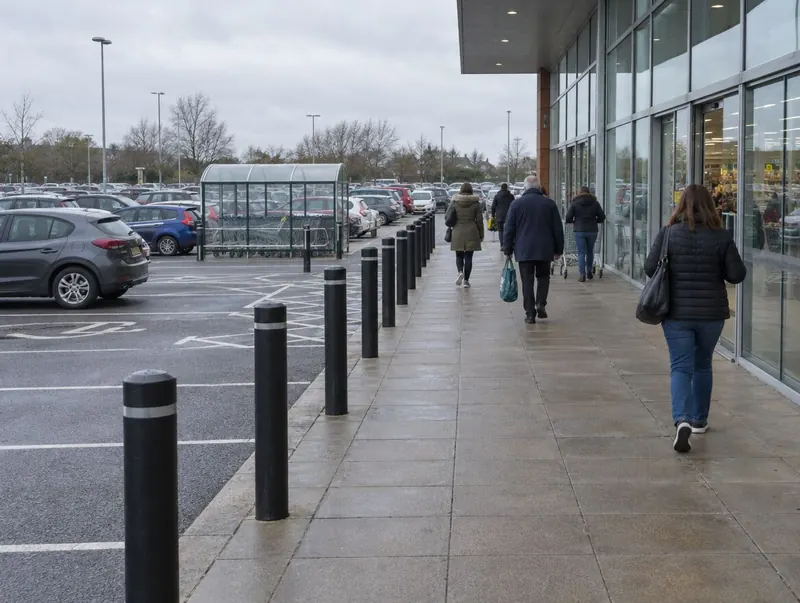 Computer-generated image
Christchurch pedestrian protection bollards
Bollards that separate people from vehicles at car parks, forecourts, walkways, drive-thrus and shop entrances. In Christchurch, that tends to mean sites such as schools, high street shopfronts and community buildings.
Coverage in Christchurch takes in the BH23 postcode district and nearby places like Winkton, West Hurn and Merritown. Nearby, we also work in Bournemouth (4.4 miles), New Milton (5.2 miles), Poole (9 miles) and Totton (17.9 miles), measured as the crow flies. Southampton is around 20 miles away.
Local details
- Area
- Dorset, England
- Highway authority
- Bournemouth, Christchurch and Poole Council (local roads)
- Planning authority
- Bournemouth, Christchurch and Poole Council
- Postcodes
- BH23
- Guide price
- Typically £245–£1,195 per bollard + VAT; minimum job £595
- Survey
- Free, with a fixed written quote
- Nearby
- Bournemouth (4.4 mi), New Milton (5.2 mi), Poole (9 mi), Totton (17.9 mi)
Typical pedestrian protection bollards jobs in Christchurch
Common uses in a place like Christchurch:
- Drive-thru lanes and order points next to seating
- EV charging points and trolley shelters
- Shop entrances facing nose-in parking bays
Christchurch: typical pedestrian protection bollard prices
| Specification | Guide price | Includes |
|---|---|---|
| Standard | £245–£645 + VAT | Standard post, foundation, reinstatement |
| Upgraded | £535–£925 + VAT | Upgraded finish or fittings, reflective band, matched keys |
| Premium | £815–£1,195 + VAT | Heavy-duty or architectural spec, premium finish |
Per bollard, supplied and installed; no regional adjustment. Guide only — the fixed price follows a survey.
What we check first in Christchurch
The highway authority for local roads in Christchurch is Bournemouth, Christchurch and Poole Council; motorways and trunk roads sit with National Highways. Pedestrian protection bollards on the adopted footway are a matter for the highway authority, so we only install there with its written agreement.
Bollards on private land often don't need planning permission, but it depends on the council's view, the height and the location; in a conservation area, next to a listed building or under an Article 4 direction, ask the local planning authority (Bournemouth, Christchurch and Poole Council) first — we flag this at survey.
Car park edges and walkways tend to be built quickly over shallow hardcore, and their kerb lines often carry lighting cables, drainage channels and ducts for EV chargers or signs. Raised kerbs also change the picture: a high kerb slows a wheel but does not stop a bumper, so the post still needs to sit within reach of the overhang rather than behind it.
- Keep clear gaps of typically at least 1,000–1,200 mm and keep main walkways wide enough, referring to Inclusive Mobility guidance.
- If a tested product has been requested, confirm PAS 170-1 or another stated standard and install to the tested foundation.
What happens on site
Reinstate
Paving, tarmac or concrete is made good flush around each post, with tactile paving reinstated where it was disturbed.
Add bands and markings
Reflective bands are fitted and any wheel stops or line markings agreed in the scheme are installed.
Agree a plan for live trading
Work is phased so entrances and walkways stay open, with each section fenced while it is dug and set. Busy sites often prefer early starts or quieter weekdays.
Specification choices
| Option | Detail |
|---|---|
| PAS 170-1 tested bollards | Tested against low-speed vehicle impacts, for sites where proven performance has been asked for. |
| Visibility bands | Reflective and contrasting bands help drivers and partially sighted pedestrians see posts. |
| Wheel stops and kerbs | Used with bollards to stop cars before they reach the posts, reducing daily knocks. |
Pricing pedestrian protection bollards in Christchurch
When we price pedestrian protection bollards in Christchurch, these make the biggest difference:
- Reinstatement of tactile paving and walkway surfaces
- Number of posts and length of line
- Working around trading hours and live car parks
Keeping them working
Protection bollards take the knocks they are there for, so inspect them regularly and after any reported strike. A post that leans or rocks has lost much of its value and should be re-bedded or replaced.
We can also service, repair or replace existing posts anywhere in Christchurch.
Pedestrian protection in Christchurch: FAQs
Which parts of Christchurch do you cover for pedestrian protection bollards?
We cover all of Christchurch (BH23) and the rest of Dorset. We also work in Bournemouth, New Milton and Poole.
Who gives permission for bollards on the pavement in Christchurch?
Bournemouth, Christchurch and Poole Council is the highway authority covering Christchurch's local roads. If any post would stand on adopted highway rather than your land, that consent is the first thing we sort out.
What's a typical price for pedestrian protection bollards in Christchurch?
In Christchurch, typically £245–£1,195 per bollard, supplied and installed, plus VAT, with a minimum job of £595 plus VAT, using our South West guide prices. The fixed figure comes in writing after we've seen the site.
How far from the kerb should car park bollards go?
Far enough back that parked bumpers do not hit them, but not so far that they narrow the walkway. That distance depends on the bay length and kerb height. We set it on site with the layout in front of us.
Will bollards block trolleys?
They should not if gaps are planned for trolleys and wheelchairs. Main routes to trolley bays need wider openings. We set gaps to suit the way the site works.
Pedestrian protection in nearby towns
- Bournemouth (4.4 mi)
- New Milton (5.2 mi)
- Poole (9 mi)
- Totton (17.9 mi)
- Hythe (18.7 mi)
- Southampton (20.1 mi)