East Ayrshire · Scotland
Pedestrian protection bollards in Kilmarnock
Local installation of pedestrian protection bollards in Kilmarnock — free survey, fixed written price, and posts set to the right spacing for people and vehicles.
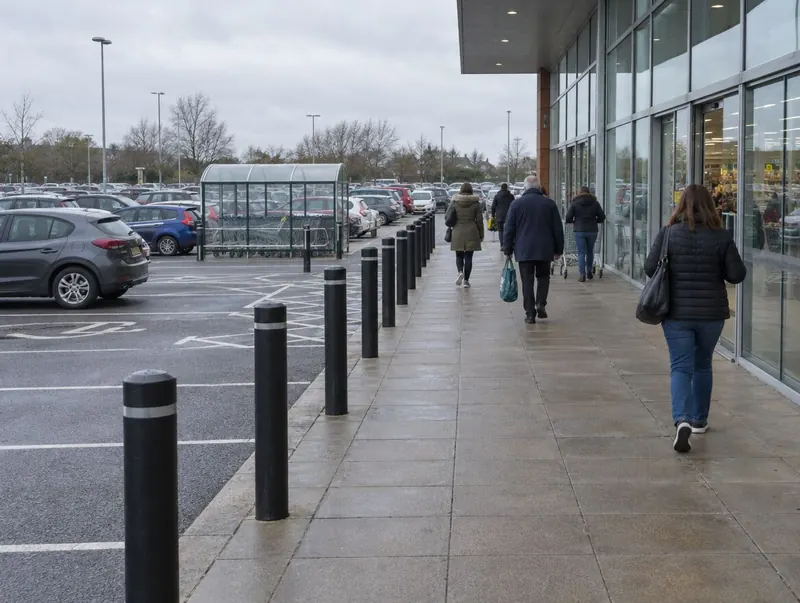 Computer-generated image
Kilmarnock pedestrian protection bollards
In the town of Kilmarnock, pedestrian protection bollards tend to go in at high street shopfronts, schools and small industrial units. Bollards that separate people from vehicles at car parks, forecourts, walkways, drive-thrus and shop entrances.
We cover Kilmarnock's KA1, KA3 and KA4 postcode districts, including places such as Hurlford, Symington, Craigie and Stewarton. Jobs in Kilmarnock can be combined with work in Irvine (6.2 miles), Troon (8.1 miles), Kilwinning (8.7 miles) and Prestwick (10 miles) (straight-line distances). Kilmarnock is about 20 miles from Glasgow.
Kilmarnock at a glance
- Area
- East Ayrshire, Scotland
- Roads authority
- East Ayrshire Council (local roads)
- Planning authority
- East Ayrshire Council
- Postcodes
- KA1, KA3 and KA4
- Guide price
- Typically £245–£1,195 per bollard + VAT; minimum job £595
- Survey
- Free, with a fixed written quote
- Nearby
- Irvine (6.2 mi), Troon (8.1 mi), Kilwinning (8.7 mi), Prestwick (10 mi)
Guide prices for Kilmarnock
| Specification | Guide price | Includes |
|---|---|---|
| Standard | £245–£645 + VAT | Standard post, foundation, reinstatement |
| Upgraded | £535–£925 + VAT | Upgraded finish or fittings, reflective band, matched keys |
| Premium | £815–£1,195 + VAT | Heavy-duty or architectural spec, premium finish |
Per bollard, supplied and installed; no regional adjustment. Guide only — the fixed price follows a survey.
Typical pedestrian protection bollards jobs in Kilmarnock
Typical reasons Kilmarnock sites choose pedestrian protection bollards:
- Petrol station forecourts and kiosk frontages
- Walkways through supermarket and retail park car parks
- EV charging points and trolley shelters
Before we dig in Kilmarnock
Kilmarnock falls under East Ayrshire Council as roads authority. If the line of posts crosses onto adopted road or pavement, permission comes before excavation; on private land it does not.
Bollards on private land often need no planning application, but listed buildings and conservation areas are different; the planning service at East Ayrshire Council can confirm before anything is ordered.
Raised kerbs also change the picture: a high kerb slows a wheel but does not stop a bumper, so the post still needs to sit within reach of the overhang rather than behind it. Reinstatement keeps walkways level and flush, because a trip edge around a new post in a busy car park creates the very hazard the posts are meant to reduce.
- Record why posts are where they are in the site's risk assessment, especially at drive-thrus and seating areas.
- Keep clear gaps of typically at least 1,000–1,200 mm and keep main walkways wide enough, referring to Inclusive Mobility guidance.
What happens on site
Watch how the site works
The free site survey looks at where cars park, where people walk and queue, and where incidents or near misses have happened. You receive a fixed written quote with positions marked.
Excavate and set
Each position is cut, dug and checked for services, and the posts are set plumb in concrete to a consistent height.
Agree a plan for live trading
Work is phased so entrances and walkways stay open, with each section fenced while it is dug and set. Busy sites often prefer early starts or quieter weekdays.
Options to consider
| Option | Detail |
|---|---|
| Lit bollards | Low-level lighting bollards double as protection on walkways where the product is robust enough for the job. |
| Stainless or architectural finishes | Stainless sleeves or decorative posts for shop entrances and public-facing frontages. |
| Wheel stops and kerbs | Used with bollards to stop cars before they reach the posts, reducing daily knocks. |
What affects the quote
When we price pedestrian protection bollards in Kilmarnock, these make the biggest difference:
- Reinstatement of tactile paving and walkway surfaces
- Number of posts and length of line
- Finishes such as stainless or decorative posts
After installation
Touch up chipped coatings, renew faded bands, and check the surface around each base for cracks that suggest movement. If one post keeps being hit, look at the bay layout or add a wheel stop rather than replacing the same post repeatedly.
For damaged or loose posts in Kilmarnock, repairs and replacements are priced in writing first.
Questions about pedestrian protection bollards in Kilmarnock
Can you install pedestrian protection bollards anywhere in Kilmarnock?
We cover all of Kilmarnock (KA1, KA3 and KA4) and the rest of East Ayrshire. We also work in Irvine, Troon and Kilwinning.
Who gives permission for bollards on the pavement in Kilmarnock?
Kilmarnock falls under East Ayrshire Council as roads authority. If the line of posts crosses onto adopted road or pavement, permission comes before excavation; on private land it does not.
What's a typical price for pedestrian protection bollards in Kilmarnock?
In Kilmarnock, typically £245–£1,195 per bollard, supplied and installed, plus VAT, with a minimum job of £595 plus VAT, using our Scotland guide prices. The fixed figure comes in writing after we've seen the site.
Are wheel stops enough on their own?
Wheel stops help drivers judge where to stop but a car can mount them with a firm press on the accelerator. Used with bollards, they reduce daily knocks on the posts. On their own they are not a barrier.
Will bollards block trolleys?
They should not if gaps are planned for trolleys and wheelchairs. Main routes to trolley bays need wider openings. We set gaps to suit the way the site works.