Gloucestershire · England
Pedestrian protection bollards in Gloucester
Pedestrian protection bollards supplied and fitted in Gloucester, Gloucestershire: surveyed, scanned for services, set in proper foundations and finished to match the ground.
 Computer-generated image
Gloucester pedestrian protection bollards
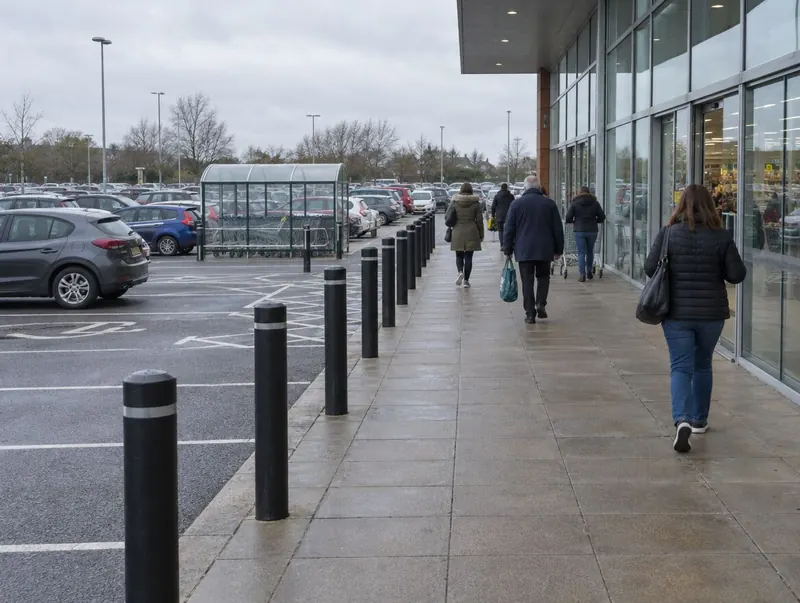
Pedestrian protection bollards suit plenty of Gloucester sites, leisure centres, supermarket frontages and business parks among them. Products range from unrated steel posts to bollards tested against low-speed impacts under PAS 170-1.
We work across GL1, GL2 and GL4 — Gloucester itself and places including Quedgeley and Hardwicke. We also cover neighbouring Cheltenham (7.4 miles), Stroud (8.2 miles), Tewkesbury (9.4 miles) and Cirencester (15.4 miles) — distances are straight-line. Gloucester is about 29 miles from Swindon.
Local details
- Area
- Gloucestershire, England
- Highway authority
- Gloucestershire County Council (local roads)
- Planning authority
- Gloucestershire County Council
- Postcodes
- GL1, GL2 and GL4
- Guide price
- Typically £245–£1,195 per bollard + VAT; minimum job £595
- Survey
- Free, with a fixed written quote
- Nearby
- Cheltenham (7.4 mi), Stroud (8.2 mi), Tewkesbury (9.4 mi), Cirencester (15.4 mi)
Where pedestrian protection bollards go in around Gloucester
Common uses in a place like Gloucester:
- Walkways through supermarket and retail park car parks
- Drive-thru lanes and order points next to seating
- EV charging points and trolley shelters
What pedestrian protection bollards cost in Gloucester
| Specification | Guide price | Includes |
|---|---|---|
| Standard | £245–£645 + VAT | Standard post, foundation, reinstatement |
| Upgraded | £535–£925 + VAT | Upgraded finish or fittings, reflective band, matched keys |
| Premium | £815–£1,195 + VAT | Heavy-duty or architectural spec, premium finish |
Per bollard, supplied and installed; no regional adjustment. Guide only — the fixed price follows a survey.
What we check first in Gloucester
In Gloucester, work on adopted pavements and verges needs consent from Gloucestershire County Council, the local highway authority. Car parks, forecourts and other private land only need the owner's permission.
If your site in Gloucester is listed or inside a conservation area, check with the local planning authority (Gloucestershire County Council) before choosing a finish — heritage settings often favour cast iron or painted steel over stainless.
Car park edges and walkways tend to be built quickly over shallow hardcore, and their kerb lines often carry lighting cables, drainage channels and ducts for EV chargers or signs. Raised kerbs also change the picture: a high kerb slows a wheel but does not stop a bumper, so the post still needs to sit within reach of the overhang rather than behind it.
- Record why posts are where they are in the site's risk assessment, especially at drive-thrus and seating areas.
- Keep clear gaps of typically at least 1,000–1,200 mm and keep main walkways wide enough, referring to Inclusive Mobility guidance.
How the job runs
Set out the line
Posts are set out allowing for bumper overhang and keeping clear routes for pedestrians, trolleys and wheelchairs.
Add bands and markings
Reflective bands are fitted and any wheel stops or line markings agreed in the scheme are installed.
Agree a plan for live trading
Work is phased so entrances and walkways stay open, with each section fenced while it is dug and set. Busy sites often prefer early starts or quieter weekdays.
Finishes and options
| Option | Detail |
|---|---|
| Visibility bands | Reflective and contrasting bands help drivers and partially sighted pedestrians see posts. |
| PAS 170-1 tested bollards | Tested against low-speed vehicle impacts, for sites where proven performance has been asked for. |
| Concrete-filled steel posts | Root-fixed galvanised and powder-coated steel, the standard unrated choice for walkways and frontages. |
What moves the price in Gloucester
Two Gloucester jobs with the same number of posts can price quite differently. The usual reasons:
- Ground conditions and services along kerb lines
- Reinstatement of tactile paving and walkway surfaces
- Unrated steel or PAS 170-1 tested products
After installation
Touch up chipped coatings, renew faded bands, and check the surface around each base for cracks that suggest movement. A post that leans or rocks has lost much of its value and should be re-bedded or replaced.
For damaged or loose posts in Gloucester, repairs and replacements are priced in writing first.
Pedestrian protection in Gloucester: FAQs
Can you install pedestrian protection bollards anywhere in Gloucester?
We cover all of Gloucester (GL1, GL2 and GL4) and the rest of Gloucestershire. We also work in Cheltenham, Stroud and Tewkesbury.
Who gives permission for bollards on the pavement in Gloucester?
In Gloucester, work on adopted pavements and verges needs consent from Gloucestershire County Council, the local highway authority. Car parks, forecourts and other private land only need the owner's permission.
How much do pedestrian protection bollards cost in Gloucester?
In Gloucester, typically £245–£1,195 per bollard, supplied and installed, plus VAT, with a minimum job of £595 plus VAT, using our South West guide prices. The fixed figure comes in writing after we've seen the site.
Are wheel stops enough on their own?
Wheel stops help drivers judge where to stop but a car can mount them with a firm press on the accelerator. Used with bollards, they reduce daily knocks on the posts. On their own they are not a barrier.
Will bollards block trolleys?
They should not if gaps are planned for trolleys and wheelchairs. Main routes to trolley bays need wider openings. We set gaps to suit the way the site works.
Pedestrian protection in nearby towns
- Cheltenham (7.4 mi)
- Stroud (8.2 mi)
- Tewkesbury (9.4 mi)
- Cirencester (15.4 mi)
- Great Malvern (17.3 mi)
- Evesham (20.1 mi)