Inverclyde · Scotland
Pedestrian protection bollards in Port Glasgow
Pedestrian protection bollards supplied and fitted in Port Glasgow, Inverclyde: surveyed, scanned for services, set in proper foundations and finished to match the ground.
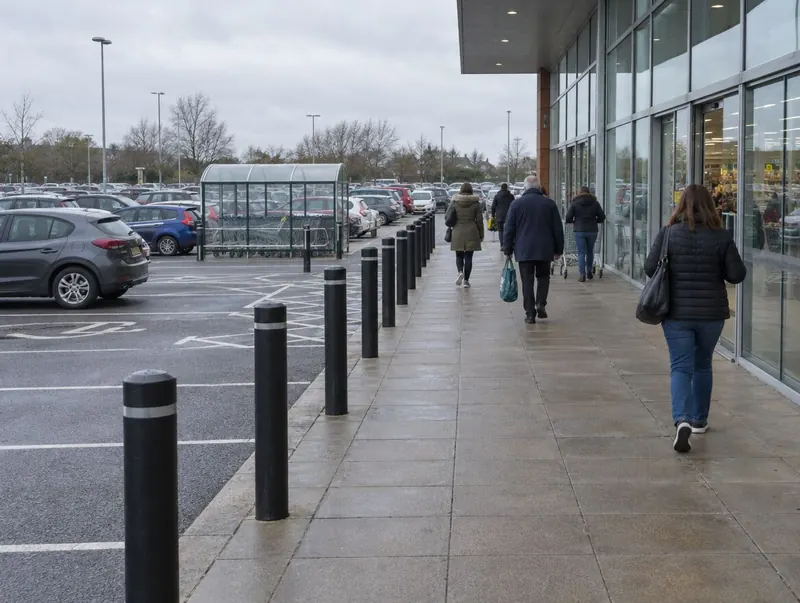 Computer-generated image
About pedestrian protection bollards in Port Glasgow
Pedestrian protection bollards suit plenty of Port Glasgow sites, small industrial units, community buildings and filling-station forecourts among them. Products range from unrated steel posts to bollards tested against low-speed impacts under PAS 170-1.
We cover Port Glasgow's PA14 and PA13 postcode districts, including places such as Kilmacolm. We also cover neighbouring Greenock (2.9 miles), Gourock (5.3 miles), Erskine (9.6 miles) and Johnstone (9.9 miles) — distances are straight-line. Glasgow is around 17 miles away.
Key facts for this area
- Area
- Inverclyde, Scotland
- Roads authority
- Inverclyde Council (local roads)
- Planning authority
- Inverclyde Council
- Postcodes
- PA14 and PA13
- Guide price
- Typically £245–£1,195 per bollard + VAT; minimum job £595
- Survey
- Free, with a fixed written quote
What pedestrian protection bollards cost in Port Glasgow
| Specification | Guide price | Includes |
|---|---|---|
| Standard | £245–£645 + VAT | Standard post, foundation, reinstatement |
| Upgraded | £535–£925 + VAT | Upgraded finish or fittings, reflective band, matched keys |
| Premium | £815–£1,195 + VAT | Heavy-duty or architectural spec, premium finish |
Per bollard, supplied and installed; no regional adjustment. Guide only — the fixed price follows a survey.
Where pedestrian protection bollards go in around Port Glasgow
Common uses in a place like Port Glasgow:
- Walkways through supermarket and retail park car parks
- Outdoor seating at cafes, pubs and restaurants
- Shop entrances facing nose-in parking bays
Consents, ground and services in Port Glasgow
In Scotland the council is the roads authority for local roads, which in Port Glasgow means Inverclyde Council. Pedestrian protection bollards on an adopted footway need its consent; trunk roads sit with Transport Scotland.
Bollards on private land often need no planning application, but listed buildings and conservation areas are different; the planning service at Inverclyde Council can confirm before anything is ordered.
Car park edges and walkways tend to be built quickly over shallow hardcore, and their kerb lines often carry lighting cables, drainage channels and ducts for EV chargers or signs. Positions are scanned and hand-dug before committing, and foundations are sized for the ground found rather than a fixed hole size.
- If a tested product has been requested, confirm PAS 170-1 or another stated standard and install to the tested foundation.
- Use contrasting bands so posts are visible to partially sighted people, and avoid linking chains across routes.
How the job runs
Set out the line
Posts are set out allowing for bumper overhang and keeping clear routes for pedestrians, trolleys and wheelchairs.
Reinstate
Paving, tarmac or concrete is made good flush around each post, with tactile paving reinstated where it was disturbed.
Agree a plan for live trading
Work is phased so entrances and walkways stay open, with each section fenced while it is dug and set. Busy sites often prefer early starts or quieter weekdays.
Choosing the right spec
| Option | Detail |
|---|---|
| Stainless or architectural finishes | Stainless sleeves or decorative posts for shop entrances and public-facing frontages. |
| Concrete-filled steel posts | Root-fixed galvanised and powder-coated steel, the standard unrated choice for walkways and frontages. |
| Lit bollards | Low-level lighting bollards double as protection on walkways where the product is robust enough for the job. |
What moves the price in Port Glasgow
Our Scotland guide prices are a starting point; the survey in Port Glasgow firms them up. What tends to move them:
- Ground conditions and services along kerb lines
- Reinstatement of tactile paving and walkway surfaces
- Finishes such as stainless or decorative posts
Keeping them working
Touch up chipped coatings, renew faded bands, and check the surface around each base for cracks that suggest movement. If one post keeps being hit, look at the bay layout or add a wheel stop rather than replacing the same post repeatedly.
We can also service, repair or replace existing posts anywhere in Port Glasgow.
Common questions
Can you install pedestrian protection bollards anywhere in Port Glasgow?
We cover all of Port Glasgow (PA14 and PA13) and the rest of Inverclyde. We also work in Greenock, Gourock and Erskine.
Do I need consent for pedestrian protection bollards on a public footway in Port Glasgow?
Port Glasgow falls under Inverclyde Council as roads authority. If the line of posts crosses onto adopted road or pavement, permission comes before excavation; on private land it does not.
What's a typical price for pedestrian protection bollards in Port Glasgow?
In Port Glasgow, typically £245–£1,195 per bollard, supplied and installed, plus VAT, with a minimum job of £595 plus VAT, using our Scotland guide prices. The fixed figure comes in writing after we've seen the site.
Are wheel stops enough on their own?
Wheel stops help drivers judge where to stop but a car can mount them with a firm press on the accelerator. Used with bollards, they reduce daily knocks on the posts. On their own they are not a barrier.
Will bollards block trolleys?
They should not if gaps are planned for trolleys and wheelchairs. Main routes to trolley bays need wider openings. We set gaps to suit the way the site works.
Pedestrian protection near Port Glasgow
- Greenock (2.9 mi)
- Gourock (5.3 mi)
- Erskine (9.6 mi)
- Johnstone (9.9 mi)
- Clydebank (11.2 mi)
- Largs (11.7 mi)