Isle of Wight · England
Pedestrian protection bollards in Ryde
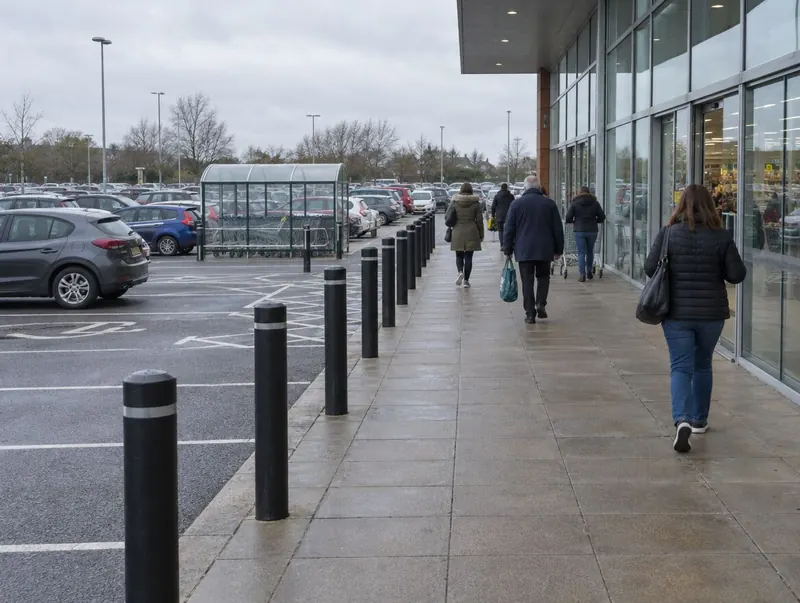
Pedestrian protection bollards supplied and fitted in Ryde, Isle of Wight: surveyed, scanned for services, set in proper foundations and finished to match the ground.
 Computer-generated image
Ryde pedestrian protection bollards
Whether it's schools, high street shopfronts and filling-station forecourts, pedestrian protection bollards in Ryde are planned around who needs to get through and who doesn't. Products range from unrated steel posts to bollards tested against low-speed impacts under PAS 170-1.
Coverage in Ryde takes in the PO33 and PO34 postcode districts and nearby places like Pondwell, Havenstreet, Ashey and Hillgrove. Jobs in Ryde can be combined with work in Sandown (5.4 miles), Newport, Isle of Wight (6 miles) and Cowes (6.3 miles) (straight-line distances).
Key facts for this area
- Area
- Isle of Wight, England
- Highway authority
- Isle of Wight Council (local roads)
- Planning authority
- Isle of Wight Council
- Postcodes
- PO33 and PO34
- Guide price
- Typically £265–£1,245 per bollard + VAT; minimum job £625
- Survey
- Free, with a fixed written quote
- Nearby
- Sandown (5.4 mi), Newport, Isle of Wight (6 mi), Cowes (6.3 mi)
Where pedestrian protection bollards go in around Ryde
Common uses in a place like Ryde:
- Walkways through supermarket and retail park car parks
- Petrol station forecourts and kiosk frontages
- School and hospital drop-off zones
What pedestrian protection bollards cost in Ryde
| Specification | Guide price | Includes |
|---|---|---|
| Standard | £265–£685 + VAT | Standard post, foundation, reinstatement |
| Upgraded | £565–£985 + VAT | Upgraded finish or fittings, reflective band, matched keys |
| Premium | £865–£1,245 + VAT | Heavy-duty or architectural spec, premium finish |
Per bollard, supplied and installed; +6% for South East. Guide only — the fixed price follows a survey.
Consents, ground and services in Ryde
In Ryde, work on adopted pavements and verges needs consent from Isle of Wight Council, the local highway authority. Car parks, forecourts and other private land only need the owner's permission.
Many private-land installations in Ryde need no planning application, but the rules don't clearly cover bollards, so listed buildings, conservation areas and prominent frontages are worth raising with the planning team at Isle of Wight Council before posts go in.
Positions are scanned and hand-dug before committing, and foundations are sized for the ground found rather than a fixed hole size. Where bollards protect a shopfront, the building's own foundations and any canopy columns may sit close to the line, which limits how deep and wide each base can go.
- Keep clear gaps of typically at least 1,000–1,200 mm and keep main walkways wide enough, referring to Inclusive Mobility guidance.
- If a tested product has been requested, confirm PAS 170-1 or another stated standard and install to the tested foundation.
How the job runs
Excavate and set
Each position is cut, dug and checked for services, and the posts are set plumb in concrete to a consistent height.
Reinstate
Paving, tarmac or concrete is made good flush around each post, with tactile paving reinstated where it was disturbed.
Add bands and markings
Reflective bands are fitted and any wheel stops or line markings agreed in the scheme are installed.
Specification choices
| Option | Detail |
|---|---|
| Stainless or architectural finishes | Stainless sleeves or decorative posts for shop entrances and public-facing frontages. |
| Concrete-filled steel posts | Root-fixed galvanised and powder-coated steel, the standard unrated choice for walkways and frontages. |
| Lit bollards | Low-level lighting bollards double as protection on walkways where the product is robust enough for the job. |
What affects the quote
Two Ryde jobs with the same number of posts can price quite differently. The usual reasons:
- Working around trading hours and live car parks
- Unrated steel or PAS 170-1 tested products
- Reinstatement of tactile paving and walkway surfaces
After installation
Damaged posts near entrances should be dealt with quickly, as a bent post with a torn edge is a hazard in its own right. Keep a simple note of strikes and their locations; over a year it shows which parts of the car park drivers find awkward, which is useful when the site is next resurfaced or re-lined.
We can also service, repair or replace existing posts anywhere in Ryde.
Common questions
Can you install pedestrian protection bollards anywhere in Ryde?
We cover all of Ryde (PO33 and PO34) and the rest of Isle of Wight. We also work in Sandown, Newport, Isle of Wight and Cowes.
Who gives permission for bollards on the pavement in Ryde?
The highway authority for local roads in Ryde is Isle of Wight Council; motorways and trunk roads sit with National Highways. Pedestrian protection bollards on the adopted footway are a matter for the highway authority, so we only install there with its written agreement.
What's a typical price for pedestrian protection bollards in Ryde?
In Ryde, typically £265–£1,245 per bollard, supplied and installed, plus VAT, with a minimum job of £625 plus VAT, using our South East guide prices. The fixed figure comes in writing after we've seen the site.
Will bollards block trolleys?
They should not if gaps are planned for trolleys and wheelchairs. Main routes to trolley bays need wider openings. We set gaps to suit the way the site works.
Do pedestrian protection bollards need to be crash-rated?
Not usually. They deal with low-speed driver errors, so firmly founded steel posts often suffice. Where an owner, insurer or designer wants proven performance, PAS 170-1 tested products are the usual choice.