Merseyside · England
Pedestrian protection bollards in Liverpool
Pedestrian protection bollards for sites across Liverpool and the rest of Merseyside, from the first measurement to the last relaid paving block.
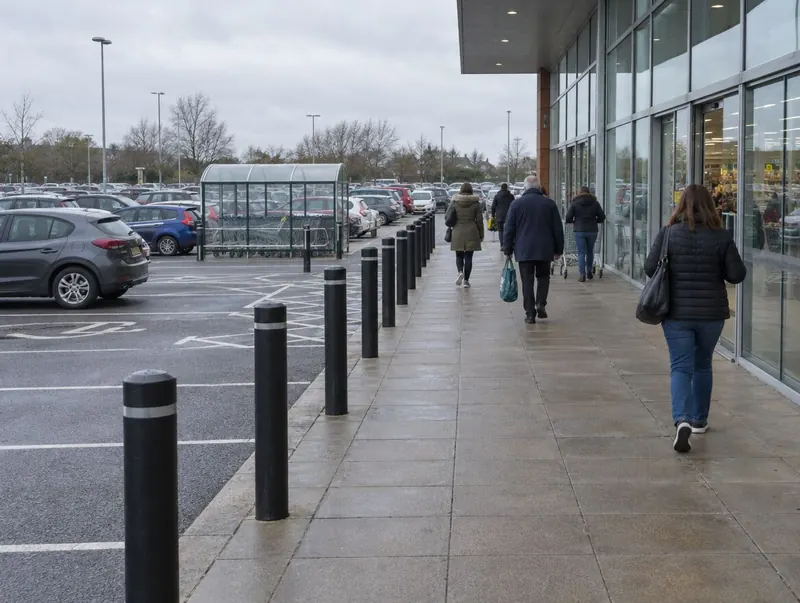 Computer-generated image
Pedestrian protection in Liverpool
From retail parks, office forecourts and stadium approaches, Liverpool has plenty of places where pedestrian protection bollards earn their keep. Products range from unrated steel posts to bollards tested against low-speed impacts under PAS 170-1.
We cover every part of Liverpool in the L3, L2, L1, L5, L7 and L6 postcode districts. Jobs in Liverpool can be combined with work in Birkenhead (1.9 miles), Wallasey (3.7 miles), Bootle (4.2 miles) and Litherland (4.2 miles) (straight-line distances). It sits roughly 27 miles from Preston as the crow flies.
Liverpool at a glance
- Area
- Merseyside, England
- Highway authority
- Liverpool City Council (local roads)
- Planning authority
- Liverpool City Council
- Postcodes
- L3, L2, L1, L5, L7, L6, L8 and L4
- Guide price
- Typically £245–£1,195 per bollard + VAT; minimum job £575
- Survey
- Free, with a fixed written quote
- Nearby
- Birkenhead (1.9 mi), Wallasey (3.7 mi), Bootle (4.2 mi), Litherland (4.2 mi)
Typical pedestrian protection bollards jobs in Liverpool
Around Liverpool, pedestrian protection bollards usually solve one of these:
- Shop entrances facing nose-in parking bays
- School and hospital drop-off zones
- Drive-thru lanes and order points next to seating
Guide prices for Liverpool
| Specification | Guide price | Includes |
|---|---|---|
| Standard | £245–£635 + VAT | Standard post, foundation, reinstatement |
| Upgraded | £515–£915 + VAT | Upgraded finish or fittings, reflective band, matched keys |
| Premium | £795–£1,195 + VAT | Heavy-duty or architectural spec, premium finish |
Per bollard, supplied and installed; -2% for North West. Guide only — the fixed price follows a survey.
Consents, ground and services in Liverpool
Liverpool City Council is the highway authority covering Liverpool's local roads. If any post would stand on adopted highway rather than your land, that consent is the first thing we sort out.
Many private-land installations in Liverpool need no planning application, but the rules don't clearly cover bollards, so listed buildings, conservation areas and prominent frontages are worth raising with the planning team at Liverpool City Council before posts go in.
Where bollards protect a shopfront, the building's own foundations and any canopy columns may sit close to the line, which limits how deep and wide each base can go. Reinstatement keeps walkways level and flush, because a trip edge around a new post in a busy car park creates the very hazard the posts are meant to reduce.
- Use contrasting bands so posts are visible to partially sighted people, and avoid linking chains across routes.
- If a tested product has been requested, confirm PAS 170-1 or another stated standard and install to the tested foundation.
What happens on site
Watch how the site works
The free site survey looks at where cars park, where people walk and queue, and where incidents or near misses have happened. You receive a fixed written quote with positions marked.
Excavate and set
Each position is cut, dug and checked for services, and the posts are set plumb in concrete to a consistent height.
Reinstate
Paving, tarmac or concrete is made good flush around each post, with tactile paving reinstated where it was disturbed.
Choosing the right spec
| Option | Detail |
|---|---|
| Concrete-filled steel posts | Root-fixed galvanised and powder-coated steel, the standard unrated choice for walkways and frontages. |
| Visibility bands | Reflective and contrasting bands help drivers and partially sighted pedestrians see posts. |
| Wheel stops and kerbs | Used with bollards to stop cars before they reach the posts, reducing daily knocks. |
What affects the quote
Our North West guide prices are a starting point; the survey in Liverpool firms them up. What tends to move them:
- Unrated steel or PAS 170-1 tested products
- Number of posts and length of line
- Reinstatement of tactile paving and walkway surfaces
Keeping them working
Damaged posts near entrances should be dealt with quickly, as a bent post with a torn edge is a hazard in its own right. Protection bollards take the knocks they are there for, so inspect them regularly and after any reported strike.
For damaged or loose posts in Liverpool, repairs and replacements are priced in writing first.
Common questions
Do you install pedestrian protection bollards in Liverpool?
We cover all of Liverpool (L3, L2, L1, L5, L7 and L6) and the rest of Merseyside. We also work in Birkenhead, Wallasey and Bootle.
Do I need consent for pedestrian protection bollards on a public footway in Liverpool?
The highway authority for local roads in Liverpool is Liverpool City Council; motorways and trunk roads sit with National Highways. Pedestrian protection bollards on the adopted footway are a matter for the highway authority, so we only install there with its written agreement.
How much do pedestrian protection bollards cost in Liverpool?
In Liverpool, typically £245–£1,195 per bollard, supplied and installed, plus VAT, with a minimum job of £575 plus VAT, using our North West guide prices. The fixed figure comes in writing after we've seen the site.
Should bollards be added at a drive-thru order point?
Often, yes, where people queue or sit beside the lane. Posts should follow the curve of the lane and be closest together at corners, where drivers tend to misjudge the turn. The positions are agreed on site with the operator.
Do pedestrian protection bollards need to be crash-rated?
Not usually. They deal with low-speed driver errors, so firmly founded steel posts often suffice. Where an owner, insurer or designer wants proven performance, PAS 170-1 tested products are the usual choice.
Pedestrian protection in nearby towns
- Birkenhead (1.9 mi)
- Wallasey (3.7 mi)
- Bootle (4.2 mi)
- Litherland (4.2 mi)
- Bebington (4.5 mi)
- Huyton (5.7 mi)