Merseyside · England
Pedestrian protection bollards in St Helens
Planning pedestrian protection bollards in St Helens? We check ownership, consents and buried services first, then quote a fixed price.
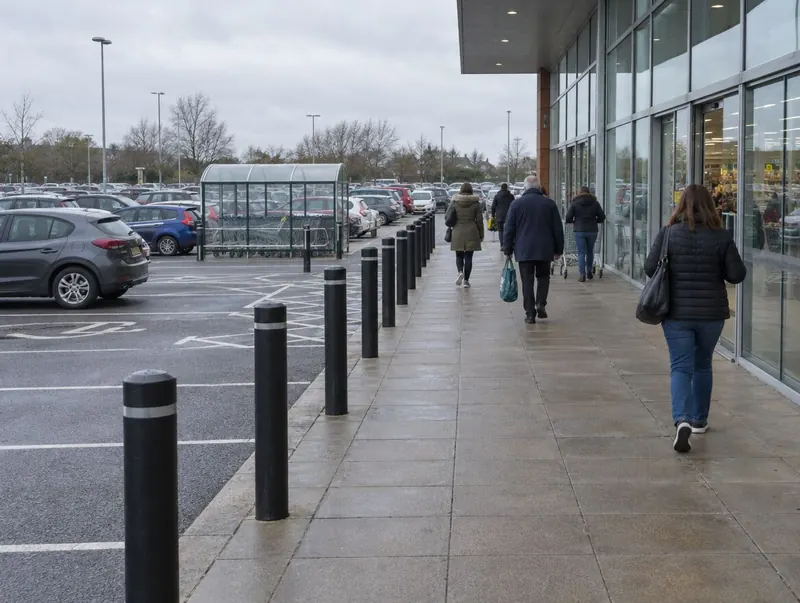 Computer-generated image
Pedestrian protection in St Helens
We supply and fit pedestrian protection bollards throughout St Helens, typically for sites such as supermarket frontages, industrial estates and housing association car parks. Bollards that separate people from vehicles at car parks, forecourts, walkways, drive-thrus and shop entrances.
We work across WA10, WA9 and WA11 — St Helens itself and places including Gillar's Green, Haydock, Rainford and Rainford Junction. We also cover neighbouring Prescot (3.1 miles), Ashton-in-Makerfield (4.6 miles), Huyton (5.1 miles) and Newton-le-Willows (5.5 miles) — distances are straight-line. It sits roughly 10 miles from Liverpool as the crow flies.
St Helens at a glance
- Area
- Merseyside, England
- Highway authority
- St. Helens Council (local roads)
- Planning authority
- St. Helens Council
- Postcodes
- WA10, WA9 and WA11
- Guide price
- Typically £245–£1,195 per bollard + VAT; minimum job £575
- Survey
- Free, with a fixed written quote
- Nearby
- Prescot (3.1 mi), Ashton-in-Makerfield (4.6 mi), Huyton (5.1 mi), Newton-le-Willows (5.5 mi)
Pedestrian protection bollard prices in St Helens
| Specification | Guide price | Includes |
|---|---|---|
| Standard | £245–£635 + VAT | Standard post, foundation, reinstatement |
| Upgraded | £515–£915 + VAT | Upgraded finish or fittings, reflective band, matched keys |
| Premium | £795–£1,195 + VAT | Heavy-duty or architectural spec, premium finish |
Per bollard, supplied and installed; -2% for North West. Guide only — the fixed price follows a survey.
Typical pedestrian protection bollards jobs in St Helens
Typical reasons St Helens sites choose pedestrian protection bollards:
- Petrol station forecourts and kiosk frontages
- School and hospital drop-off zones
- Drive-thru lanes and order points next to seating
Before we dig in St Helens
The highway authority for local roads in St Helens is St. Helens Council; motorways and trunk roads sit with National Highways. Pedestrian protection bollards on the adopted footway are a matter for the highway authority, so we only install there with its written agreement.
If your site in St Helens is listed or inside a conservation area, check with the local planning authority (St. Helens Council) before choosing a finish — heritage settings often favour cast iron or painted steel over stainless.
Where bollards protect a shopfront, the building's own foundations and any canopy columns may sit close to the line, which limits how deep and wide each base can go. Positions are scanned and hand-dug before committing, and foundations are sized for the ground found rather than a fixed hole size.
- Keep clear gaps of typically at least 1,000–1,200 mm and keep main walkways wide enough, referring to Inclusive Mobility guidance.
- Record why posts are where they are in the site's risk assessment, especially at drive-thrus and seating areas.
How the job runs
Watch how the site works
The free site survey looks at where cars park, where people walk and queue, and where incidents or near misses have happened. You receive a fixed written quote with positions marked.
Excavate and set
Each position is cut, dug and checked for services, and the posts are set plumb in concrete to a consistent height.
Add bands and markings
Reflective bands are fitted and any wheel stops or line markings agreed in the scheme are installed.
Options to consider
| Option | Detail |
|---|---|
| Lit bollards | Low-level lighting bollards double as protection on walkways where the product is robust enough for the job. |
| PAS 170-1 tested bollards | Tested against low-speed vehicle impacts, for sites where proven performance has been asked for. |
| Visibility bands | Reflective and contrasting bands help drivers and partially sighted pedestrians see posts. |
Pricing pedestrian protection bollards in St Helens
Our North West guide prices are a starting point; the survey in St Helens firms them up. What tends to move them:
- Working around trading hours and live car parks
- Reinstatement of tactile paving and walkway surfaces
- Ground conditions and services along kerb lines
After installation
Touch up chipped coatings, renew faded bands, and check the surface around each base for cracks that suggest movement. Keep a simple note of strikes and their locations; over a year it shows which parts of the car park drivers find awkward, which is useful when the site is next resurfaced or re-lined.
If posts in St Helens are later hit or damaged, we can repair or replace them — see bollard repairs.
Pedestrian protection in St Helens: FAQs
Do you install pedestrian protection bollards in St Helens?
We cover all of St Helens (WA10, WA9 and WA11) and the rest of Merseyside. We also work in Prescot, Ashton-in-Makerfield and Huyton.
Who gives permission for bollards on the pavement in St Helens?
In St Helens, work on adopted pavements and verges needs consent from St. Helens Council, the local highway authority. Car parks, forecourts and other private land only need the owner's permission.
How much do pedestrian protection bollards cost in St Helens?
In St Helens, typically £245–£1,195 per bollard, supplied and installed, plus VAT, with a minimum job of £575 plus VAT, using our North West guide prices. The fixed figure comes in writing after we've seen the site.
Will bollards block trolleys?
They should not if gaps are planned for trolleys and wheelchairs. Main routes to trolley bays need wider openings. We set gaps to suit the way the site works.
Should bollards be added at a drive-thru order point?
Often, yes, where people queue or sit beside the lane. Posts should follow the curve of the lane and be closest together at corners, where drivers tend to misjudge the turn. The positions are agreed on site with the operator.
Pedestrian protection near St Helens
- Prescot (3.1 mi)
- Ashton-in-Makerfield (4.6 mi)
- Huyton (5.1 mi)
- Newton-le-Willows (5.5 mi)
- Golborne (5.9 mi)
- Widnes (6.1 mi)