Warwickshire · England
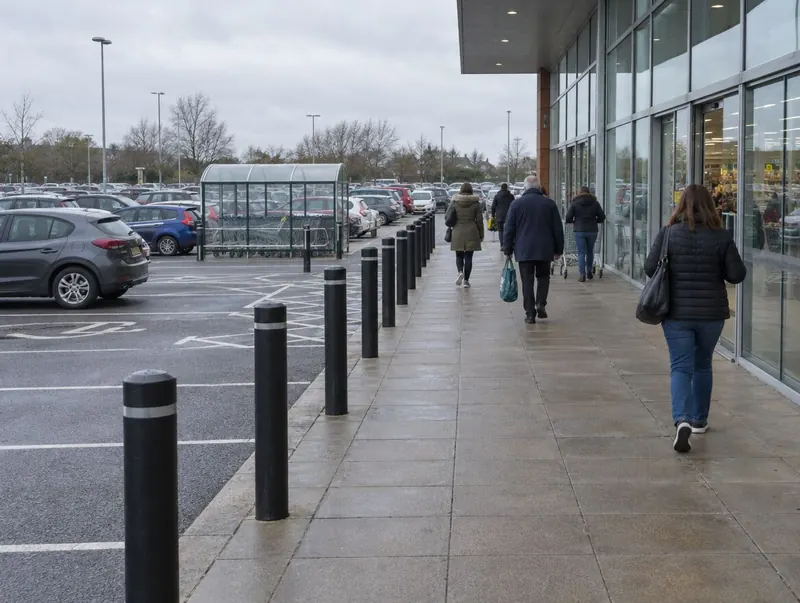
Pedestrian protection bollards in Rugby
Pedestrian protection bollards supplied and fitted in Rugby, Warwickshire: surveyed, scanned for services, set in proper foundations and finished to match the ground.
 Computer-generated image
Rugby pedestrian protection bollards
We supply and fit pedestrian protection bollards throughout Rugby, typically for sites such as leisure centres, industrial estates and business parks. Bollards that separate people from vehicles at car parks, forecourts, walkways, drive-thrus and shop entrances.
Coverage in Rugby takes in the CV23, CV21 and CV22 postcode districts and nearby places like Long Lawford, Brinklow, Clifton upon Dunsmore and Stretton-on-Dunsmore. We also cover neighbouring Daventry (9 miles), Coventry (10.7 miles), Bedworth (11.4 miles) and Hinckley (12.5 miles) — distances are straight-line. Rugby is about 11 miles from Coventry.
Local details
- Area
- Warwickshire, England
- Highway authority
- Warwickshire County Council (local roads)
- Planning authority
- the council for Rugby
- Postcodes
- CV23, CV21 and CV22
- Guide price
- Typically £245–£1,195 per bollard + VAT; minimum job £595
- Survey
- Free, with a fixed written quote
Typical pedestrian protection bollards jobs in Rugby
Typical reasons Rugby sites choose pedestrian protection bollards:
- Outdoor seating at cafes, pubs and restaurants
- School and hospital drop-off zones
- Walkways through supermarket and retail park car parks
What pedestrian protection bollards cost in Rugby
| Specification | Guide price | Includes |
|---|---|---|
| Standard | £245–£645 + VAT | Standard post, foundation, reinstatement |
| Upgraded | £535–£925 + VAT | Upgraded finish or fittings, reflective band, matched keys |
| Premium | £815–£1,195 + VAT | Heavy-duty or architectural spec, premium finish |
Per bollard, supplied and installed; no regional adjustment. Guide only — the fixed price follows a survey.
Permissions and groundwork in Rugby
Warwickshire County Council is the highway authority covering Rugby's local roads. If any post would stand on adopted highway rather than your land, that consent is the first thing we sort out.
Bollards on private land often don't need planning permission, but it depends on the council's view, the height and the location; in a conservation area, next to a listed building or under an Article 4 direction, ask the local planning authority (the council for Rugby) first — we flag this at survey.
Raised kerbs also change the picture: a high kerb slows a wheel but does not stop a bumper, so the post still needs to sit within reach of the overhang rather than behind it. Where bollards protect a shopfront, the building's own foundations and any canopy columns may sit close to the line, which limits how deep and wide each base can go.
- If a tested product has been requested, confirm PAS 170-1 or another stated standard and install to the tested foundation.
- Record why posts are where they are in the site's risk assessment, especially at drive-thrus and seating areas.
Installation, step by step
Excavate and set
Each position is cut, dug and checked for services, and the posts are set plumb in concrete to a consistent height.
Add bands and markings
Reflective bands are fitted and any wheel stops or line markings agreed in the scheme are installed.
Agree a plan for live trading
Work is phased so entrances and walkways stay open, with each section fenced while it is dug and set. Busy sites often prefer early starts or quieter weekdays.
Options to consider
| Option | Detail |
|---|---|
| Wheel stops and kerbs | Used with bollards to stop cars before they reach the posts, reducing daily knocks. |
| PAS 170-1 tested bollards | Tested against low-speed vehicle impacts, for sites where proven performance has been asked for. |
| Lit bollards | Low-level lighting bollards double as protection on walkways where the product is robust enough for the job. |
What moves the price in Rugby
When we price pedestrian protection bollards in Rugby, these make the biggest difference:
- Finishes such as stainless or decorative posts
- Ground conditions and services along kerb lines
- Unrated steel or PAS 170-1 tested products
Keeping them working
Protection bollards take the knocks they are there for, so inspect them regularly and after any reported strike. Touch up chipped coatings, renew faded bands, and check the surface around each base for cracks that suggest movement.
For damaged or loose posts in Rugby, repairs and replacements are priced in writing first.
Questions about pedestrian protection bollards in Rugby
Can you install pedestrian protection bollards anywhere in Rugby?
We cover all of Rugby (CV23, CV21 and CV22) and the rest of Warwickshire. We also work in Daventry, Coventry and Bedworth.
Who gives permission for bollards on the pavement in Rugby?
Warwickshire County Council is the highway authority covering Rugby's local roads. If any post would stand on adopted highway rather than your land, that consent is the first thing we sort out.
How much do pedestrian protection bollards cost in Rugby?
In Rugby, typically £245–£1,195 per bollard, supplied and installed, plus VAT, with a minimum job of £595 plus VAT, using our West Midlands guide prices. The fixed figure comes in writing after we've seen the site.
Should bollards be added at a drive-thru order point?
Often, yes, where people queue or sit beside the lane. Posts should follow the curve of the lane and be closest together at corners, where drivers tend to misjudge the turn. The positions are agreed on site with the operator.
Will bollards block trolleys?
They should not if gaps are planned for trolleys and wheelchairs. Main routes to trolley bays need wider openings. We set gaps to suit the way the site works.
Pedestrian protection in nearby towns
- Daventry (9 mi)
- Coventry (10.7 mi)
- Bedworth (11.4 mi)
- Hinckley (12.5 mi)
- Kenilworth (13.5 mi)
- Nuneaton (13.5 mi)