Antrim and Newtownabbey · Northern Ireland
Ram-raid protection bollards in Antrim
Ram-raid bollards for sites across Antrim and the rest of Antrim and Newtownabbey, from the first measurement to the last relaid paving block.
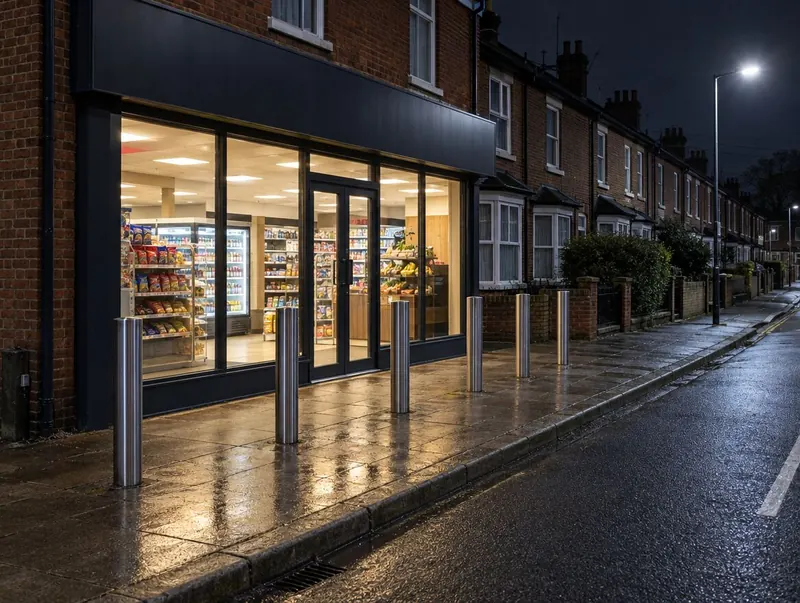 Computer-generated image
Antrim ram-raid bollards
In the town of Antrim, ram-raid bollards tend to go in at community car parks, schools and high street shopfronts. Bollards fitted in front of shopfronts, ATMs, jewellers and convenience stores to stop vehicles being used to break in.
We cover every part of Antrim in the BT41 postcode district. Jobs in Antrim can be combined with work in Ballymena (10.4 miles), Newtownabbey (12.7 miles), Belfast (14.1 miles) and Lisburn (15.1 miles) (straight-line distances). Belfast is around 14 miles away.
Antrim at a glance
- Area
- Antrim and Newtownabbey, Northern Ireland
- Roads authority
- the Department for Infrastructure (DfI Roads)
- Planning authority
- Antrim and Newtownabbey Borough Council
- Postcodes
- BT41
- Guide price
- Typically £385–£1,445 per bollard + VAT; minimum job £925
- Survey
- Free, with a fixed written quote
- Nearby
- Ballymena (10.4 mi), Newtownabbey (12.7 mi), Belfast (14.1 mi), Lisburn (15.1 mi)
What Antrim sites use ram-raid bollards for
Common uses in a place like Antrim:
- Premises that have already been targeted once
- Filling station kiosks and forecourt shops
- Convenience stores and off-licences with glazed frontages
Guide prices for Antrim
| Specification | Guide price | Includes |
|---|---|---|
| Standard | £385–£835 + VAT | Standard post, foundation, reinstatement |
| Upgraded | £715–£1,145 + VAT | Upgraded finish or fittings, reflective band, matched keys |
| Premium | £1,045–£1,445 + VAT | Heavy-duty or architectural spec, premium finish |
Per bollard, supplied and installed; -2% for Northern Ireland. Guide only — the fixed price follows a survey.
Before we dig in Antrim
Across Northern Ireland the Department for Infrastructure's DfI Roads is the roads authority, so ram-raid bollards on a public footway or road in Antrim need its agreement before anything is dug. Posts on your own land do not.
If your site in Antrim is listed or inside a conservation area, check with the local planning authority (Antrim and Newtownabbey Borough Council) before choosing a finish — heritage settings often favour cast iron or painted steel over stainless.
Shop forecourts may be thin concrete over old fill, and filling station forecourts carry fuel lines, tank vents and interceptors that must be located precisely before anything is dug. We hand-dig near known services, adjust positions if a vault or duct is found, and reinstate the surface to match, whether that is slabs, block paving, asphalt or a sealed forecourt finish.
- Check who owns the ground in front of the shop; if it is public highway, DfI Roads' agreement is needed.
- Leave clear gaps for wheelchairs and buggies, typically at least 1,000 mm, and keep the footway width usable, referring to Inclusive Mobility guidance.
From survey to handover
Agree the post type and positions
We agree unrated or tested posts with you, your landlord and any insurer or security adviser involved. A fixed written quote sets out the positions, foundations and reinstatement.
Excavate and set the posts
Each position is hand-dug near services and taken to depth, then the post is set plumb in a reinforced concrete base. Work is planned around trading hours where possible.
Reinstate the pavement
Paving, tarmac or forecourt concrete is made good flush with the base of each post, leaving no trip edges.
Specification choices
| Option | Detail |
|---|---|
| Reflective and contrasting bands | Bands near the top help pedestrians, including partially sighted people, see the posts on a busy pavement. |
| Stainless or decorative covers | Covers over steel cores for shopping streets and branded frontages where plain steel would look out of place. |
| Concrete-filled steel posts | Thick-walled steel tube root-fixed in a deep reinforced base. The usual unrated choice for shopfronts and ATMs. |
Pricing ram-raid bollards in Antrim
Our Northern Ireland guide prices are a starting point; the survey in Antrim firms them up. What tends to move them:
- Number of posts across the frontage or ATM
- Covers and finishes for shopping streets
- Reinstatement of forecourt or natural stone surfaces
Keeping them working
Check them after any knock, because a post that has been hit may have cracked its foundation even if it still looks straight. If you have been raided despite having bollards, look again at the positions and gaps, because offenders tend to aim at any weak point.
If posts in Antrim are later hit or damaged, we can repair or replace them — see bollard repairs.
Ram-raid bollards in Antrim: FAQs
Can you install ram-raid bollards anywhere in Antrim?
We cover all of Antrim (BT41) and the rest of Antrim and Newtownabbey. We also work in Ballymena, Newtownabbey and Belfast.
Do I need consent for ram-raid bollards on a public footway in Antrim?
Across Northern Ireland the Department for Infrastructure's DfI Roads is the roads authority, so ram-raid bollards on a public footway or road in Antrim need its agreement before anything is dug. Posts on your own land do not.
How much do ram-raid bollards cost in Antrim?
In Antrim, typically £385–£1,445 per bollard, supplied and installed, plus VAT, with a minimum job of £925 plus VAT, using our Northern Ireland guide prices. The fixed figure comes in writing after we've seen the site.
Can we still take deliveries through the front?
Yes, if one or more positions are removable. Staff unlock and lift out the post for deliveries, then refit it. The socket is designed to sit flush when the post is out.
Will bollards spoil the look of the shop?
They change the frontage, but stainless or powder-coated finishes in shopfront colours can make them look deliberate rather than defensive. Many shopping streets already have similar posts, so new ones can be matched to what is there.
Ram-raid bollards in nearby towns
- Ballymena (10.4 mi)
- Newtownabbey (12.7 mi)
- Belfast (14.1 mi)
- Lisburn (15.1 mi)
- Carrickfergus (16.2 mi)
- Larne (18.2 mi)