Isle of Wight · England
Ram-raid protection bollards in Cowes
Ram-raid bollards for sites across Cowes and the rest of Isle of Wight, from the first measurement to the last relaid paving block.
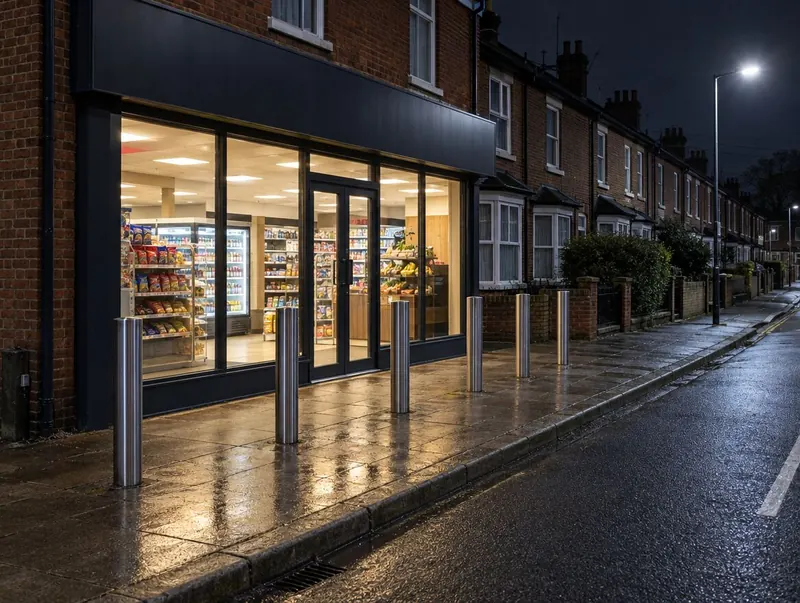 Computer-generated image
Ram-raid bollards in Cowes
Ram-raid bollards suit plenty of Cowes sites, filling-station forecourts, town-centre squares and small industrial units among them. Bollards fitted in front of shopfronts, ATMs, jewellers and convenience stores to stop vehicles being used to break in.
Coverage in Cowes takes in the PO31 and PO32 postcode districts and nearby places like Rew Street, Great Thorness and Whippingham. Nearby, we also work in Newport, Isle of Wight (4.2 miles), Ryde (6.3 miles) and Sandown (9.7 miles), measured as the crow flies.
Key facts for this area
- Area
- Isle of Wight, England
- Highway authority
- Isle of Wight Council (local roads)
- Planning authority
- Isle of Wight Council
- Postcodes
- PO31 and PO32
- Guide price
- Typically £415–£1,595 per bollard + VAT; minimum job £995
- Survey
- Free, with a fixed written quote
- Nearby
- Newport, Isle of Wight (4.2 mi), Ryde (6.3 mi), Sandown (9.7 mi)
Ram-raid bollard prices in Cowes
| Specification | Guide price | Includes |
|---|---|---|
| Standard | £415–£905 + VAT | Standard post, foundation, reinstatement |
| Upgraded | £765–£1,245 + VAT | Upgraded finish or fittings, reflective band, matched keys |
| Premium | £1,095–£1,595 + VAT | Heavy-duty or architectural spec, premium finish |
Per bollard, supplied and installed; +6% for South East. Guide only — the fixed price follows a survey.
Ram-raid bollards in Cowes: common uses
Common uses in a place like Cowes:
- Filling station kiosks and forecourt shops
- Premises that have already been targeted once
- Convenience stores and off-licences with glazed frontages
Permissions and groundwork in Cowes
Isle of Wight Council is the highway authority covering Cowes's local roads. If any post would stand on adopted highway rather than your land, that consent is the first thing we sort out.
Bollards on private land often don't need planning permission, but it depends on the council's view, the height and the location; in a conservation area, next to a listed building or under an Article 4 direction, ask the local planning authority (Isle of Wight Council) first — we flag this at survey.
Deep foundations need care near the building's own footings and basement walls. Shopfronts often sit over cellars, coal holes, vaults and service entries, so what lies under the pavement can be more complicated than it looks.
- Leave clear gaps for wheelchairs and buggies, typically at least 1,000 mm, and keep the footway width usable, referring to Inclusive Mobility guidance.
- Ask your landlord, and check any lease restrictions on alterations to the frontage.
Installation, step by step
Look at how a vehicle would approach
At the free site survey we look at where a vehicle could reverse from, the kerb line, the forecourt and the frontage construction. Ownership of the pavement in front of the shop is checked at the same time.
Arrange consents
If the posts will stand on public highway, the highway authority's agreement is needed before work starts. Landlord consent is usually needed for leased units.
Reinstate the pavement
Paving, tarmac or forecourt concrete is made good flush with the base of each post, leaving no trip edges.
Finishes and options
| Option | Detail |
|---|---|
| Stainless or decorative covers | Covers over steel cores for shopping streets and branded frontages where plain steel would look out of place. |
| Crash-rated bollards | Tested to IWA 14-1, ISO 22343-1 or PAS 68 for high-value premises or where a vehicle could build up speed. |
| Reflective and contrasting bands | Bands near the top help pedestrians, including partially sighted people, see the posts on a busy pavement. |
What affects the quote
Two Cowes jobs with the same number of posts can price quite differently. The usual reasons:
- Unrated, PAS 170-1 or crash-rated product
- Number of posts across the frontage or ATM
- Foundation depth and what is found under the pavement
Looking after them
Keep visibility bands clean, repaint chips before rust sets in on steel, and keep locks on removable posts lubricated so staff can actually use them. Check them after any knock, because a post that has been hit may have cracked its foundation even if it still looks straight.
If posts in Cowes are later hit or damaged, we can repair or replace them — see bollard repairs.
Ram-raid bollards in Cowes: FAQs
Can you install ram-raid bollards anywhere in Cowes?
We cover all of Cowes (PO31 and PO32) and the rest of Isle of Wight. We also work in Newport, Isle of Wight, Ryde and Sandown.
Do I need consent for ram-raid bollards on a public footway in Cowes?
The highway authority for local roads in Cowes is Isle of Wight Council; motorways and trunk roads sit with National Highways. Ram-raid bollards on the adopted footway are a matter for the highway authority, so we only install there with its written agreement.
How much do ram-raid bollards cost in Cowes?
In Cowes, typically £415–£1,595 per bollard, supplied and installed, plus VAT, with a minimum job of £995 plus VAT, using our South East guide prices. The fixed figure comes in writing after we've seen the site.
What is PAS 170-1 and do I need it?
PAS 170-1 is a standard for testing vehicle security barriers against low-speed impacts. It suits ram-raid risks where someone has asked for tested performance, such as an insurer or security adviser. If nobody has asked for a tested product, a well-founded unrated post is often adequate.
Can we still take deliveries through the front?
Yes, if one or more positions are removable. Staff unlock and lift out the post for deliveries, then refit it. The socket is designed to sit flush when the post is out.