Stirling · Scotland
Ram-raid protection bollards in Dunblane
Local installation of ram-raid bollards in Dunblane — free survey, fixed written price, and posts set to the right spacing for people and vehicles.
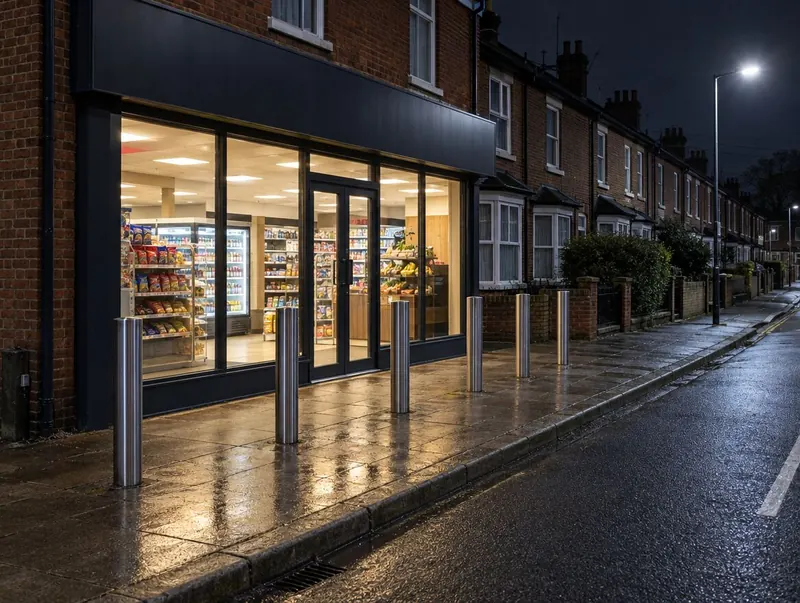 Computer-generated image
About ram-raid bollards in Dunblane
In the town of Dunblane, ram-raid bollards tend to go in at town-centre squares, small industrial units and filling-station forecourts. Bollards fitted in front of shopfronts, ATMs, jewellers and convenience stores to stop vehicles being used to break in.
We cover Dunblane's FK15 and FK16 postcode districts, including places such as Doune and Deanston. Nearby, we also work in Stirling (4.9 miles), Tullibody (6.1 miles), Alloa (8.4 miles) and Falkirk (14.6 miles), measured as the crow flies. It sits roughly 25 miles from Glasgow as the crow flies.
Dunblane at a glance
- Area
- Stirling, Scotland
- Roads authority
- Stirling Council (local roads)
- Planning authority
- Stirling Council
- Postcodes
- FK15 and FK16
- Guide price
- Typically £395–£1,495 per bollard + VAT; minimum job £945
- Survey
- Free, with a fixed written quote
Guide prices for Dunblane
| Specification | Guide price | Includes |
|---|---|---|
| Standard | £395–£855 + VAT | Standard post, foundation, reinstatement |
| Upgraded | £725–£1,195 + VAT | Upgraded finish or fittings, reflective band, matched keys |
| Premium | £1,045–£1,495 + VAT | Heavy-duty or architectural spec, premium finish |
Per bollard, supplied and installed; no regional adjustment. Guide only — the fixed price follows a survey.
What Dunblane sites use ram-raid bollards for
Common uses in a place like Dunblane:
- Jewellers, pawnbrokers and phone shops holding high-value stock
- Through-the-wall and freestanding ATMs
- Pharmacies and late-opening premises
What we check first in Dunblane
In Scotland the council is the roads authority for local roads, which in Dunblane means Stirling Council. Ram-raid bollards on an adopted footway need its consent; trunk roads sit with Transport Scotland.
If your site in Dunblane is listed or inside a conservation area, check with the local planning authority (Stirling Council) before choosing a finish — heritage settings often favour cast iron or painted steel over stainless.
Deep foundations need care near the building's own footings and basement walls. We hand-dig near known services, adjust positions if a vault or duct is found, and reinstate the surface to match, whether that is slabs, block paving, asphalt or a sealed forecourt finish.
- Check who owns the ground in front of the shop; if it is public highway, the roads authority's agreement is needed.
- Leave clear gaps for wheelchairs and buggies, typically at least 1,000 mm, and keep the footway width usable, referring to Inclusive Mobility guidance.
How the job runs
Look at how a vehicle would approach
At the free site survey we look at where a vehicle could reverse from, the kerb line, the forecourt and the frontage construction. Ownership of the pavement in front of the shop is checked at the same time.
Arrange consents
If the posts will stand on public highway, the highway authority's agreement is needed before work starts. Landlord consent is usually needed for leased units.
Reinstate the pavement
Paving, tarmac or forecourt concrete is made good flush with the base of each post, leaving no trip edges.
Choosing the right spec
| Option | Detail |
|---|---|
| PAS 170-1 tested bollards | Tested against low-speed vehicle impacts and suited to ram-raid risks where a tested product is requested. |
| Concrete-filled steel posts | Thick-walled steel tube root-fixed in a deep reinforced base. The usual unrated choice for shopfronts and ATMs. |
| Reflective and contrasting bands | Bands near the top help pedestrians, including partially sighted people, see the posts on a busy pavement. |
Pricing ram-raid bollards in Dunblane
Our Scotland guide prices are a starting point; the survey in Dunblane firms them up. What tends to move them:
- Out-of-hours working to avoid closing the shop
- Reinstatement of forecourt or natural stone surfaces
- Number of posts across the frontage or ATM
Looking after them
If you have been raided despite having bollards, look again at the positions and gaps, because offenders tend to aim at any weak point. Check them after any knock, because a post that has been hit may have cracked its foundation even if it still looks straight.
We can also service, repair or replace existing posts anywhere in Dunblane.
Ram-raid bollards in Dunblane: FAQs
Do you install ram-raid bollards in Dunblane?
We cover all of Dunblane (FK15 and FK16) and the rest of Stirling. We also work in Stirling, Tullibody and Alloa.
Who gives permission for bollards on the pavement in Dunblane?
Dunblane falls under Stirling Council as roads authority. If the line of posts crosses onto adopted road or pavement, permission comes before excavation; on private land it does not.
How much do ram-raid bollards cost in Dunblane?
In Dunblane, typically £395–£1,495 per bollard, supplied and installed, plus VAT, with a minimum job of £945 plus VAT, using our Scotland guide prices. The fixed figure comes in writing after we've seen the site.
What is PAS 170-1 and do I need it?
PAS 170-1 is a standard for testing vehicle security barriers against low-speed impacts. It suits ram-raid risks where someone has asked for tested performance, such as an insurer or security adviser. If nobody has asked for a tested product, a well-founded unrated post is often adequate.
Will bollards spoil the look of the shop?
They change the frontage, but stainless or powder-coated finishes in shopfront colours can make them look deliberate rather than defensive. Many shopping streets already have similar posts, so new ones can be matched to what is there.
Ram-raid bollards in nearby towns
- Stirling (4.9 mi)
- Tullibody (6.1 mi)
- Alloa (8.4 mi)
- Falkirk (14.6 mi)
- Cumbernauld (16.7 mi)
- Kirkintilloch (18.7 mi)