Cambridgeshire · England
Removable bollard installation in March
Removable bollards supplied and fitted in March, Cambridgeshire: surveyed, scanned for services, set in proper foundations and finished to match the ground.
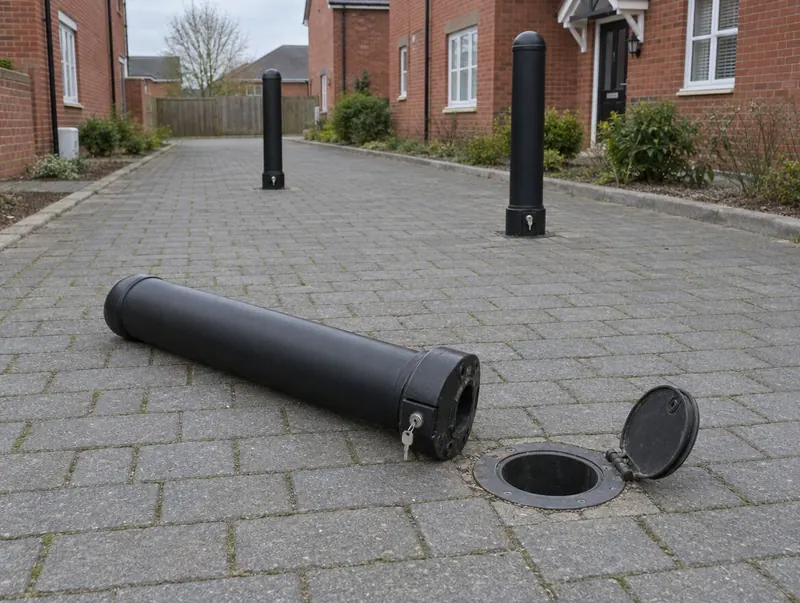 Computer-generated image
Removable bollards in March
Across March, typical sites for removable bollards include high street shopfronts, small industrial units and community car parks. Lift-out bollards in lockable ground sockets for driveways, delivery routes, access roads and emergency access points.
Coverage in March takes in the PE15 postcode district and nearby places like Doddington, Manea, Wimblington and Benwick. We also cover neighbouring Wisbech (8.5 miles), Ely (12.8 miles), Peterborough (14.2 miles) and King's Lynn (18.9 miles) — distances are straight-line.
Local details
- Area
- Cambridgeshire, England
- Highway authority
- Cambridgeshire County Council (local roads)
- Planning authority
- the council for Fenland
- Postcodes
- PE15
- Guide price
- Typically £255–£875 per bollard + VAT (£305–£1,045 inc VAT for homes); minimum job £605
- Survey
- Free, with a fixed written quote
- Nearby
- Wisbech (8.5 mi), Ely (12.8 mi), Peterborough (14.2 mi), King's Lynn (18.9 mi)
Where removable bollards go in around March
Around March, removable bollards usually solve one of these:
- Maintenance tracks through parks and open spaces
- Temporary event closures and market streets
- Delivery bays in pedestrian areas and shop frontages
Guide prices for March
| Specification | Guide price | Includes |
|---|---|---|
| Standard | £255–£515 + VAT · £305–£615 inc VAT | Standard post, foundation, reinstatement |
| Upgraded | £435–£695 + VAT · £515–£825 inc VAT | Upgraded finish or fittings, reflective band, matched keys |
| Premium | £625–£875 + VAT · £745–£1,045 inc VAT | Heavy-duty or architectural spec, premium finish |
Per bollard with ground socket, supplied and installed; +3% for East of England. Guide only — the fixed price follows a survey.
Before we dig in March
Cambridgeshire County Council is the highway authority covering March's local roads. If any post would stand on adopted highway rather than your land, that consent is the first thing we sort out.
Bollards on private land often don't need planning permission, but it depends on the council's view, the height and the location; in a conservation area, next to a listed building or under an Article 4 direction, ask the local planning authority (the council for Fenland) first — we flag this at survey.
On thin tarmac drives, the surround is sized so the socket does not loosen over time. The critical details are level and drainage.
- Keep a clear route of typically at least 1,000–1,200 mm between posts on pedestrian routes, and check against Inclusive Mobility guidance.
- On emergency access routes, agree with the fire service how they will remove the posts, such as standard keys or bolt croppers on padlocks.
Installation, step by step
Cut and excavate
A small square of surface is cut out and excavated to socket depth, with a bed of free-draining stone at the bottom so water can leave the socket.
Reinstate around the socket
Block paving, tarmac or flags are cut tight to the collar and made good. On resin or bound surfaces, the edge is sealed neatly.
Fit posts and hand over keys
Posts are fitted and locked, and the lift-out and refit routine is checked on site. Keys and any storage brackets are handed over.
Specification choices
| Option | Detail |
|---|---|
| Diameter and height | Commonly 76–140 mm diameter and around 900–1,000 mm high, chosen to suit visibility and handling. |
| Rated removable posts | Crash-tested removable models exist for security lines; they use heavier sockets and tested foundations. |
| Heads and handles | Dome, flat or ball heads, with lifting handles or eyes so posts can be pulled out without strain. |
What moves the price in March
Two March jobs with the same number of posts can price quite differently. The usual reasons:
- Post material: steel, stainless or aluminium
- Surface type and reinstatement
- Drainage at the socket base
Keeping them working
Check the lid springs and hinges. Keep spare keys somewhere sensible, because lost keys are a common reason for a post being cut out.
For damaged or loose posts in March, repairs and replacements are priced in writing first.
Questions about removable bollards in March
Can you install removable bollards anywhere in March?
We cover all of March (PE15) and the rest of Cambridgeshire. We also work in Wisbech, Ely and Peterborough.
Do I need consent for removable bollards on a public footway in March?
In March, work on adopted pavements and verges needs consent from Cambridgeshire County Council, the local highway authority. Car parks, forecourts and other private land only need the owner's permission.
What's a typical price for removable bollards in March?
In March, typically £255–£875 per bollard with ground socket, supplied and installed, plus VAT (£305–£1,045 including VAT for homeowners), with a minimum job of £605 plus VAT, using our East of England guide prices. The fixed figure comes in writing after we've seen the site.
Can all the bollards on our site use one key?
Yes, if the locks are ordered keyed alike. That is common on estates and car parks with several access points. Spare keys can be supplied at the same time.
Can removable bollards be installed on block paving?
Yes. The socket is set in concrete beneath the blocks and the blocks are cut tight around the collar. It finishes neatly if the socket is set to the exact paving level.
Removable bollards near March
- Wisbech (8.5 mi)
- Ely (12.8 mi)
- Peterborough (14.2 mi)
- King's Lynn (18.9 mi)
- Spalding (19.1 mi)
- Huntingdon (19.2 mi)