Suffolk · England
Removable bollard installation in Newmarket
Removable bollards for sites across Newmarket and the rest of Suffolk, from the first measurement to the last relaid paving block.
 Computer-generated image
Newmarket removable bollards
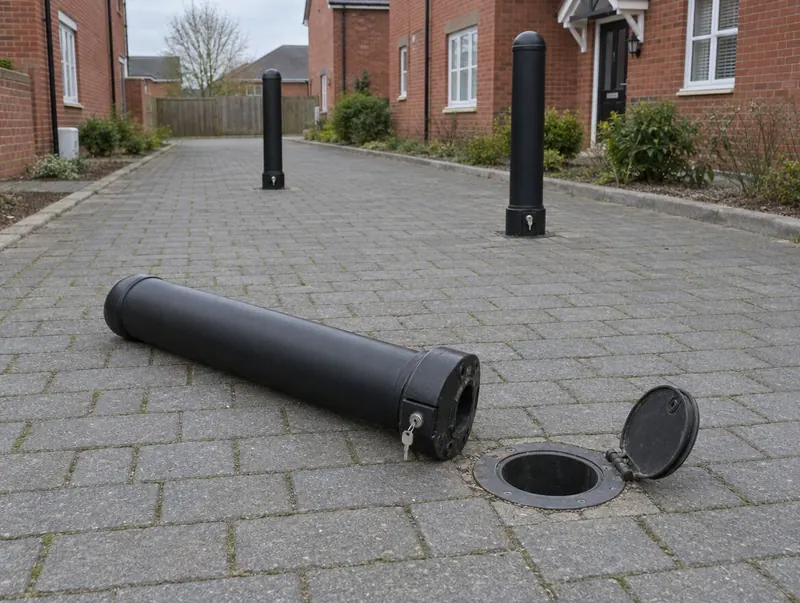
Removable bollards are used where vehicles need occasional rather than daily access. In Newmarket, that tends to mean sites such as schools, community car parks and residential driveways.
We work across CB8 — Newmarket itself and places including Exning, Kentford and Gazeley. Jobs in Newmarket can be combined with work in Haverhill (11.3 miles), Ely (12.3 miles), Cambridge (12.6 miles) and Bury St Edmunds (13 miles) (straight-line distances).
Key facts for this area
- Area
- Suffolk, England
- Highway authority
- Suffolk County Council (local roads)
- Planning authority
- the council for West Suffolk
- Postcodes
- CB8
- Guide price
- Typically £255–£875 per bollard + VAT (£305–£1,045 inc VAT for homes); minimum job £605
- Survey
- Free, with a fixed written quote
- Nearby
- Haverhill (11.3 mi), Ely (12.3 mi), Cambridge (12.6 mi), Bury St Edmunds (13 mi)
Guide prices for Newmarket
| Specification | Guide price | Includes |
|---|---|---|
| Standard | £255–£515 + VAT · £305–£615 inc VAT | Standard post, foundation, reinstatement |
| Upgraded | £435–£695 + VAT · £515–£825 inc VAT | Upgraded finish or fittings, reflective band, matched keys |
| Premium | £625–£875 + VAT · £745–£1,045 inc VAT | Heavy-duty or architectural spec, premium finish |
Per bollard with ground socket, supplied and installed; +3% for East of England. Guide only — the fixed price follows a survey.
What Newmarket sites use removable bollards for
Around Newmarket, removable bollards usually solve one of these:
- Emergency and fire service access routes
- School gates closed during drop-off and pick-up
- Maintenance tracks through parks and open spaces
What we check first in Newmarket
Suffolk County Council is the highway authority covering Newmarket's local roads. If any post would stand on adopted highway rather than your land, that consent is the first thing we sort out.
Many private-land installations in Newmarket need no planning application, but the rules don't clearly cover bollards, so listed buildings, conservation areas and prominent frontages are worth raising with the planning team at the council for West Suffolk before posts go in.
The critical details are level and drainage. A socket set even a few millimetres proud becomes a trip edge and gets clipped by tyres and snow ploughs; one set low collects water and grit.
- On emergency access routes, agree with the fire service how they will remove the posts, such as standard keys or bolt croppers on padlocks.
- Check whether the location is public highway; a highway authority agreement is usually needed there.
What happens on site
Cut and excavate
A small square of surface is cut out and excavated to socket depth, with a bed of free-draining stone at the bottom so water can leave the socket.
Set the socket flush
The socket is set in concrete with its rim exactly at finished surface level and to the fall of the ground, so the lid sits flat and nothing catches on it.
Fit posts and hand over keys
Posts are fitted and locked, and the lift-out and refit routine is checked on site. Keys and any storage brackets are handed over.
Specification choices
| Option | Detail |
|---|---|
| Locking type | Triangular or square key, padlock, or integral keyed cylinder. Keyed-alike locks let one key open every post on a site. |
| Heads and handles | Dome, flat or ball heads, with lifting handles or eyes so posts can be pulled out without strain. |
| Socket lids | Spring-closing, hinged or lockable lids that sit flush when the post is removed, so there is no open hole. |
What affects the quote
Two Newmarket jobs with the same number of posts can price quite differently. The usual reasons:
- Post material: steel, stainless or aluminium
- Rated removable posts where security is required
- Number of posts and sockets
After installation
Keep spare keys somewhere sensible, because lost keys are a common reason for a post being cut out. Check the lid springs and hinges.
If posts in Newmarket are later hit or damaged, we can repair or replace them — see bollard repairs.
Removable bollards in Newmarket: FAQs
Which parts of Newmarket do you cover for removable bollards?
We cover all of Newmarket (CB8) and the rest of Suffolk. We also work in Haverhill, Ely and Cambridge.
Who gives permission for bollards on the pavement in Newmarket?
The highway authority for local roads in Newmarket is Suffolk County Council; motorways and trunk roads sit with National Highways. Removable bollards on the adopted footway are a matter for the highway authority, so we only install there with its written agreement.
How much do removable bollards cost in Newmarket?
In Newmarket, typically £255–£875 per bollard with ground socket, supplied and installed, plus VAT (£305–£1,045 including VAT for homeowners), with a minimum job of £605 plus VAT, using our East of England guide prices. The fixed figure comes in writing after we've seen the site.
Can removable bollards be installed on block paving?
Yes. The socket is set in concrete beneath the blocks and the blocks are cut tight around the collar. It finishes neatly if the socket is set to the exact paving level.
Where do we keep the post when it is removed?
Somewhere it cannot become a trip hazard or be taken. A wall-mounted storage bracket or a locked store nearby works well. Leaving posts lying on the ground is how they get damaged or lost.
Removable bollards in nearby towns
- Haverhill (11.3 mi)
- Ely (12.3 mi)
- Cambridge (12.6 mi)
- Bury St Edmunds (13 mi)
- Thetford (18.8 mi)
- Sudbury (19.9 mi)