Midlothian · Scotland
Semi-automatic bollard installation in Bonnyrigg
Semi-automatic bollards for sites across Bonnyrigg and the rest of Midlothian, from the first measurement to the last relaid paving block.
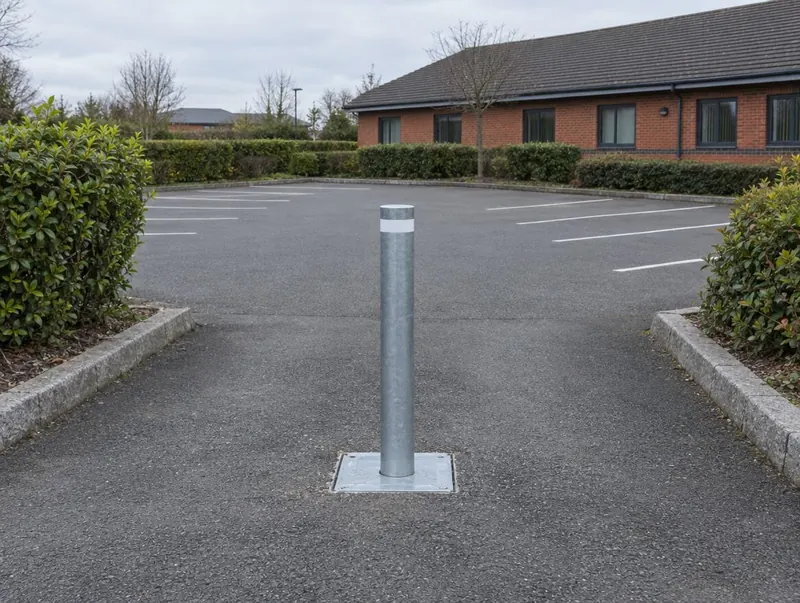 Computer-generated image
Semi-automatic bollards in Bonnyrigg
Across Bonnyrigg, typical sites for semi-automatic bollards include filling-station forecourts, community car parks and schools. Gas-strut assisted bollards that rise on their own when unlocked and lower by hand, with no mains power needed.
Coverage in Bonnyrigg takes in the EH19, EH18, EH24, EH20, EH25 and EH23 postcode districts and nearby places like Rosewell, Loanhead, Old Pentland and Roslin. Jobs in Bonnyrigg can be combined with work in Dalkeith (2 miles), Musselburgh (5.2 miles), Penicuik (5.5 miles) and Edinburgh (6.5 miles) (straight-line distances). Bonnyrigg is about 6 miles from Edinburgh.
Key facts for this area
- Area
- Midlothian, Scotland
- Roads authority
- Midlothian Council (local roads)
- Planning authority
- Midlothian Council
- Postcodes
- EH19, EH18, EH24, EH20, EH25 and EH23
- Guide price
- Typically £1,095–£3,495 per bollard + VAT (£1,295–£4,195 inc VAT for homes); minimum job £1,195
- Survey
- Free, with a fixed written quote
- Nearby
- Dalkeith (2 mi), Musselburgh (5.2 mi), Penicuik (5.5 mi), Edinburgh (6.5 mi)
Semi-automatic bollards in Bonnyrigg: common uses
Typical reasons Bonnyrigg sites choose semi-automatic bollards:
- Staff car parks and reserved bays used several times a day
- Delivery entrances without a power supply nearby
- Locations where automatic bollards are not justified
What semi-automatic bollards cost in Bonnyrigg
| Specification | Guide price | Includes |
|---|---|---|
| Standard | £1,095–£2,095 + VAT · £1,295–£2,495 inc VAT | Standard post, foundation, reinstatement |
| Upgraded | £1,795–£2,845 + VAT · £2,145–£3,395 inc VAT | Upgraded finish or fittings, reflective band, matched keys |
| Premium | £2,545–£3,495 + VAT · £3,045–£4,195 inc VAT | Heavy-duty or architectural spec, premium finish |
Per bollard, supplied and installed; no regional adjustment. Guide only — the fixed price follows a survey.
Before we dig in Bonnyrigg
For anything on the public footway in Bonnyrigg we check with the roads authority first — Midlothian Council for local roads, Transport Scotland on trunk routes. Private ground such as a car park or forecourt only needs the owner's go-ahead.
If your site in Bonnyrigg is listed or inside a conservation area, check with the local planning authority (Midlothian Council) before choosing a finish — heritage settings often favour cast iron or painted steel over stainless.
On sandy or gravel ground a soakaway beneath the cassette often drains it adequately; on clay, chalk with poor drainage or where groundwater rises, a pipe to a surface water drain or a dedicated soakaway is needed. Because the cassette houses both the post and its strut mechanism, the pit is deep and must stay dry.
- Keep clear gaps of typically at least 1,000–1,200 mm where pedestrians pass between posts, referring to Inclusive Mobility guidance.
- Check land ownership; bollards on public highway need the roads authority's agreement.
Installation, step by step
Survey use and ground
At the free site survey we look at how often the post will be used, who will operate it and what is under the surface. A fixed written quote follows, including drainage.
Reinstate the surface
Paving or surfacing is made good tight to the cassette collar so there is no lip for tyres or feet to catch.
Test and show users
The post is cycled several times to check it rises fully, locks at both heights and lowers smoothly. Users are shown how to operate it and to keep clear of the head when it rises.
Choosing the right spec
| Option | Detail |
|---|---|
| Finishes | Galvanised and powder-coated or stainless steel, with reflective bands for visibility. |
| Head lighting | Some models include battery or solar LEDs in the head to improve visibility on unlit sites. |
| Duty level | Light-duty domestic models and heavier commercial versions with stronger cassettes and posts. |
What moves the price in Bonnyrigg
When we price semi-automatic bollards in Bonnyrigg, these make the biggest difference:
- Domestic or commercial duty model
- Finish and any head lighting
- Number of posts and keyed-alike locks
Keeping them working
In winter, keep an eye on the lid after frost or snow; ice around the head can stop the post rising, and forcing the key or the post at that point damages the latch. Do not try to dismantle the strut assembly without the right procedure, as it holds stored energy.
We can also service, repair or replace existing posts anywhere in Bonnyrigg.
Common questions
Do you install semi-automatic bollards in Bonnyrigg?
We cover all of Bonnyrigg (EH19, EH18, EH24, EH20, EH25 and EH23) and the rest of Midlothian. We also work in Dalkeith, Musselburgh and Penicuik.
Who gives permission for bollards on the pavement in Bonnyrigg?
For anything on the public footway in Bonnyrigg we check with the roads authority first — Midlothian Council for local roads, Transport Scotland on trunk routes. Private ground such as a car park or forecourt only needs the owner's go-ahead.
How much do semi-automatic bollards cost in Bonnyrigg?
In Bonnyrigg, typically £1,095–£3,495 per bollard, supplied and installed, plus VAT (£1,295–£4,195 including VAT for homeowners), with a minimum job of £1,195 plus VAT, using our Scotland guide prices. The fixed figure comes in writing after we've seen the site.
Is it hard to push the bollard back down?
Not usually; most users press it down with a hand or foot. The strut resists, so it needs a steady push rather than a sharp kick. Heavier commercial models take more effort than domestic ones.
What makes a semi-automatic bollard rise without power?
A gas strut or spring inside the cassette. Pushing the post down compresses it and a latch holds the post below ground. Turning the key releases the latch and the stored energy lifts the post.
Semi-automatic bollards in nearby towns
- Dalkeith (2 mi)
- Musselburgh (5.2 mi)
- Penicuik (5.5 mi)
- Edinburgh (6.5 mi)
- Tranent (7.6 mi)
- South Queensferry (14 mi)