Cardiff · Wales
Shallow-mount security bollard installation in Thornhill
Shallow-mount bollards supplied and fitted in Thornhill, Cardiff: surveyed, scanned for services, set in proper foundations and finished to match the ground.
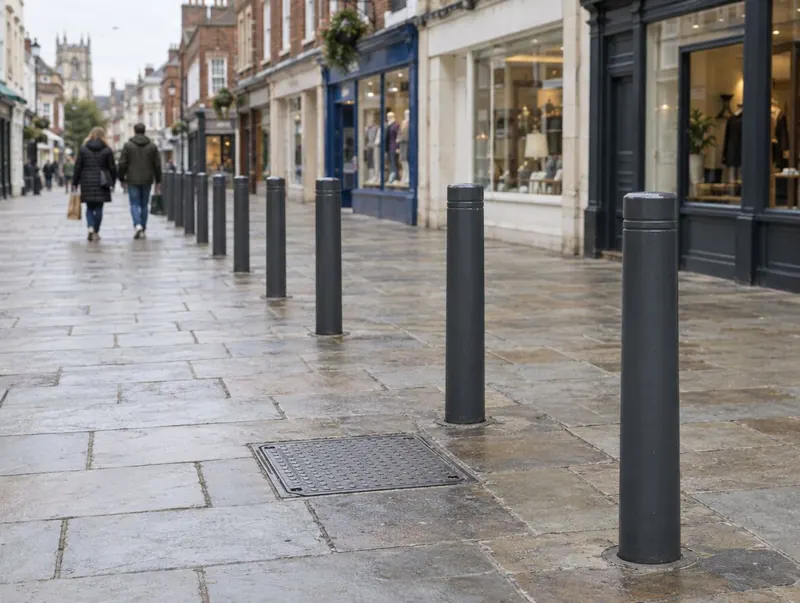 Computer-generated image
Thornhill shallow-mount bollards
We supply and fit shallow-mount bollards throughout Thornhill, typically for sites such as schools, community car parks and small industrial units. Like any rated product, its performance applies only to the configuration and foundation that were tested.
We cover Thornhill's CF14 postcode district, including places such as Wenallt. Nearby, we also work in Caerphilly (2.5 miles), Cardiff (4.3 miles), Risca (6 miles) and Penarth (7.2 miles), measured as the crow flies. Cardiff is around 4 miles away.
Local details
- Area
- Cardiff, Wales
- Highway authority
- Cardiff Council (local roads)
- Planning authority
- Cardiff Council
- Postcodes
- CF14
- Guide price
- Typically £1,945–£8,745 per bollard + VAT; minimum job £4,845
- Survey
- Free, with a fixed written quote
- Nearby
- Caerphilly (2.5 mi), Cardiff (4.3 mi), Risca (6 mi), Penarth (7.2 mi)
What Thornhill sites use shallow-mount bollards for
Around Thornhill, shallow-mount bollards usually solve one of these:
- Podium decks, car park roofs and basement slabs
- Retrofits outside occupied buildings with tight programmes
- Bridges and structures where excavation depth is limited
What shallow-mount bollards cost in Thornhill
| Specification | Guide price | Includes |
|---|---|---|
| Standard | £1,945–£4,795 + VAT | Rated for a 7.5 t vehicle at 30 mph (48 km/h), tested foundation |
| Upgraded | £3,995–£6,845 + VAT | Rated for 7.5 t at 40 mph (64 km/h), tested foundation |
| Premium | £5,995–£8,745 + VAT | Rated for 7.5 t at 50 mph (80 km/h), or a specialist foundation |
Per bollard position, supplied and installed; -3% for Wales. Guide only — the fixed price follows a survey.
Permissions and groundwork in Thornhill
Before digging near the kerb in Thornhill we establish who owns the ground: adopted footways are Cardiff Council's responsibility, trunk roads the Welsh Government's, and everything else belongs to the site owner.
Many private-land installations in Thornhill need no planning application, but the rules don't clearly cover bollards, so listed buildings, conservation areas and prominent frontages are worth raising with the planning team at Cardiff Council before posts go in.
On decks and roofs, the waterproofing and drainage layers must be protected or rebuilt, and fixings must not puncture membranes unless the structural and waterproofing designers have agreed a detail. Utility owners may set minimum separation distances or ask to be present when digging near their apparatus.
- Check gaps work for wheelchair users and buggies while still stopping vehicles, referring to Inclusive Mobility guidance.
- Record the frame's position on as-built drawings so future excavation near the line can be planned safely.
Installation, step by step
Map what is underground
Utility records, radar scanning and trial holes establish exactly how much depth is available along the line. This is the survey that decides whether a shallow system will fit at all.
Assemble and level the frame
Frame sections are placed, joined and set to line and level, with posts fixed as the drawing shows. Joints and fixings are photographed before any concrete goes in.
Pour, cure and reinstate
Concrete is placed to the specified grade and finish depth, then the surface is rebuilt to match. The line is protected until the specified curing period has passed.
Specification choices
| Option | Detail |
|---|---|
| Removable posts within a run | Some systems include removable or retractable positions for maintenance or emergency access. Check how these affect the rating. |
| Modular cassette sections | Pre-made sections joined on site, allowing short runs and changes of direction within the manufacturer's tested limits. |
| Surface-mounted rated units | Some tested products sit on or very close to the surface with minimal digging. These are often used for temporary or semi-permanent protection and need careful checking of the surface they bear on. |
Pricing shallow-mount bollards in Thornhill
Two Thornhill jobs with the same number of posts can price quite differently. The usual reasons:
- Changes of direction, end details and removable positions
- Structural engineering checks on slabs or decks
- Lifting, storing and relaying natural stone paving
Looking after them
Once cured, a shallow-mount line needs much the same care as any static rated barrier: periodic visual checks, cleaning of covers and renewal of visibility bands. If one post is struck, the frame may have transmitted load to its neighbours, so the whole run near the impact should be checked with the manufacturer rather than replacing a single post in isolation.
If posts in Thornhill are later hit or damaged, we can repair or replace them — see bollard repairs.
Common questions
Which parts of Thornhill do you cover for shallow-mount bollards?
We cover all of Thornhill (CF14) and the rest of Cardiff. We also work in Caerphilly, Cardiff and Risca.
Who gives permission for bollards on the pavement in Thornhill?
Before digging near the kerb in Thornhill we establish who owns the ground: adopted footways are Cardiff Council's responsibility, trunk roads the Welsh Government's, and everything else belongs to the site owner.
How much do shallow-mount bollards cost in Thornhill?
In Thornhill, typically £1,945–£8,745 per bollard position, supplied and installed, plus VAT, with a minimum job of £4,845 plus VAT, using our Wales guide prices. The fixed figure comes in writing after we've seen the site.
Will future roadworks damage the system?
They can if contractors dig beside it without knowing it is there. That is why we provide as-built drawings showing the frame position. Ask anyone excavating nearby to check those drawings first.
Does a shallow system protect as well as a deep one?
It can achieve the same rating, because both are tested to the same standards. What differs is how the load is resisted. Your security adviser should compare the specific ratings, not the foundation depths.