Cornwall · England
Shallow-mount security bollard installation in St Austell
Local installation of shallow-mount bollards in St Austell — free survey, fixed written price, and posts set to the right spacing for people and vehicles.
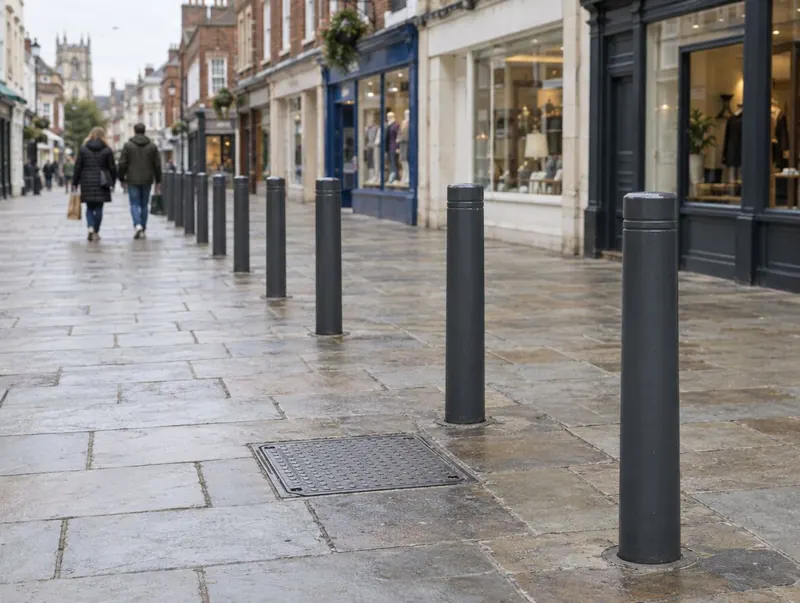 Computer-generated image
St Austell shallow-mount bollards
Across St Austell, typical sites for shallow-mount bollards include high street shopfronts, small industrial units and community car parks. Rated shallow-foundation bollard systems installed where buried services, basements or slabs rule out deep excavation.
We work across PL25, PL26 and PL24 — St Austell itself and places including Trewoon, Carlyon Bay, Tregrehan Mills and Trethowel. We also cover neighbouring Truro (13.5 miles), Newquay (14.1 miles), Falmouth (18.5 miles) and Redruth (21.3 miles) — distances are straight-line. St Austell is about 28 miles from Plymouth.
St Austell at a glance
- Area
- Cornwall, England
- Highway authority
- Cornwall Council (local roads)
- Planning authority
- Cornwall Council
- Postcodes
- PL25, PL26 and PL24
- Guide price
- Typically £1,995–£8,995 per bollard + VAT; minimum job £4,995
- Survey
- Free, with a fixed written quote
St Austell: typical shallow-mount bollard prices
| Specification | Guide price | Includes |
|---|---|---|
| Standard | £1,995–£4,945 + VAT | Rated for a 7.5 t vehicle at 30 mph (48 km/h), tested foundation |
| Upgraded | £4,095–£7,045 + VAT | Rated for 7.5 t at 40 mph (64 km/h), tested foundation |
| Premium | £6,195–£8,995 + VAT | Rated for 7.5 t at 50 mph (80 km/h), or a specialist foundation |
Per bollard position, supplied and installed; no regional adjustment. Guide only — the fixed price follows a survey.
Typical shallow-mount bollards jobs in St Austell
Typical reasons St Austell sites choose shallow-mount bollards:
- Retrofits outside occupied buildings with tight programmes
- Listed or historic streets where deep digging is unwelcome
- Podium decks, car park roofs and basement slabs
Before we dig in St Austell
In St Austell, work on adopted pavements and verges needs consent from Cornwall Council, the local highway authority. Car parks, forecourts and other private land only need the owner's permission.
Bollards on private land often don't need planning permission, but it depends on the council's view, the height and the location; in a conservation area, next to a listed building or under an Article 4 direction, ask the local planning authority (Cornwall Council) first — we flag this at survey.
Utility owners may set minimum separation distances or ask to be present when digging near their apparatus. Paving is often natural stone in the streets where these systems are used, so careful lifting, storage and relaying is part of the job.
- Check gaps work for wheelchair users and buggies while still stopping vehicles, referring to Inclusive Mobility guidance.
- Keep the test certificate for the exact system and configuration, including the minimum run length and end details.
What happens on site
Map what is underground
Utility records, radar scanning and trial holes establish exactly how much depth is available along the line. This is the survey that decides whether a shallow system will fit at all.
Cut and excavate the trench
Paving is lifted and kept for reuse where possible, and a shallow trench is excavated by hand near known services. Where a service sits higher than expected, work stops and the detail is referred back.
Assemble and level the frame
Frame sections are placed, joined and set to line and level, with posts fixed as the drawing shows. Joints and fixings are photographed before any concrete goes in.
Finishes and options
| Option | Detail |
|---|---|
| Rated planters and street furniture | Benches, planters and cycle stands built around a tested shallow core, used where a line of posts would look out of place. |
| Covers and sleeves | Stainless, cast or powder-coated covers fitted over the cores to match surrounding street furniture, supplied or approved by the manufacturer. |
| Linked-frame systems | Posts are welded or bolted to a continuous steel frame laid in a shallow trench and encased in concrete. Suited to straight or gently curved lines. |
What moves the price in St Austell
Two St Austell jobs with the same number of posts can price quite differently. The usual reasons:
- Length of run and the system needed to achieve the rating
- Restricted working hours in busy streets or occupied sites
- Lifting, storing and relaying natural stone paving
After installation
Once cured, a shallow-mount line needs much the same care as any static rated barrier: periodic visual checks, cleaning of covers and renewal of visibility bands. If one post is struck, the frame may have transmitted load to its neighbours, so the whole run near the impact should be checked with the manufacturer rather than replacing a single post in isolation.
If posts in St Austell are later hit or damaged, we can repair or replace them — see bollard repairs.
Common questions
Which parts of St Austell do you cover for shallow-mount bollards?
We cover all of St Austell (PL25, PL26 and PL24) and the rest of Cornwall. We also work in Truro, Newquay and Falmouth.
Who gives permission for bollards on the pavement in St Austell?
The highway authority for local roads in St Austell is Cornwall Council; motorways and trunk roads sit with National Highways. Shallow-mount bollards on the adopted footway are a matter for the highway authority, so we only install there with its written agreement.
How much do shallow-mount bollards cost in St Austell?
In St Austell, typically £1,995–£8,995 per bollard position, supplied and installed, plus VAT, with a minimum job of £4,995 plus VAT, using our South West guide prices. The fixed figure comes in writing after we've seen the site.
Will future roadworks damage the system?
They can if contractors dig beside it without knowing it is there. That is why we provide as-built drawings showing the frame position. Ask anyone excavating nearby to check those drawings first.
How much shallower is a shallow-mount bollard foundation?
Often a fraction of the depth of a conventional rated foundation, commonly a few hundred millimetres. The exact depth depends on the system and rating chosen. What you gain in depth is usually traded for width, because the load is spread along a linked frame.