Lincolnshire · England
Shallow-mount security bollard installation in Spalding
Planning shallow-mount bollards in Spalding? We check ownership, consents and buried services first, then quote a fixed price.
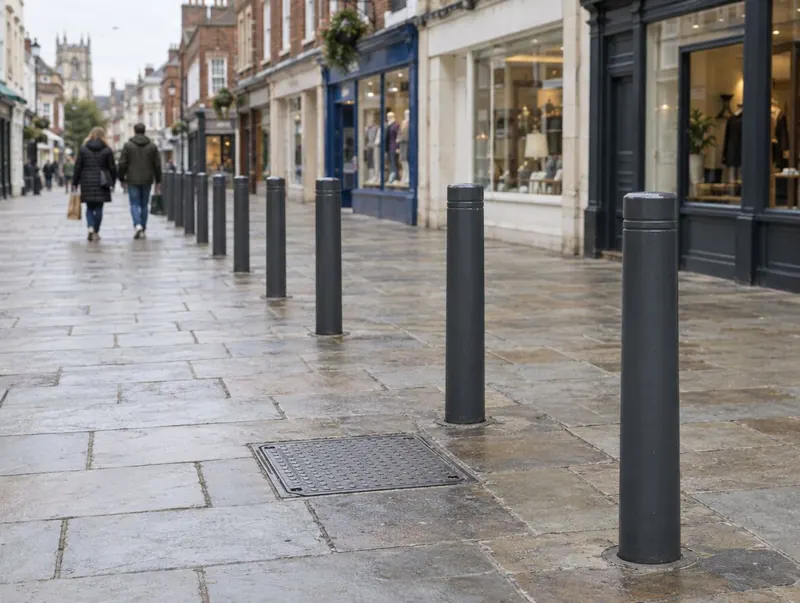 Computer-generated image
Spalding shallow-mount bollards
Whether it's filling-station forecourts, community car parks and small industrial units, shallow-mount bollards in Spalding are planned around who needs to get through and who doesn't. Like any rated product, its performance applies only to the configuration and foundation that were tested.
Coverage in Spalding takes in the PE11 postcode district and nearby places like Pinchbeck, Donington, Gosberton and Deeping St Nicholas. Jobs in Spalding can be combined with work in Boston (14.1 miles), Peterborough (15.3 miles), Wisbech (15.5 miles) and Stamford (16.8 miles) (straight-line distances).
Local details
- Area
- Lincolnshire, England
- Highway authority
- Lincolnshire County Council (local roads)
- Planning authority
- the council for South Holland
- Postcodes
- PE11
- Guide price
- Typically £2,045–£9,245 per bollard + VAT; minimum job £5,145
- Survey
- Free, with a fixed written quote
- Nearby
- Boston (14.1 mi), Peterborough (15.3 mi), Wisbech (15.5 mi), Stamford (16.8 mi)
Spalding: typical shallow-mount bollard prices
| Specification | Guide price | Includes |
|---|---|---|
| Standard | £2,045–£5,095 + VAT | Rated for a 7.5 t vehicle at 30 mph (48 km/h), tested foundation |
| Upgraded | £4,195–£7,245 + VAT | Rated for 7.5 t at 40 mph (64 km/h), tested foundation |
| Premium | £6,395–£9,245 + VAT | Rated for 7.5 t at 50 mph (80 km/h), or a specialist foundation |
Per bollard position, supplied and installed; +3% for East of England. Guide only — the fixed price follows a survey.
Shallow-mount bollards in Spalding: common uses
Around Spalding, shallow-mount bollards usually solve one of these:
- Footways with dense utility runs just below the surface
- Retrofits outside occupied buildings with tight programmes
- Sites where service diversions would be slow or impractical
Before we dig in Spalding
In Spalding, work on adopted pavements and verges needs consent from Lincolnshire County Council, the local highway authority. Car parks, forecourts and other private land only need the owner's permission.
Many private-land installations in Spalding need no planning application, but the rules don't clearly cover bollards, so listed buildings, conservation areas and prominent frontages are worth raising with the planning team at the council for South Holland before posts go in.
Paving is often natural stone in the streets where these systems are used, so careful lifting, storage and relaying is part of the job. The trench has to sit over services with enough cover to protect them, but the frame also needs a firm, consistent bearing; soft spots, old backfill around pipe trenches and voids under paving can all need treating first.
- Keep the test certificate for the exact system and configuration, including the minimum run length and end details.
- Get written confirmation from a structural engineer before installing on slabs, decks, basements or over voids.
What happens on site
Confirm the system with the manufacturer
The survey findings go back to the manufacturer and the client's adviser to confirm the system, its layout and any end details. A fixed written quote follows the free site survey.
Assemble and level the frame
Frame sections are placed, joined and set to line and level, with posts fixed as the drawing shows. Joints and fixings are photographed before any concrete goes in.
Record and hand over
As-built drawings show the frame position relative to services, which matters for anyone digging nearby later. Product certificates and photographs go to the client's adviser.
Options to consider
| Option | Detail |
|---|---|
| Surface-mounted rated units | Some tested products sit on or very close to the surface with minimal digging. These are often used for temporary or semi-permanent protection and need careful checking of the surface they bear on. |
| Modular cassette sections | Pre-made sections joined on site, allowing short runs and changes of direction within the manufacturer's tested limits. |
| Covers and sleeves | Stainless, cast or powder-coated covers fitted over the cores to match surrounding street furniture, supplied or approved by the manufacturer. |
What moves the price in Spalding
When we price shallow-mount bollards in Spalding, these make the biggest difference:
- Length of run and the system needed to achieve the rating
- Restricted working hours in busy streets or occupied sites
- Lifting, storing and relaying natural stone paving
After installation
Pay attention to the surface around the posts, because settlement or loose paving can indicate movement in the bearing layer. Any later utility work beside the line should be supervised so the frame is not undermined.
If posts in Spalding are later hit or damaged, we can repair or replace them — see bollard repairs.
Common questions
Which parts of Spalding do you cover for shallow-mount bollards?
We cover all of Spalding (PE11) and the rest of Lincolnshire. We also work in Boston, Peterborough and Wisbech.
Who gives permission for bollards on the pavement in Spalding?
The highway authority for local roads in Spalding is Lincolnshire County Council; motorways and trunk roads sit with National Highways. Shallow-mount bollards on the adopted footway are a matter for the highway authority, so we only install there with its written agreement.
What's a typical price for shallow-mount bollards in Spalding?
In Spalding, typically £2,045–£9,245 per bollard position, supplied and installed, plus VAT, with a minimum job of £5,145 plus VAT, using our East of England guide prices. The fixed figure comes in writing after we've seen the site.
Will future roadworks damage the system?
They can if contractors dig beside it without knowing it is there. That is why we provide as-built drawings showing the frame position. Ask anyone excavating nearby to check those drawings first.
Does a shallow system protect as well as a deep one?
It can achieve the same rating, because both are tested to the same standards. What differs is how the load is resisted. Your security adviser should compare the specific ratings, not the foundation depths.